Portuguese
  Spanish


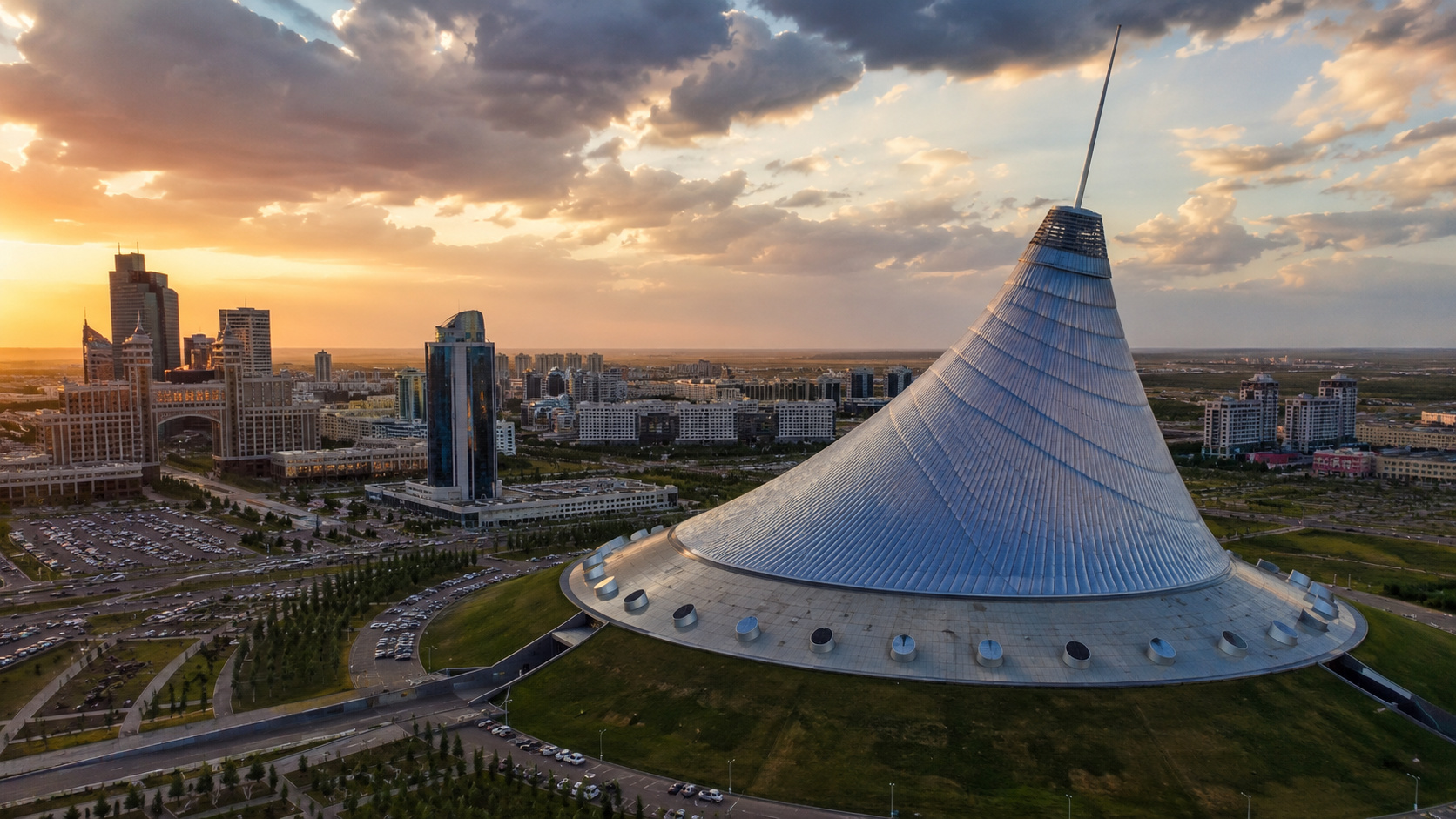

The Khan Shatyr in Astana draws attention because it transforms a 150-meter transparent tent into a shopping mall, urban park, and artificial beach, using cables and ETFE membrane to create a covered city on a monumental scale
A 150-meter transparent tent in Kazakhstan houses an entire shopping center, an indoor urban park, and an artificial beach under the same roof. The building is the Khan Shatyr, located in Astana, and it stands out for looking more like a large fabric and cable structure than a traditional mall.
The information was published by Archello, an international architecture project platform. The project was designed by Foster + Partners and uses a tent-shaped tensioned structure, with an elliptical base and ETFE membrane to cover a large indoor urban space.
The impact lies in how the building changes the common idea of a mall. Instead of heavy walls and a closed appearance, the Khan Shatyr uses the roof itself as the building, creating a protected place where shopping, leisure, and socializing occur under a single cover.
-
Giant Robots Build Entire Neighborhood of 100 3D-Printed Homes in the U.S., Showcasing Technology’s Impact on Construction Industry

-
Helsinki Residents Receive Water That Travels 120 Kilometers Through a Hidden Rock Tunnel from a Lake Before Treatment

-
Brazil’s Sertão Region Nears Completion of Latin America’s Longest Artificial River, Transforming Water Access in Drought-Prone Ceará
-
SENAI Launches $36 Million Innovation Round to Boost Brazilian Manufacturing Productivity and Reduce Business Risks with R&D Projects by 2026



The 150-meter transparent tent changes the traditional image of a common mall
Most malls are remembered for closed corridors, sequential stores, and similar facades. The Khan Shatyr takes a different path. It appears as a giant tent, with a tall, light, and transparent form, capable of marking Astana’s urban landscape.


This difference is important because the construction does not rely solely on luxury, size, or decoration. The central point is the structural solution. The building uses cables and membrane to form a cover that also defines the external appearance and internal space.
In practice, the mall ceases to be just a constructed block and starts functioning as a covered city. The visitor enters a protected environment but still perceives the idea of a large span, natural light, and visual openness.
The tensioned cover uses cables, ETFE membrane, and a large internal span to support the structure
A tensioned covering works through forces distributed among cables, supports, and a resistant membrane. In simple words, the structure holds because its elements work stretched and well-positioned, like a large tent made with advanced engineering.
In Khan Shatyr, this logic allows covering a large space without turning the interior into a heavy environment. The ETFE membrane helps close the construction and allows light to enter, which reinforces the sense of transparency.
ETFE is a material used in special coverings for being lightweight and translucent. It does not function like a common wall. Its role is to protect the internal space while maintaining the impression that the tent remains clear and open.
Artificial beach and urban park make Khan Shatyr look like a city inside a tent
The most striking detail is the artificial beach installed within the structure. The idea makes an impact because it mixes a typical image of open areas with a closed environment, protected by a large transparent covering.

Besides the beach, the project includes an internal urban park. This changes the role of the mall, which ceases to be just a consumption point and starts functioning as a space for staying, strolling, and socializing.
This type of use makes the work stronger from an architectural point of view. Khan Shatyr impresses not only by its shape. It also shows how a covering can organize different activities within the same environment.
Archello shows how the structure transforms the roof into the main element of the building
Archello, an international architecture project platform, detailed Khan Shatyr as a tent-shaped structure, with cables, an elliptical base, and an ETFE membrane. The work appears as an entertainment center where the covering is not a detail but the point that explains the entire project.
In many buildings, the roof is hidden or appears only as the final closure. In Khan Shatyr, the opposite happens. The covering creates the shape of the building, defines the urban image, and organizes the large internal space.
Therefore, the project is different from common malls. The construction does not try to look like a tower, a commercial block, or a glass facade. It embraces the logic of a monumental tent and transforms this idea into permanent architecture.
The mall in Kazakhstan shows how engineering and architecture can create a protected urban space
The strength of Khan Shatyr lies in the union between engineering and public use. The cables support the shape, the membrane protects the interior, and the large span allows for leisure, shopping, and circulation in a continuous environment.
This solution helps to understand why the building has become so talked about. It doesn’t attract attention just for being 150 meters tall. What makes the work original is the way a transparent tent becomes a shelter for an entire shopping center.
For the lay public, the explanation is simple. Khan Shatyr functions as a huge habitable cover. Underneath it, there is space to walk, shop, circulate, rest, and enjoy leisure areas without the feeling of being in a common mall.

A work that doesn’t rely on extreme height, but on a visually unforgettable idea
In a world full of skyscrapers and buildings with striking shapes, Khan Shatyr stands out for another reason. It transforms a simple idea, a tent, into a large-scale construction.
The proposal is easy to understand and hard to ignore. A 150-meter transparent tent, with an artificial beach and urban park inside, creates a strong image for any reader, even for those who don’t follow architecture.
This type of work also shows that innovation is not just about making the tallest or most expensive building. Sometimes, the impact comes from changing the logic of construction and making the roof the true protagonist.
Khan Shatyr, in Astana, combines shopping, artificial beach, urban park, and tensioned cover in a construction that breaks away from the traditional shopping center standards. The structure shows how cables, membrane, and natural light can transform a tent into an urban indoor space.
The work draws attention because it replaces the closed appearance of many malls with a lighter, more curious, and striking visual solution. Do you think a construction like this would work in Brazilian cities, or is the greater impact precisely in the contrast with Kazakhstan’s climate and landscape?