






 Portuguese
  Spanish


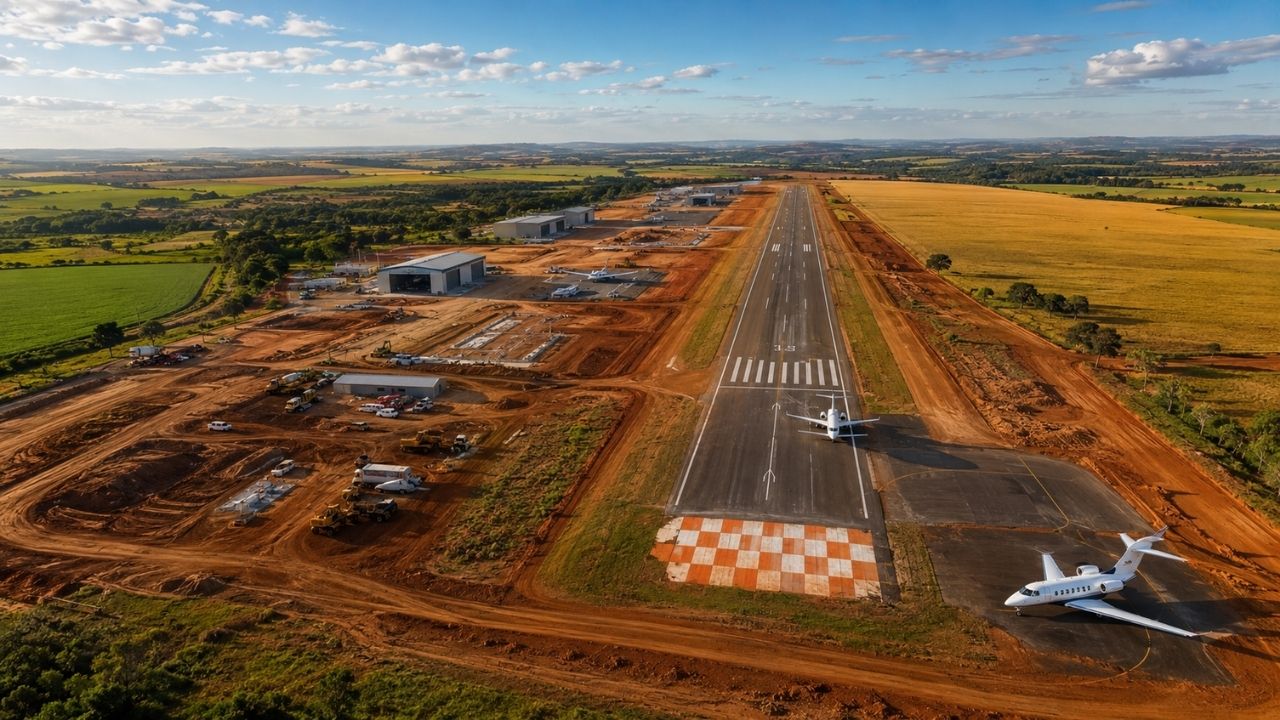

In Goiás, private airport near Goiânia will have 180 hangars, support for executive aviation, and structure for executive jets. With a 2 km runway approved by DECEA and forecast for 2028, the project targets private aircraft and strengthens the connection between agribusiness and the country’s interior with regional impact.
A private airport considered the largest under construction in Brazil is advancing in Goiás, in the region near Bela Vista and about 30 km from Goiânia. With 180 hangars planned, the project was designed for executive aviation, private aircraft, executive jets, and specialized operations, with operations expected to begin in the second half of 2028.
According to a video published by the Record Goiás channel on June 10, 2026, the project already has a runway approved by the Department of Airspace Control, allowing for tests and initial operations during implementation. The structure is expected to include a 2 km runway, 180 hangars, maintenance, operational support, and services aimed at aircraft of different sizes.
Private airport advances in strategic area of Goiás
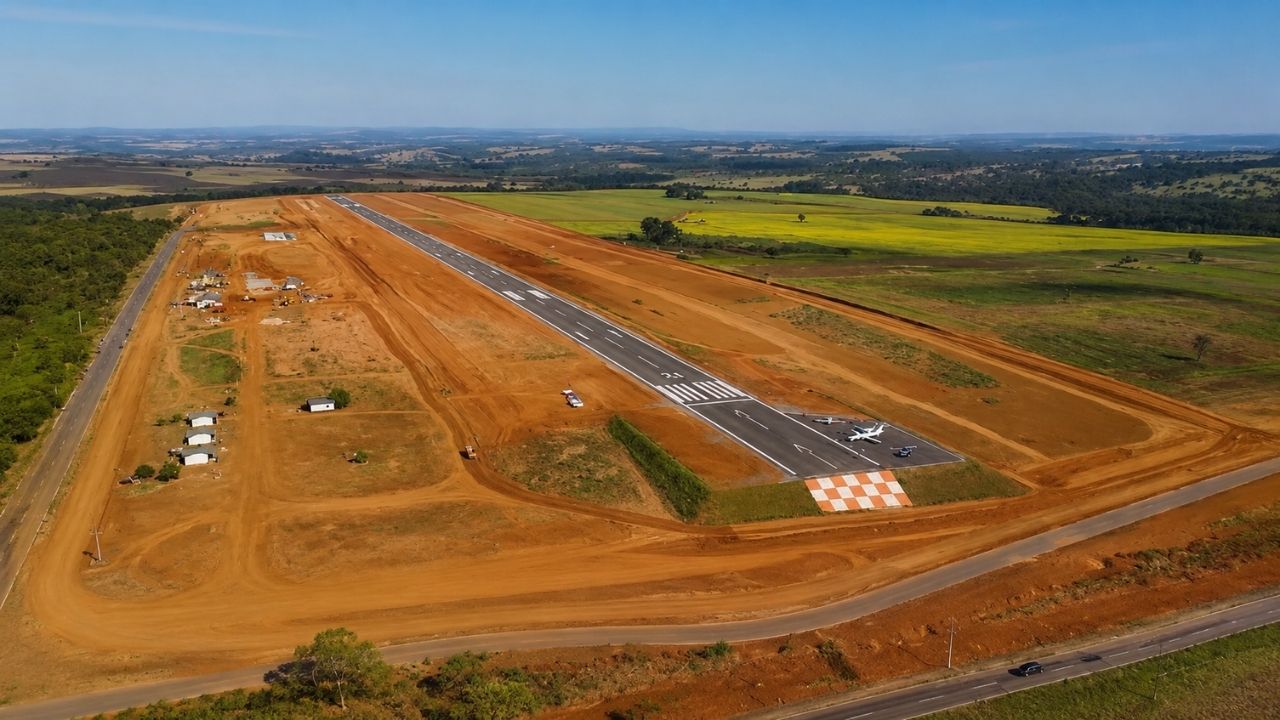
The new private airport was planned to serve a specific audience: owners of private aircraft, executive jet operators, and business aviation users. The proposal is to concentrate, in one space, hangaring, maintenance, and operational structure for this segment.
-
Giant 3,600-ton Crane Breaks Two World Records by Installing World’s Largest Single-Piece Forged and Welded Hydrogenation Reactor, Weighing 3,037 Tons, in Chinese Petrochemical Plant in Just Six Days

-
$80 Million Bridge in Brazil Cuts Travel Time from 30 Minutes to 1 Minute, but Audit Reveals Major Flaws
-
Man Builds Stone Bed with Granite Rocks and Hand-Sawn Cedar Beams, Home Extension Garners Over 437,000 Views on Bonus Bolts Channel

-
Brazilian Researcher Develops Color-Changing Roof Tile to Reduce Air Conditioning Use by Up to 15%




The location also weighs in on the project’s strategy. The source reports that the development is located next to a dual carriageway, about 30 km from Goiânia and 14 km from Bela Vista. This position tends to facilitate land access and strengthen the connection with surrounding economic hubs.
The project emerges in a region where agribusiness has a strong economic weight. In this context, executive aviation appears as a tool for rapid movement for entrepreneurs, producers, investors, and professionals who need to move between cities, farms, capitals, and decision centers.
The impact of the project goes beyond the runway. An airport focused on private aircraft can boost maintenance services, refueling, transportation, security, logistics, technical jobs, and new businesses in the surrounding area.
Certified runway is 2 km long
The main runway of the private airport is about 2 km long and 30 meters wide, according to the source. The size places the structure among the most significant in the state and allows it to accommodate everything from smaller aircraft to larger executive jets.
Another important point is the certification by the Airspace Control Department. This authorization allows the runway to proceed to testing and initial operations within the implementation process, an essential step before the full consolidation of activities.
The source points out that this runway would be the second largest in operation in Goiás, second only to Santa Genoveva Airport in Goiânia. This data helps explain the scale of the project and why it is considered a milestone for regional executive aviation.
A certified runway changes the stage of the project. It indicates that the structure is not just on paper but has already reached a relevant technical phase for future operation.
Structure plans for 180 hangars and operational support
The project was designed to gather 180 hangars in a single space. This shows that the private airport does not intend to function only as a landing and takeoff point but as a complete base for the storage, maintenance, and operation of private aircraft.
Hangars are a central part of the logic of executive aviation. They protect aircraft, facilitate maintenance, reduce travel for technical services, and create a more controlled environment for owners and operators.
The structure should also include operational support and necessary services for small aircraft and larger executive jets. With this, the project targets an audience that depends on availability, security, agility, and predictability.
The concentration of these services can transform the airport into a specialized hub. Instead of spreading maintenance, hangaring, and support across different locations, the proposal is to gather everything in a structure aimed at the same segment.
Executive aviation gains strength in the interior
The growth of executive aviation helps explain the interest in a private airport of this size in Goiás. The source mentions that the state has one of the largest private fleets in the country and is also among the largest aeronautical maintenance hubs in Brazil.
This scenario reveals a demand that does not depend solely on tourism or luxury. In regions of strong agricultural production and decentralized businesses, private aircraft can be used as a tool for management, travel, and decision-making.
Entrepreneurs, producers, and executives often need to travel long distances in a short time. In a continental country, private aviation fills this gap, especially where highways and commercial flights do not provide the same speed.
The country’s interior is changing the aviation logic. Large investments are not restricted to capitals; they follow areas where there is production, income, urban expansion, and demand for more sophisticated infrastructure.
Agribusiness and executive jets appear on the same map

The source associates the enterprise with the development of Goiás as a leader in agribusiness. This connection is important because it shows how the private airport can be integrated into a broader economic chain, linked to rural production, business, services, and capital circulation.
Executive aviation usually follows regions where time has strategic value. For rural producers, investors, and entrepreneurs, reducing travel hours can make a difference in managing properties, meetings, and operations in different cities.
In this context, the airport does not appear just as a symbol of luxury. It also functions as mobility infrastructure for a specific user profile, with high investment power and the need for quick travel.
The project reveals a change in the Brazilian interior: areas linked to agribusiness are beginning to attract structures previously more associated with large urban centers. The runway, hangars, and technical support are part of this new economic landscape.
Operation is expected for 2028
The expectation presented in the source is that the airport will start operating in the second half of 2028. Until then, construction should continue, and the structure should gradually expand operations in the coming months.
This schedule places the enterprise in an implementation phase, not full operation. The already approved runway represents technical progress, but the project’s consolidation depends on the completion of other structures, such as hangars, support, and operational services.
For the GO-020 region, the promise is of new businesses and development. A private airport of this size can attract service companies, specialized professionals, suppliers, and activities related to the aeronautical sector.
The economic expectation is precisely this: to transform an aviation infrastructure into a business vector. The project can expand the presence of executive aviation in the state and reinforce Goiás as a hub for the segment.
Local conditions are considered favorable


The source mentions that pilots positively evaluate the local conditions, such as wind, approach, and location. These factors are relevant because airports depend not only on the runway but also on an adequate operational environment.
Being close to Goiânia, Bela Vista, and a duplicated highway helps to combine air and land access. For executive aviation users, this integration can reduce the total travel time between landing, leaving the airport, and arriving at the final destination.
Furthermore, the presence of maintenance and hangars in the same space can make the venture more competitive. Aircraft owners tend to seek locations that offer safety, technical support, and operational ease.
When runway, location, and services combine, the airport ceases to be just a construction and starts functioning as a business platform. This is the bet behind the project in Goiás.
Project shows a new phase of private infrastructure
The advancement of the largest private airport under construction in Brazil also exposes a larger trend: private infrastructure gaining ground in highly specialized sectors. Instead of relying solely on public or commercial airports, the executive segment seeks structures designed for its own demands.
This movement accompanies economic changes in the interior. Regions with strong agriculture, high-income entrepreneurs, and a significant aircraft fleet begin to demand more complete services, nearby and adapted to the local profile.
The construction of 180 hangars indicates that the project aims for permanence and recurring operation, not just occasional landings. The idea is to create a base for aircraft, professionals, and companies to orbit around the venture.
The airport, in this case, becomes a sign of regional transformation. It points to an interior that is more connected, more expensive, more specialized, and increasingly integrated into business aviation.
Do you think private airports like this help to develop the interior or do they reinforce an infrastructure aimed only at a high-income audience? Leave your opinion in the comments.


