






 Portuguese
  Spanish


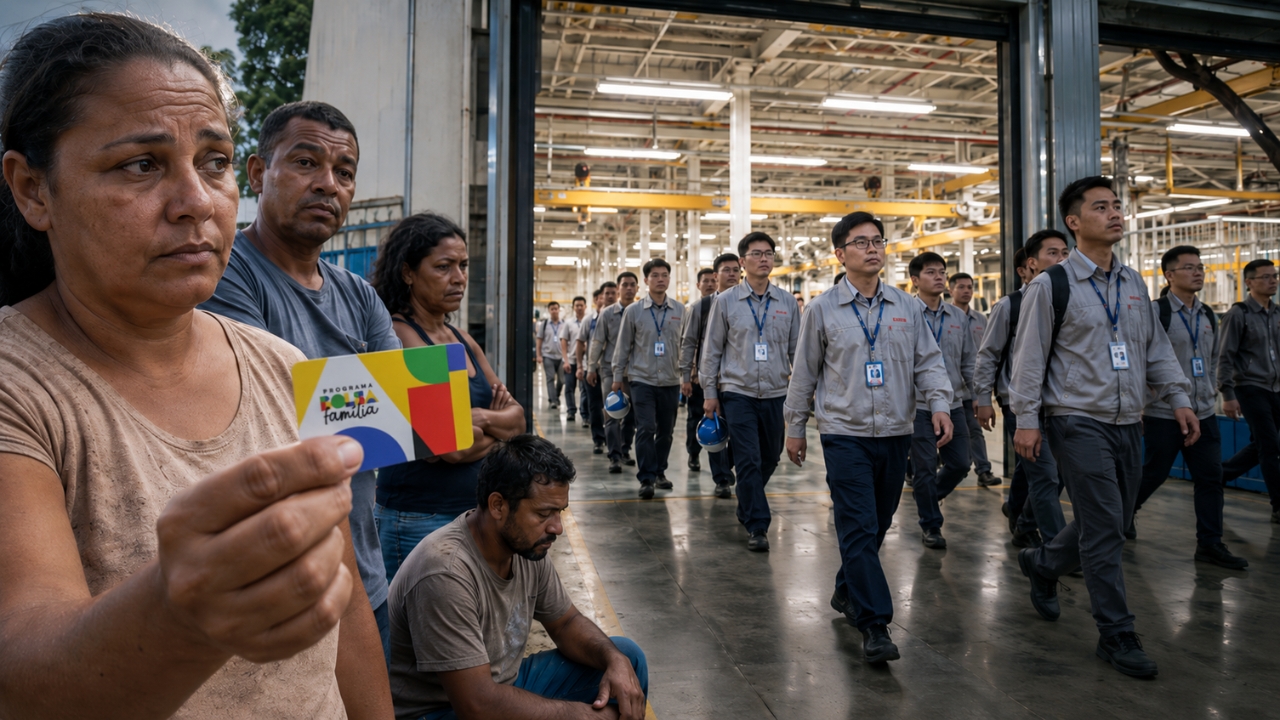


While millions of Brazilians depend on Bolsa Família to ensure food on the table, companies operating in the country are bringing more than a thousand Chinese workers per month to work in Brazil. The contrast has fueled a national controversy: is there a lack of jobs or a lack of willing and prepared workforce?
According to data from the Ministry of Justice compiled by Folha de S.Paulo, Chinese citizens represented 38% of work permits granted to foreigners in the first quarter of 2026, as reported by O Tempo. The number exposed a wound that many prefer to avoid.
The question that exploded on social media is harsh, uncomfortable, and divides opinions: how can a country with so many people receiving social aid need to import workers from another continent to run factories, construction sites, and production lines?
-
Brazil to Issue “Panda Bonds” in China, Aiming to Raise Up to 5 Billion Yuan at Lower Interest Rates Than Dollar Debt
-
NATO Faces Internal Tensions as U.S. Pushes for Increased Defense Spending, Targeting 5% of GDP by 2035, with Warnings for Countries Near 2% Level

-
Brazil to Introduce B16 Diesel with Increased Soybean Oil Content for Trucks by 2026
-
Brazil’s July Bolsa Família Payments May Include Extra $150 and $50 for Families with Children, Pregnant Women, and Updated CadÚnico Registration


The data that ignited the national debate
The numbers show a rapid change. In 2023, the monthly average of permits for Chinese workers was about 270 registrations. In 2024, it rose to 625 per month. In 2025, it exceeded 844 per month.
Now, Brazil sees the entry of more than a thousand Chinese workers per month, while part of the population still directly depends on public money to survive. For critics, this contrast has become a symbol of a country that created a vast assistance network but failed to establish a true culture of work, qualification, and productivity.
The problem is not just the arrival of the Chinese. The problem is what this arrival reveals: companies claim to need technical, disciplined, and trained labor, while Brazil still coexists with millions of people outside the formal productive workforce.

Has Bolsa Família become a symbol of dependency?
Bolsa Família was created as a poverty alleviation program and continues to be defended by many as an essential tool against hunger. But for a growing part of society, the program has also become a symbol of a dangerous question: to what extent can permanent assistance discourage the search for formal work?
Recent studies have reignited this discussion. Research cited by FGV IBRE indicates that the expanded model of Bolsa Família, with a much higher average benefit than in the past, may reduce the participation of some groups in the labor market, especially young men in the North and Northeast.
This is precisely the group that should be entering the market strongly, occupying industrial positions, learning technical functions, and competing in new production chains. Instead, the country watches as companies seek professionals from abroad.
The controversy of the “work culture”
On social media, many Brazilians were direct: there is no shortage of people in Brazil, there is a shortage of people prepared and willing to work under the conditions that companies offer. Others went further and accused social programs of fostering a dependency mentality.
The expression “lack of work culture” gained traction precisely in this context. For critics, the problem is not emergency aid to those who are hungry, but the normalization of a life sustained by public benefit without a clear exit path to employment, qualification, and financial independence.
This is the most explosive point of the debate: if the State pays for millions to survive but does not require a real transition to productivity, the country risks keeping entire families trapped in assistance while importing workers for roles that could generate local income.

Bahia becomes a showcase of contrast
Bahia appears at the center of this movement. The city of Camaçari, severely affected after the closure of Ford, began receiving Chinese investments, especially with the arrival of BYD.
The promise is great: industrial recovery, production of electric vehicles, technology transfer, and the creation of thousands of jobs. But the presence of Chinese workers in the initial process raised an inevitable question: will Brazilians be protagonists of this new industry or just spectators?
Industry executives state that some of the Chinese come to Brazil for technical training, equipment installation, and knowledge transfer. BYD also claims that the majority of workers planned in the country will be Brazilian.
The clash between social assistance and industry
Brazil is experiencing a contradiction that is hard to hide. On one side, there are billion-dollar social programs supporting millions of families. On the other, there are foreign companies saying they need to bring in professionals from abroad to set up factories and operate technologies.
For supporters of Bolsa Família, the comparison is unfair because poverty is not solved merely with moral pressure. There is a lack of technical schools, training, quality jobs, and an industrial policy connected to the poor population.
But for critics, this explanation is no longer sufficient. They argue that the country spent years expanding benefits but did not create an efficient bridge between social aid and productive work. The result would be a dependent population while strategic sectors seek labor in another country.
The question no one wants to answer
The arrival of Chinese people does not necessarily mean a mass replacement of Brazilians. Many may be in the country temporarily, in specialized roles. But the size of the flow has raised a national alert.
If Brazil wants to attract foreign investment, it needs to ensure that these projects train Brazilians, hire Brazilians, and leave knowledge in the country. Otherwise, the promise of development may become just another beautiful showcase while the people continue to depend on benefits.
In the end, the phrase that divides the country sums up the crisis: with a large part of the population on Bolsa Família, companies bring more than a thousand Chinese per month to work in Brazil. For some, it is proof of a lack of qualification. For others, it is a sign of corporate exploitation. For many, however, it is something even more serious: the portrait of a country that pays for poverty to survive but still does not teach its population to escape it through work.







