Portuguese
  Spanish


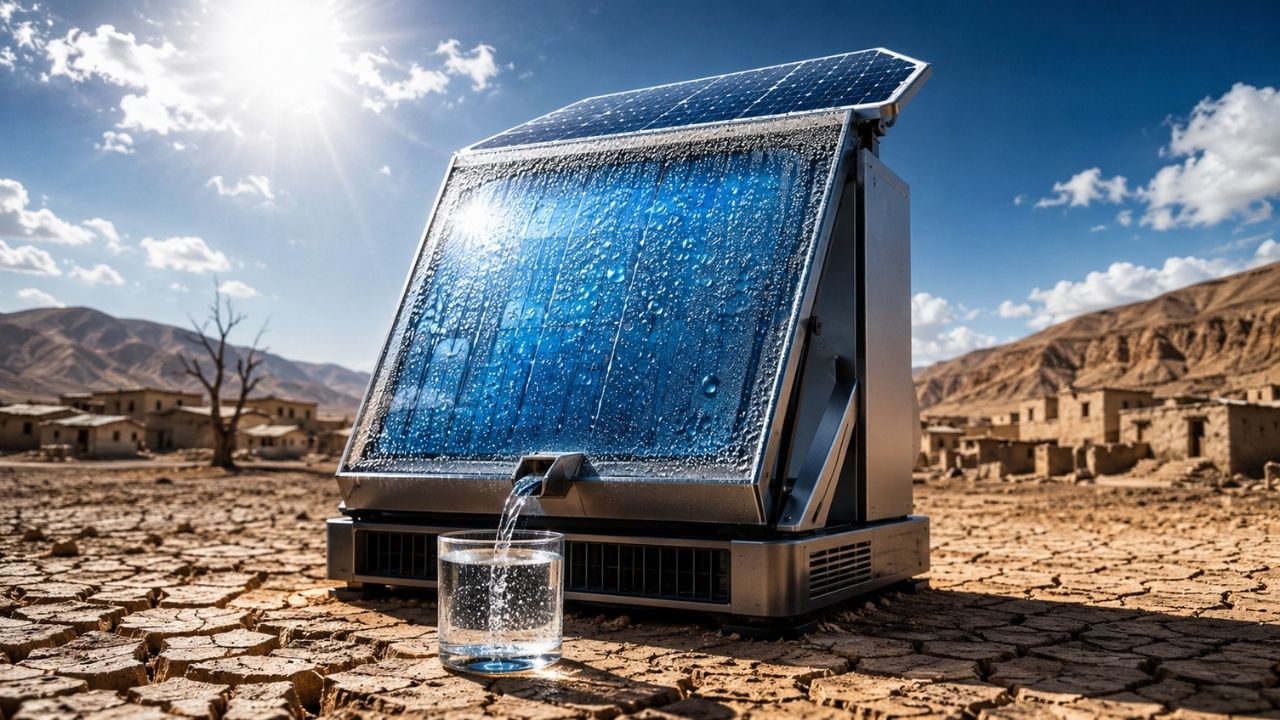


The new route to generate potable water from air combines hydrogel and solar energy, overcomes one of the main durability bottlenecks of these materials, and can expand supply in arid, rural, and off-grid regions.
Potable water from air is no longer just a laboratory promise and has made significant progress at Stanford. Scientists linked to the university described, in a study published on May 7, 2026 in Nature Communications, a hydrogel capable of capturing ambient moisture, releasing that water with the heat of the sun, and maintaining stability for more than eight months and more than 190 collection cycles, something that can make this route much more viable outside of theory.
According to information from Stanford University, the detail that makes the news seem bigger lies in the problem that has hindered this technology until now. Previous hydrogels could capture vapor from the air but tended to degrade quickly, often in about 30 cycles, which increased costs and also threatened the safety of the water produced. The team discovered that contact with metallic surfaces was accelerating this degradation and showed that an anticorrosive coating on the metal decisively changes this scenario.
Stanford tackled the issue that prevented water from air from leaving the lab

In recent years, scientists have been trying to transform atmospheric moisture into potable water using materials made of absorbent salts and polymers. The problem was not just capturing water: it was doing so with low cost, little energy, and sufficient stability for real-world use. The new work focuses precisely on this durability barrier, treated by the authors as a critical parameter for water production to be reliable and economical.
-
She spent 73 years breathing inside an iron lung, survived the aftereffects of polio, and became the last woman in the United States dependent on the equipment before dying at 78 years old.

-
Brazilian students created a $1 filter using pine bark, cotton, and 3D-printed parts to clean cassava wastewater, reduce the toxicity of a hazardous waste, and transform contaminated water into biofertilizer.

-
Astronaut from Artemis II steps down after mission to the Moon and decision surprises after a record of 406,771 km, a historic 10-day journey, and an unprecedented achievement for Canada.

-
A fossil kept for years in a small museum in Montreal concealed 450-million-year-old soft tissue, a discovery that has only happened once before in history.


According to the Stanford Doerr School of Sustainability, the long-lasting hydrogel can produce water with solar energy and without relying on grid connection, provided it is coupled to a metal structure protected against corrosion. It is this combination that supports the idea of supply virtually anywhere, including in dry areas where other solutions, such as desalination, are not viable.
The numbers show why the breakthrough attracted so much attention

The old material, used by the team in previous tests, could fail after about 30 cycles of water filling and release. With the new approach, the hydrogel remained stable for more than 190 cycles and also resisted for more than eight months in a test at 75 °C, designed to subject the material to extreme conditions.
The scale is still for demonstration, but the data already helps measure the potential. The current design can produce up to two liters per day with a thin layer of material spread over a panel about the size of a bath towel. Carlos Díaz-Marín stated that the goal now is to increase this production to five liters per day.
There is also a number that changes the economic conversation: the researcher said he sees a way to produce water for about one cent of a dollar per liter. According to Stanford, this would be equivalent to approximately 1% of the cost of bottled water and would also open up the possibility of competing, in the future, even with tap water in some contexts.
The curious turnaround came from an invisible enemy within the structure itself
The most unexpected point of the research is that the hydrogel’s limitation was not just in the salt or the polymer, but in the material’s contact with the metal used to heat it. Scientists concluded that this metal released ions capable of generating radicals that attacked the long polymer chains, transforming the gel into an unstable mass and compromising the potability of the water produced.
Instead of changing the entire system logic, the team attacked this interface. Applying an anticorrosive coating to a copper plate prevented metal-mediated degradation and preserved the hydrogel’s cyclic performance. This solution is one of the reasons why the study stands out: it’s not just about a new material, but a technical adjustment that can unlock the practical use of an already very promising technology.
Why this matters for those living under water stress

The relevance goes far beyond the laboratory. Stanford highlights that more than half a million families in the United States lack access to piped water and that one in four people worldwide do not have safe drinking water. In arid and remote regions, the possibility of capturing water from air humidity with an autonomous, solar-powered system can represent an additional source of supply where water trucks, pumping, and desalination are not simple or cheap solutions.
The authors themselves also associate the topic with increasing pressure on water systems. Díaz-Marín cited water-intensive sectors, such as semiconductor manufacturing and data centers, as examples of activities that intensify the competition for water resources. This helps explain why the discovery is of interest not only to vulnerable communities but also to a larger market for water security technologies.
Hydrogel enters a global race for new supply routes
Water capture from the air has been studied as a decentralized alternative for dry regions, islands, rural areas, and emergency environments. The differential of this work is to address the combination of cost, durability, and low energy consumption, three points that normally hinder the transition from the lab bench to continuous use. In the article’s abstract, the authors state that the advancement offers a path to low-cost water from atmospheric humidity.
This type of technology tends to gain ground in a scenario where water scarcity, industrial pressure, and extreme weather events increase the demand for local and resilient solutions. Since the system uses the sun to heat the hydrogel and release the vapor, which is then condensed, it also fits into the movement to seek lighter, modular infrastructure less dependent on conventional networks.
What’s still needed for water from the sky to become routine
Scientists make it clear that the technology is not yet ready to supply entire communities. The focus now is to increase efficiency, boost daily production, and reduce costs to a competitive level. Díaz-Marín stated that he already sees a path for transfer to the real world, whether through a startup or technology licensing.
Even so, the case deserves attention right now. When a material that failed after a few dozen cycles starts to last for months, operating with solar energy and pointing towards low-cost potable water, the topic ceases to be mere scientific curiosity and begins to address a central theme of the century: how to expand supply on a planet where safe water is still lacking for millions.