






 Portuguese
  Spanish


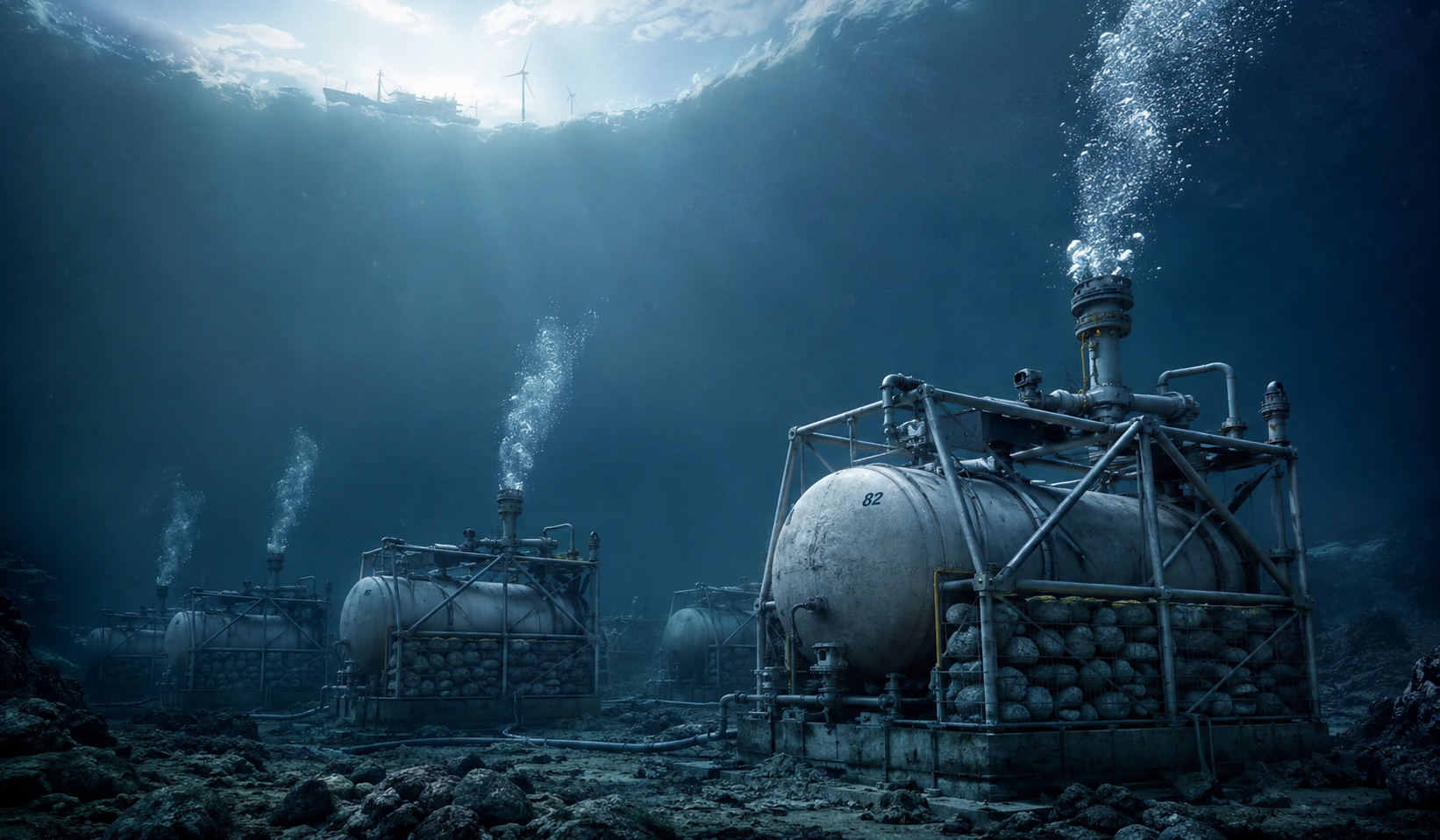

With tanks at the bottom of the sea and the use of natural water pressure, a project attempts to transform compressed air into a way to store renewable energy for long periods.
The race for systems capable of storing energy for many hours has moved beyond just a technical discussion and has become part of the expansion plans of electrical grids with more renewable sources.
As solar and wind generation grows, companies and research centers are seeking alternatives to store electricity surpluses when production exceeds demand and return them to the grid during periods of lower generation.
In this scenario, the Israeli startup BaroMar is developing a solution installed at the sea bottom, based on compressed air and rigid tanks made of concrete and steel.
-
What is a red flashlight used for, after all? See why it is so commonly used at night.

-
He has never read a line of code, but he already knows how to work: the French company UMA presented in Paris the Northstar, its first AI-powered humanoid robot designed for factories and warehouses, capable of copying tasks just by observing an employee in action.

-
A young Kenyan engineer collects plastic waste from the streets and transforms it into robots that translate physics lessons into sign language in real-time, a machine made with old bottles that teaches what was missing to deaf children left out of science.
-
What is the dark substance found in the sand of Ipanema Beach? Civil Police conduct an examination, collect samples of the material, and initiate an investigation to identify the composition, clarify the origin, and verify if there was an environmental crime.



The current page of the company describes the PROTEAS project as a first configuration initiative, with 3 MWh of storage and a duration of 10 hours, while previous communications from the consultancy Jacobs mentioned a pilot of 4 MWh off the coast of Cyprus.
In December 2024, BaroMar and the Cyprus Institute announced a partnership to install and test the technology at the PROTEAS facility in Cyprus, with submerged reservoirs at about 100 meters depth.
The system attempts to address a limitation of intermittent renewable sources: the difference between the time energy is generated and the period it is consumed.
When there is excess electricity in the grid, the equipment uses this energy to compress air and send it to tanks installed in the sea.
Later, when demand increases, the air returns to the surface and drives generation equipment.
The technology is still in the demonstration phase.
Before the partnership announced with the Cyprus Institute, the consultancy Jacobs had been contracted by BaroMar to develop the preliminary design of a long-duration underwater storage pilot off the coast of Cyprus.
According to Jacobs, the goal of the pilot is to achieve round-trip efficiency of up to 70%.
This indicator measures the proportion of stored energy that can be recovered after the complete cycle of compression, storage, and generation.
The consultancy also reported that the project requires geophysical, geotechnical, and bathymetric surveys, as well as feasibility and licensing studies.
How the compressed air underwater battery works
The principle used by BaroMar is part of compressed air energy storage systems, known by the acronym CAES, for “compressed air energy storage”.
In this technology, excess electricity feeds compressors, which push air into reservoirs.
At another time, this air is released to drive a turbine or an expander connected to a generator.
The difference proposed by the startup is in the storage environment.
In land-based projects, compressed air usually relies on underground caves, suitable geological formations, or tanks capable of withstanding high internal pressure.
In the underwater model, the natural pressure of the water helps balance the air pressure inside the reservoir.
This configuration can reduce the structural requirement of the tanks compared to reservoirs installed on land, according to the logic presented by the company.
As the external pressure of the water column acts on the structure, the tank does not need to withstand alone the difference between the compressed air inside and the atmospheric pressure outside.
In the storage cycle, the tanks start filled with seawater.
When there is excess energy, compressors installed on land send air through pipelines to the submerged reservoirs.
The air displaces the water out of the tank and remains compressed by the hydrostatic pressure of the environment.
To recover the energy, the process occurs in reverse.
The water re-enters the reservoir and pushes the air back through the pipeline.
On the surface, this flow passes through a thermal recovery system and expansion equipment that drives an electric generator.
Tanks on the seabed use stone ballast
The design described by BaroMar envisions rigid tanks installed on the seabed, with concrete and steel structures kept submerged by ballasts.
The company mentions the use of cages with stones to help stabilize the reservoirs and prevent the buoyancy of the compressed air from displacing the assembly.
In deeper concepts, the technology is presented for operation between 200 and 700 meters below the surface.
The greater the depth, the greater the hydrostatic pressure available to compress the air.
This physical relationship is the central point of the system, as the sea becomes part of the storage mechanism.
The project in Cyprus, however, starts from a shallower configuration.
According to the Cyprus Institute, the tanks of the PROTEAS center would be positioned at about 100 meters deep, connected to the land infrastructure by a flexible pipeline for air transport.
The land installation would be responsible for the compression, expansion, control, and electrical connection systems.
The choice of static reservoirs also differentiates the proposal from other submarine storage ideas that use membranes, flexible bags, or mobile structures.
In the case of BaroMar, the company claims to seek to reduce geological restrictions and expand installation possibilities in coastal areas with adequate depth.
Long-duration renewable energy storage
Electric grids with a high share of solar and wind energy need to deal with production variations throughout the day, week, and seasons.
Solar generation depends on light incidence, while wind generation varies according to wind conditions.
This fluctuation creates demand for systems capable of absorbing surpluses and returning them when production drops.
Siemens Energy, which operates in the compressed air storage sector, states that the advancement of solar and wind energy increases the need for long-duration solutions to balance the variability of renewable generation.
The United States Department of Energy also classifies compressed air storage among the technological routes evaluated for long-duration applications, including systems with underground reservoirs and submerged tanks.
Lithium-ion batteries are used to compensate for short-term variations and stabilize grids in smaller intervals.
For longer periods, other technologies compete for space, including reversible hydroelectric, thermal storage, flow batteries, and compressed air systems.
The choice depends on cost, installation location, lifespan, response time, and continuous operation capacity.
BaroMar positions its technology in this long-duration storage segment.
The proposal targets applications such as renewable source integration, grid balancing, load shifting, and providing additional capacity during peak demand times.
These applications are described by the company as potential uses for systems installed near coastal areas.
Proximity to the coast is a relevant factor for the idea, as a significant portion of the world’s population and energy infrastructure is in coastal regions.
Still, the application depends on specific local conditions, such as depth, submarine relief, environmental licensing, connection to the electrical grid, and feasibility of equipment installation on land and at sea.
Project in Cyprus evaluates the feasibility of the technology
The project in Cyprus is expected to serve as a way to observe how the system behaves outside a purely conceptual environment.
The proposal involves rigid tanks on the seabed, air pipelines, compressors, expansion equipment, thermal systems, and operation controls.
Each of these components needs to work in an integrated manner for the storage cycle to be efficient.
According to Jacobs, development requires studies on seabed conditions, depth, submarine soil behavior, and licensing requirements.
These surveys are necessary because installing tanks in a marine environment involves different technical risks than those found in land-based projects.
Challenges include corrosion, salinity, currents, biological fouling, remote inspection, maintenance, pipeline safety, and impacts on the local ecosystem.
These factors do not prevent research but need to be evaluated before any potential expansion to commercial scale.
The Cyprus Institute reported that the project will be integrated with heat recovery and storage systems.
In compressed air systems, thermal control is important because compression heats the air, while expansion reduces its temperature.
Recovering some of this heat can help improve the efficiency of the cycle.
Submarine battery is still in demonstration phase
The idea of BaroMar combines known engineering elements, such as compressed air, hydrostatic pressure, rigid reservoirs, and electricity generation by gas expansion.
The current stage, however, is still seeking to prove whether this combination can operate reliably, at competitive cost, and with low maintenance needs in the marine environment.
The announcement with Jacobs in 2024 pointed to a 4 MWh pilot off the coast of Cyprus.
The current page of BaroMar presents PROTEAS as a project of 3 MWh and 10 hours of storage, indicating a configuration update compared to the initial material released about the pilot.
Later, in December of the same year, the partnership with the Cyprus Institute indicated a research configuration at the PROTEAS center, with tanks at about 100 meters depth.
Until the available public check, no secure confirmation of commercial operation of the system was found.
If the tests confirm the parameters disclosed by the company and technical partners, compressed air submarine batteries could be evaluated as an alternative among long-duration storage solutions.
The outcome will depend on actual installation costs, operational efficiency, licensing, tank durability, and the possibility of replication in other coastal regions.


