






 Portuguese
  Spanish


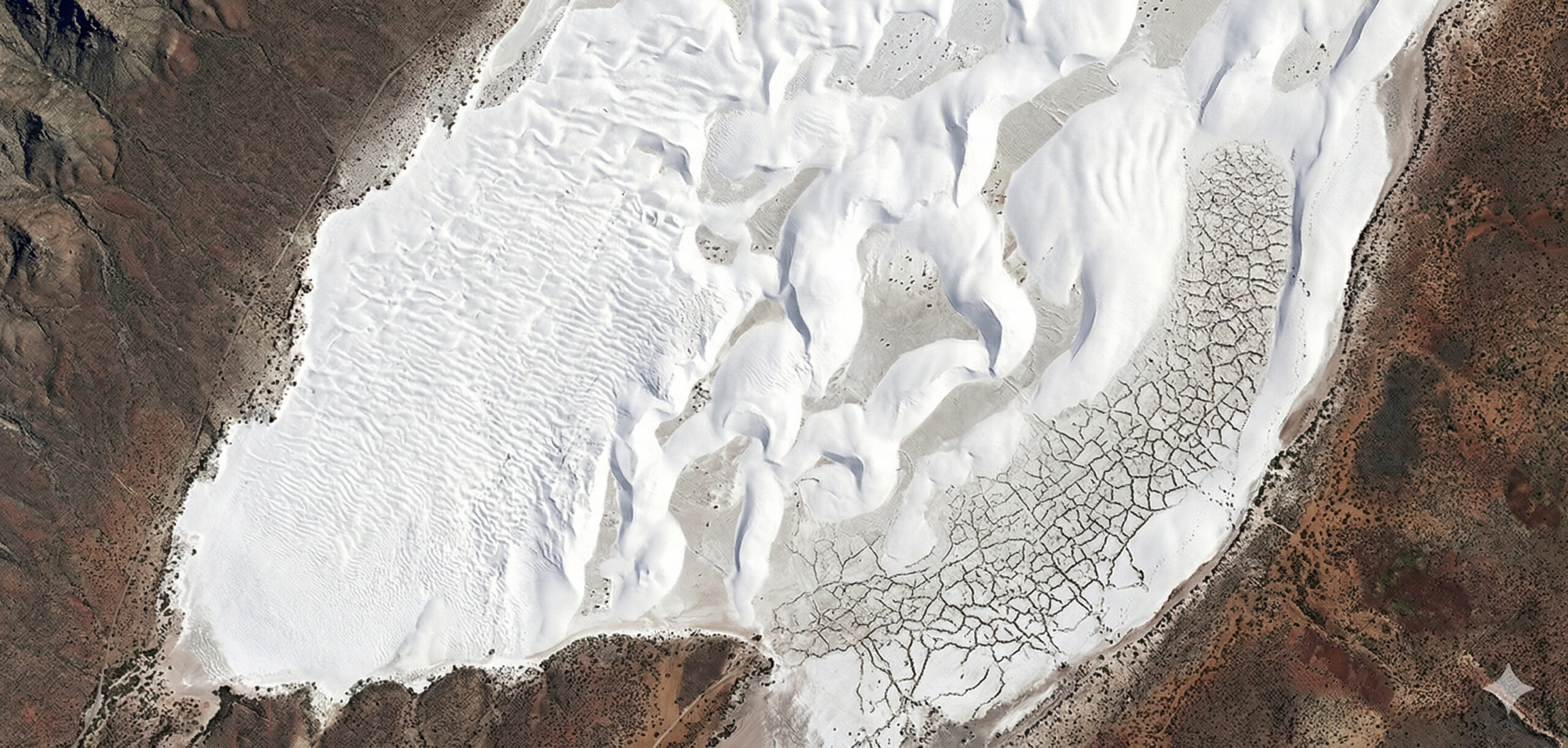

White Sands reveals unique gypsum dunes, originating from a prehistoric lake and human marks up to 23 thousand years seen from space by NASA.
In 2009, 2012, and 2016, analyses published by NASA Earth Observatory, in later updates such as this 2023 orbital reading, consolidated White Sands, in the state of New Mexico, in the United States, as one of the most recognizable landscapes in images taken from space. The set of white gypsum dunes stands out precisely because it appears as a bright and clear area amidst the arid and dark surroundings of the Tularosa Basin, immediately breaking the typical visual pattern of the region’s deserts.
While the surrounding desert displays predominantly ochre, reddish, and brown tones, White Sands appears in images as a continuous light band, with a wavy texture and striking visual boundaries. This visibility does not happen by chance: according to NASA Earth Observatory, the brightness of the dunes comes from gypsum, a rare mineral in the formation of sand fields, whose white surface contrasts sharply with the nearby dark slopes and makes the area easily identifiable even for astronauts in orbit.
What NASA records in these images, however, is not just an unusual landscape, but an active geological system. According to the National Park Service, the origin of White Sands is linked to a long sequence of climatic and geological transformations, including the presence of ancient seas, the formation and evaporation of bodies of water such as the ancient Lake Otero, and the processes associated with the end of the last ice age, which allowed for the accumulation and continuous recycling of gypsum that today makes up the largest gypsum dune field on the planet.
-
Brazilian Entrepreneur Turns Door-to-Door Jewelry Sales into a Family Business Empire with Over 70 Stores

-
$75 Million Bridge in Brazil Opens to Connect Cities, Create Jobs, and Cut Travel Time from 30 to 2 Minutes; Spanning 1.24 km, It’s Among the Country’s Largest and Ends Decades of Ferry Queues.

-
Brazilian Farmer Builds 8-Ton Tractor from Army Truck Engine, Plants Over 100 Hectares of Soybeans
-
11-Year-Old Entrepreneur Turns Fear of Bees into Honey Lemonade, Wins $60,000 on Shark Tank, Secures Whole Foods Deal, and Expands Brand Across U.S. Stores




More than 700 km² of gypsum dunes form a desert that should not exist
White Sands occupies an area of over 700 square kilometers, establishing itself as the largest gypsum dune field on the planet. This fact alone places the region in a unique position within global geology.
The most unusual aspect of this formation lies in the material that makes up the dunes. Unlike most deserts in the world, formed by quartz particles, White Sands is composed of gypsum, a highly soluble hydrated calcium sulfate.


This detail is crucial because, under normal conditions, gypsum tends to dissolve quickly when exposed to moisture, making its accumulation in the form of dunes difficult. However, the region presents a specific set of geographical and climatic factors that prevent this process, allowing the mineral to accumulate and be continuously redistributed by the wind.
This phenomenon creates a scenario that, from a geological perspective, is considered unlikely, as it combines conditions that rarely coexist in a stable manner.
Lake Otero explains the origin of a completely out of pattern landscape
The formation of White Sands is directly linked to the existence of an ancient body of water known as Lake Otero, which occupied the basin of the region during the end of the last ice age, approximately 20,000 to 40,000 years ago.
During that period, the local climate was cooler and wetter, allowing for the formation of a large lake. This lake accumulated water rich in dissolved minerals from the surrounding mountains, especially gypsum.
With the end of the ice age, climatic changes led to a progressive reduction in water volume. As the lake evaporated, the minerals became concentrated and deposited at the bottom of the basin.
When the water completely disappeared, an extensive layer of gypsum-rich sediments remained. These deposits were then fragmented by the action of the wind and transported to form the dunes that today dominate the landscape.
This process transforms White Sands into a direct record of climatic transitions that profoundly altered the region’s environment over time.
Intense white color reflects light and alters the local microclimate
The characteristic white coloration of White Sands is a direct consequence of the mineral composition of the dunes. Gypsum has a high capacity to reflect sunlight, which reduces heat absorption compared to deserts formed by dark sand.
This factor influences the thermal behavior of the region, creating specific conditions on the surface of the dunes. Even under intense solar radiation, the temperature of the sand tends to be lower than in other deserts.

This effect also contributes to the visibility of the area in orbital images, as the reflection of light creates a striking contrast with the surroundings.
Furthermore, the interaction between light, relief, and mineral composition creates complex visual patterns that vary throughout the day, depending on the angle of solar incidence.
Human marks up to 23 thousand years challenge theories about the occupation of the Americas
One of the most relevant elements of White Sands is not only its geological formation but also what has been preserved in its sediments. Scientific studies published in the early 2020s identified fossilized human marks dated between 23 thousand and 21 thousand years.
These marks were found in ancient beds of Lake Otero, preserved under layers of sediments that prevented their erosion over time.

The dating of this evidence has a direct impact on the understanding of human presence on the American continent, as it suggests that groups were already inhabiting the region at a time earlier than many theories considered possible.
This data expands the scientific debate on migratory routes and environmental conditions faced by the first inhabitants of the Americas.
Natural processes continue to shape the landscape continuously
Despite its origin being linked to ancient events, White Sands remains a dynamic environment. The action of the wind remains the main agent of transformation, displacing gypsum particles and constantly altering the shape of the dunes.
Occasional rains dissolve part of the material, which can later recrystallize, feeding back into the cycle of dune formation.
This continuous process causes the landscape to be in constant change, even if these transformations occur on time scales that are not immediately perceptible.
Geographical isolation reinforces the uniqueness of the system
The basin where White Sands is located is surrounded by mountain ranges that limit the flow of water and sediments out of the region. This isolation contributes to the maintenance of the conditions that allow the existence of gypsum dunes.
Without this natural confinement, the material would be dispersed or dissolved, preventing the formation of the dune field. This geographical factor reinforces the unique character of the region, which depends on a specific set of conditions to exist.

White Sands brings together, in a single area, elements that rarely appear so integrated. The region combines climatic record of an ice age, unusual mineral formation, active geological dynamics, and direct evidence of ancient human presence.
This convergence transforms the site into one of the most complete environments for studies on the natural history of the Earth.
What is observed today as a white desert is, in fact, the result of processes that involved water, climate, relief, and deep time, creating a landscape that continues to be analyzed by scientists from different fields.
What do you think of this landscape that came from a lake and is now visible from space
White Sands shows how environmental changes can completely transform a region, creating scenarios that challenge known patterns.
Now I want to know your opinion: do you believe that discoveries like these can still significantly alter what we know about human occupation in the Americas or are the main points of this history already consolidated?


