






 Portuguese
  Spanish


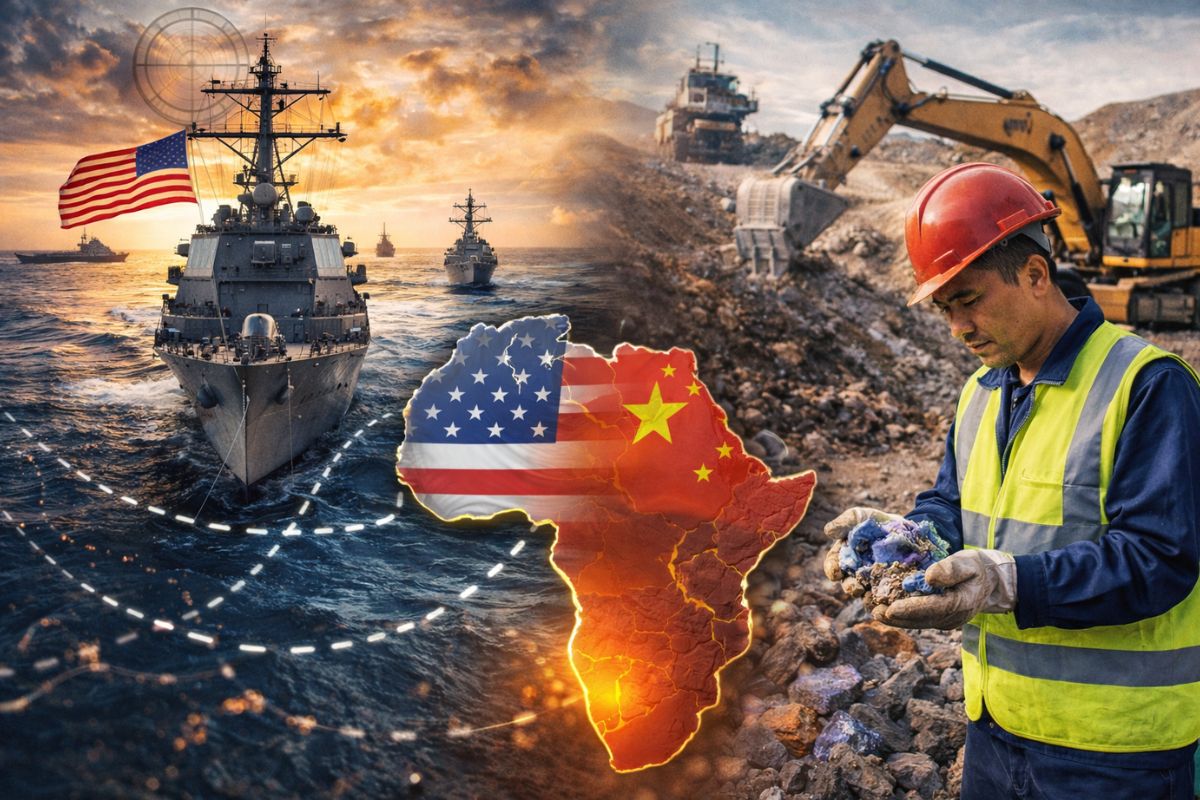

The minerals that make a cell phone work, an electric car run, and a missile find its target depend on a group of elements called rare earths. And the global dispute for these resources is redefining alliances, trade routes, and the balance of power between the two largest economies on the planet.
China controls about 70% of global rare earth mining and approximately 90% of refining. This means that practically any high-tech product manufactured in the world passes, at some point, through a Chinese facility.
Beijing has decided to use this position as a geopolitical pressure tool.
What has changed in recent weeks?

According to Business Insider, while China was tightening export controls on gallium, germanium, and antimony, the United States adopted a different strategy. Instead of directly competing for the mines, Washington began to strengthen its military and logistical presence in two of the most important maritime chokepoints on the planet: the Strait of Hormuz and the Strait of Malacca.
-
At 14 years old, she worked in a factory in Hong Kong, studied economics abroad, and then entered the Chinese real estate market, which helped change the landscape of Beijing.

-
While NATO secured more than $10 billion in missiles and space surveillance at a single forum, Brazil still spends 1.1% of its GDP on defense and is stalling its own anti-aircraft system.

-
Corn ethanol attracts R$ 23 billion in 21 new plants and prepares for a nearly 50% jump in Brazilian production by 2027, even with high interest rates.
-
A newly opened terminal in the middle of the Amazon has begun transporting soy and corn through Amapá, eyeing the queue of ships that is congesting the ports in the South.


The logic is simple. Between 45% and 50% of the crude oil imported by China passes through the Strait of Hormuz. Another 60% to 80% of Chinese oil imports cross the Strait of Malacca. If either of these corridors suffers prolonged disruption, China’s industrial capacity would be directly affected.
The message from the United States is not subtle: if China controls the minerals, the Americans control the route through which the energy that powers Chinese factories flows.
Why has Africa become the center of this dispute?

The African continent has become the main battleground in this race. China invested $24.9 billion in mining projects in Africa just in the first half of 2025, consolidating lithium contracts that extend until 2032.
The most emblematic case occurred in Tanzania. The Ngualla project, operated by the Australian Peak Rare Earths, is considered one of the largest rare earth deposits outside of China. The Chinese company Shenghe Resources, which already held 19.7% of Peak, made an offer of approximately $150 million to acquire full control.
An American management firm, General Innovation Capital Partners, attempted to block the operation with a higher proposal, of about $160 million. Nevertheless, the American offer was rejected by the board of Peak Rare Earths, which deemed Shenghe’s proposal more structured and more likely to be completed.
The result is that China now controls a project capable of producing 37,200 tons of rare earth concentrate per year for two decades. This volume feeds production chains for permanent magnets and electric vehicles, two central sectors in the global technological race.
And what about Brazil?

This point is what makes the dispute between China and the United States especially relevant for the Brazilian reader. Brazil has the second or third largest rare earth reserve in the world, depending on the estimation methodology used. There are approximately 21 million tons of rare earth oxides, equivalent to about 18% of the known global reserves.
However, Brazilian production is insignificant in light of this potential. While China extracts over 200,000 tons per year and even the United States produces significant volumes from its operations in California, Brazil ranks between ninth and tenth in the global production ranking, with about 1,000 tons annually.
The Serra Verde, in Goiás, is currently the only commercial rare earth operation in the country. The ionic clay deposit of Cabo Verde Mining, in southern Minas Gerais, has estimated reserves of over 500 million tons, but is still in the development phase.
In addition to rare earths, Brazil holds more than 90% of the world’s niobium reserves. CBMM, based in Araxá, Minas Gerais, is responsible for about 80% of the global production of this metal, which is used in high-strength steel alloys for pipelines, oil platforms, and aerospace components. Unlike rare earths, Brazilian niobium is already processed and exported as an industrial product.
The contrast between niobium and rare earths reveals a pattern that repeats in Brazilian economic history: the country holds natural resources on a global scale but often fails to transform them into its own industrial capacity before others occupy that space.
What could happen in the coming months?
Three movements deserve attention. First, President Donald Trump’s visit to Beijing, scheduled for mid-May. The expectation is that critical minerals will be at the center of negotiations, especially after China tripled the number of export restrictions since 2021.
Second, the United States is directly investing in alternatives outside of China. In 2025, Washington signed agreements with Australia, Saudi Arabia, Cambodia, Malaysia, and Thailand to develop mining and refining projects for critical minerals. The U.S. Department of Defense has set a deadline of January 2027 to completely eliminate Chinese rare earth components from the military supply chain.
Third, the American company MP Materials is expected to open a heavy rare earth separation facility in California by 2026. If this operation works as planned, it will be the first concrete step to reduce American dependence on Chinese refining.
None of these measures solve the problem in the short term. Building alternative supply chains for critical minerals is a process that takes years, requires billion-dollar investments, and faces considerable technical barriers. China took decades to build the processing infrastructure that dominates the current market, and replicating that capacity elsewhere does not happen by decree.
While the United States and China compete for mines in Africa and bottlenecks in the ocean, Brazil watches from afar with the second-largest rare earth reserve on the planet buried in its backyard. The window of opportunity exists, but windows do not stay open forever. What do you think about this?








