






 Portuguese
  Spanish


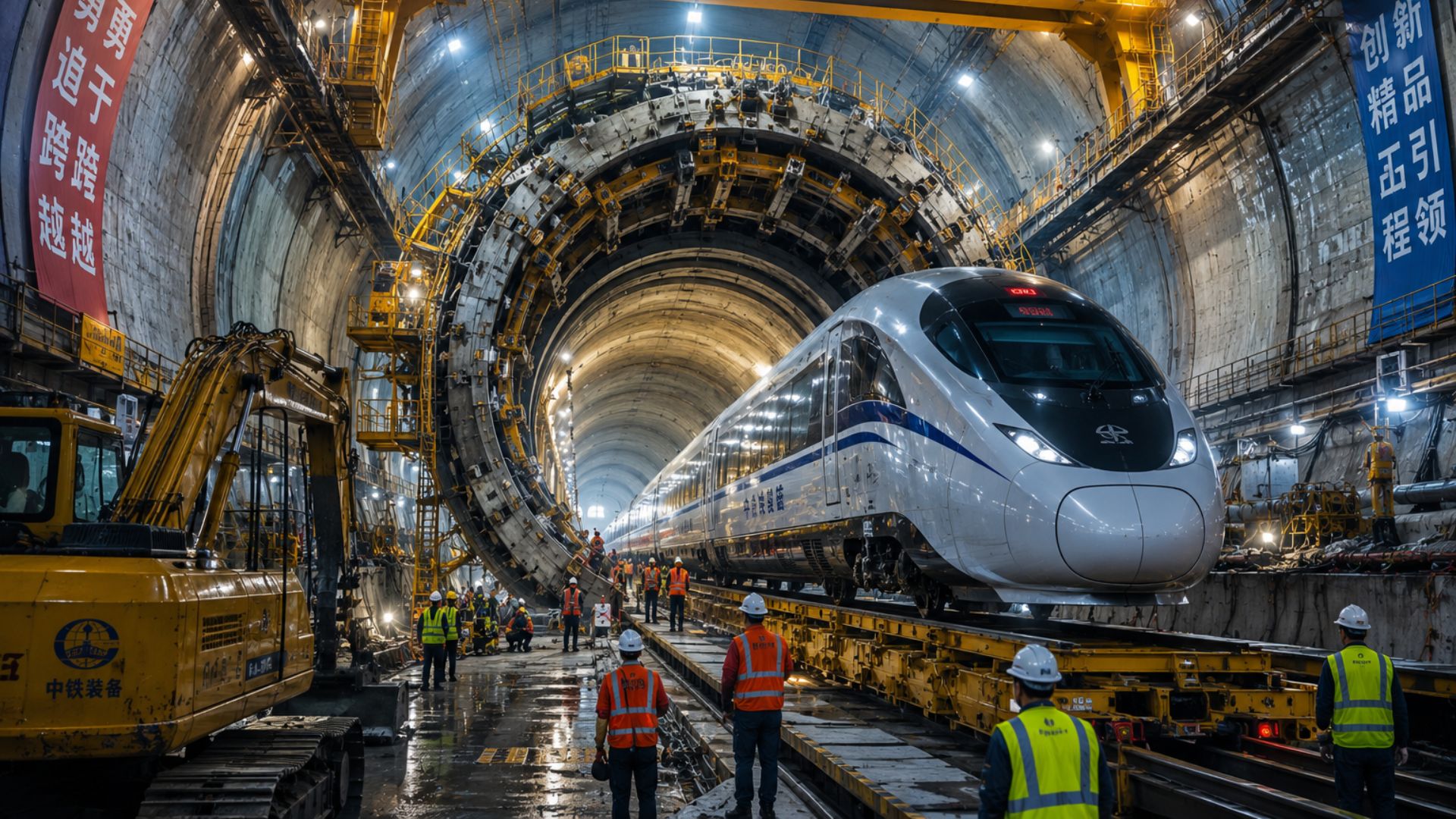

Chinese submarine tunnel project foresees high-speed rail link between Dalian and Yantai in just 40 minutes, drastically reducing journeys that currently can last up to eight hours and expanding logistical, economic, and railway integration in one of the country’s most strategic regions.
China is still reviewing the project for the Bohai Strait Trans-sea Corridor, an underwater railway link planned to connect Dalian, in Liaoning province, to Yantai, in Shandong, creating a new strategic route between two industrial areas considered fundamental to the Chinese economy.
If it goes ahead, the system will feature a tunnel approximately 123 to 125 kilometers long, including about 90 kilometers under the sea, reducing a crossing that currently can take six to eight hours to an estimated travel time of just 40 minutes.
In addition to its unprecedented scale for a submarine railway corridor, the project drew attention due to the projected investment of between 200 billion and 300 billion yuan, a range that corresponds to something between R$ 150 billion and R$ 220 billion, depending on the exchange rate applied in the conversion.
-
China Constructs 5.1 km Undersea Highway in Dalian Bay, Reducing Travel Time from 1 Hour to 5 Minutes

-
Massive Transporters Otto and Lore Move ALMA Radio Telescope in Chile’s Atacama Desert
-
Singapore Turns Incinerated Waste Ash into Construction “Sand” in Ambitious Project to Revolutionize Megacity Waste Management
-
Brazilian Entrepreneur Turns Passion for Amazonian Cocoa into a Million-Real Chocolate Business After Studying in France



Within these estimates released by authorities and international media, the figure of R$ 200 billion appears as one of the values most frequently associated with the Chinese railway megaproject.
What the submarine tunnel in the Bohai Strait will be like
By directly connecting two strategic peninsulas in northeastern China, the proposal aims to shorten travel in an area marked by a concentration of ports, industrial hubs, and logistical corridors considered essential for the transport of cargo and passengers in the region.

According to studies already released, trains could reach a design speed close to 250 km/h, although technical projections mention practical operation between 220 km/h and 240 km/h during the submarine crossing under the Bohai Strait.
In the configuration presented so far, the railway corridor would have parallel galleries intended for passenger transport, in addition to a central structure dedicated to maintenance, evacuation, and operational safety procedures in situations considered critical.
Large-scale submarine projects usually adopt this model because separating flows reduces risks, facilitates technical inspections, and expands response capacity in the face of potential emergencies along extensive routes under the ocean.
As it is an area with complex geological conditions and the presence of seismic faults, the crossing requires specific solutions to prevent infiltrations and ensure structural stability during the continuous operation of the railway system.
In this scenario, studies related to the project cite ventilation systems, waterproofing, structural monitoring, and escape routes as elements considered fundamental to ensure the safe operation of the submarine link.
Travel time between Dalian and Yantai could drop to 40 minutes
Today, those who need to travel between Dalian and Yantai rely on extensive land routes or maritime services that require long periods of travel between the two cities located on opposite sides of the Bohai Strait.
While the ferry crossing usually lasts six to eight hours, the land route requires bypassing the entire Bohai region, significantly increasing the distance traveled and extending the time needed to connect the two urban centers.
With the construction of the tunnel, the railway route would be reduced to just over 100 kilometers, creating a direct link between Liaoning and Shandong and drastically shortening travel time for passengers and logistical operations.
Even so, the estimate of a 40-minute journey depends on the final definition of the route, the authorized speed for train circulation, and the integration model with China’s extensive railway network.
In addition to the submarine crossing, the planning foresees connection with the country’s existing national high-speed corridors, expanding the reach of the future link to other important regions of China.

In practice, this integration would allow passengers and cargo to continue their journey on different railway sections without the need for structural changes during the trip, although operational details still remain without definitive confirmation.
Railway megaproject still depends on definitive approval
Even after gaining international repercussion in recent years, the project still does not have official confirmation that it has entered a full construction phase, remaining linked to technical, environmental, and financial studies conducted by Chinese authorities.
Public documents indicate that the plans were presented to China’s National Development and Reform Commission in May 2019, but more recent materials continue to treat the proposal as an undertaking under analysis and structural definition.
There is also no reliable confirmation that full operation will begin in 2035, although this deadline continues to appear in projections related to the estimated timeline for the execution of the submarine railway system.
More conservative assessments indicate that, if construction begins in the coming years, the development of the work could take between 10 and 15 years until it becomes effectively operational.
In addition to the technical complexity involved in a structure of this magnitude, the volume of investment continues to be pointed out as one of the main challenges to enable the definitive advancement of the submarine corridor.
Estimates released since 2013 maintain the range between 200 billion and 300 billion yuan, while the definition of the financing model continues to be treated as a sensitive issue for regional governments and national Chinese authorities.
Economic impacts and environmental challenges of the Chinese tunnel
For the Chinese government, the railway corridor represents an opportunity to strengthen economic integration around the Bohai Sea, a region that concentrates strategic ports, industrial centers, and connections considered relevant for the country’s internal trade.
With the reduction of distances between Dalian and Yantai, experts point out that the future link could reduce logistical costs and increase the circulation of people and goods between northeastern and eastern China.
At the same time, the undertaking continues to be surrounded by technical, environmental, and financial questions related to the feasibility of large-scale submarine construction within a geologically sensitive area.
Among the points frequently mentioned in recent analyses are the risks linked to seismic activity, the need to preserve the marine ecosystem, and the possible impacts on species present in the region, such as the spotted seal.
If completed within the specifications currently discussed, the Bohai Strait tunnel is expected to surpass world references in submarine extension, including the Eurotunnel and the Seikan in Japan.
Even with the ambition to transform regional logistics and drastically reduce travel time, the project remains conditioned on official approvals, complementary studies, and financial decisions that will define the next steps of the Chinese proposal.


