






 Portuguese
  Spanish


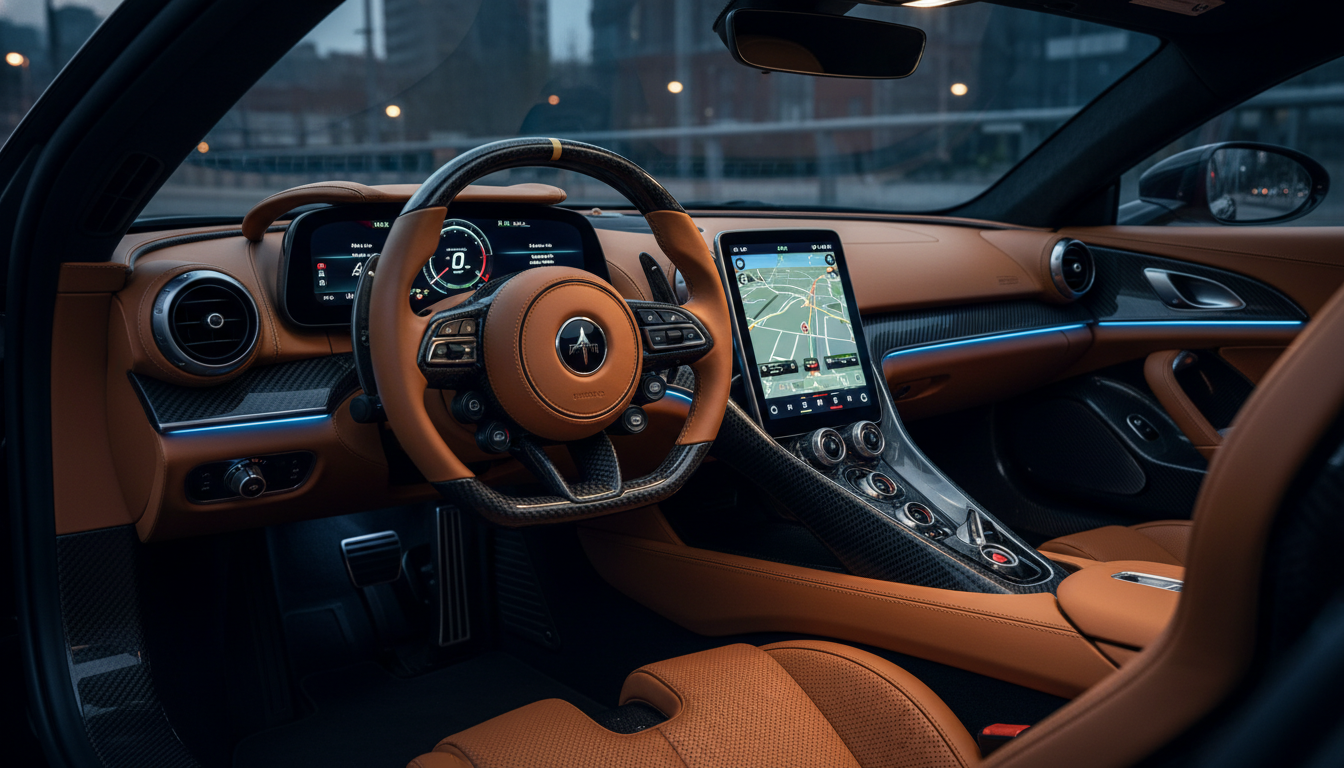

The Pininfarina Battista is the most powerful electric car ever made in Italy — it boasts 1,900 horsepower distributed across four motors, a torque of 2,300 Nm that pushes the body against the seat, and such limited production that fewer people will own a Battista than astronauts who have been to space
Only 150 units will be manufactured.
Each one costs approximately 2 million euros — more than many apartments in European capitals.
The Pininfarina Battista is the Italian answer to the question: what happens when the most famous design house in the world decides to make its own car?
-
“No One Will Want to Buy”: Dealer Claims Used Cars Over R$ 100,000 Are Stalling Due to BYD New Models, While R$ 109,990 Electric Model Leads Brazilian Retail

-
GWM ORA 03 BEV58 Electric Car Offers 315 km of Range According to Inmetro, 171 hp, and Seven Airbags, Accelerating from 0 to 100 km/h in 9 Seconds with 360-Degree Camera, Panoramic Sunroof, and Two 10.25-Inch Screens with a 58 kWh Battery

-
Free Flow Feature Now Available in Brazil’s CNH App, Transforming Drivers’ Experience on Toll Roads
-
Forget the Fiat Toro: The 2026 Hyundai Santa Cruz Offers a Turbo Version with 281 hp and 422 Nm for About R$215,000, Featuring All-Wheel Drive and 8-Speed Automatic Transmission, but Available Only in the U.S.


Pininfarina, founded in 1930 by Battista “Pinin” Farina, has designed Ferraris, Alfa Romeos, and Maseratis for nearly a century.
But it had never produced a car under its own brand.
Until now.
According to the official Automobili Pininfarina website, the Battista delivers 1,900 horsepower (1,400 kW) with zero emissions.
The numbers that keep combustion car engineers awake at night
Four electric motors — two rear ones with 603 horsepower each and two front ones with 335 — work together.
The result: acceleration from 0 to 100 km/h in 1.86 seconds.
For comparison, a 1,500-horsepower gasoline Bugatti Chiron does it in 2.4 seconds.
The torque of 2,300 Newton-meters is available instantly — no turbo lag, no gear shifting.
Top speed: 350 km/h, electronically limited.
The 120 kWh battery allows for a range of about 480 km in mixed driving.
It’s like having a fighter jet in your hands, but it makes no noise and doesn’t pollute.
The design that carries 94 years of history
The body is entirely made of carbon fiber, built on a monocoque with aluminum structures.
The design is signed by the team at Automobili Pininfarina, the direct heir of the studio that shaped some of the most beautiful Ferraris in history.
21-inch Pirelli P Zero Corsa tires complete the look.
There are five customizable driving modes.
One of them includes synthesized sound at 54 Hz — a frequency chosen to provide excitement without being too artificial.
Battista vs. Rimac Nevera vs. Tesla Roadster
The Battista is not alone in the race of electric hypercars.
The Rimac Nevera, from Croatia, has 1,914 horsepower and a platform shared with the Battista.
In fact, both cars use the same battery, the same carbon fiber tub, and similar components.
The difference lies in design and calibration — the Battista is more GT, the Nevera more brutal.
The Tesla Roadster, promised since 2017, has yet to enter production.
Elon Musk promised over 1,000 km of range and acceleration under 2 seconds.
But while the Roadster lives in the world of promises, the Battista and the Nevera are already on the streets.
Why only 150 units
The limited production is intentional.
Each Battista is hand-assembled at the factory in Cambiano, near Turin.
With 150 units and a price of 2 million euros, the estimated total revenue is 300 million euros.
Automobili Pininfarina belongs to the Indian group Mahindra, which uses the project to enter the premium EV market.
Exclusivity is part of the appeal: fewer than 150 people on the planet will own one.
For comparison, over 600 people have been to space.
Charging: 0 to 80% in 40 minutes
The Battista supports fast DC charging of up to 250 kW.
From 0 to 80%, it takes about 40 minutes.
The range of 480 km is sufficient for a trip from Turin to Milan and back without stopping.
However, in aggressive track use, the range drops drastically.
As a Top Gear presenter said: “300 miles of range — if driven like a retiree.”
The other side of the coin
The Battista weighs just over 2 tons — heavy for a supercar.
About 70% of the technology is shared with the Rimac Nevera — so it’s not 100% “Pininfarina”.
The charging infrastructure for hypercars is still limited in many regions.
And the price of 2 million euros puts it out of reach for 99.999% of the population.
But the Battista was not made to be popular.
It was made to prove that the future of supercars is electric — and that Italy intends to lead it.
After nearly a century of designing other people’s cars, Pininfarina finally made its own — and it’s the fastest of all.


