Portuguese
  Spanish


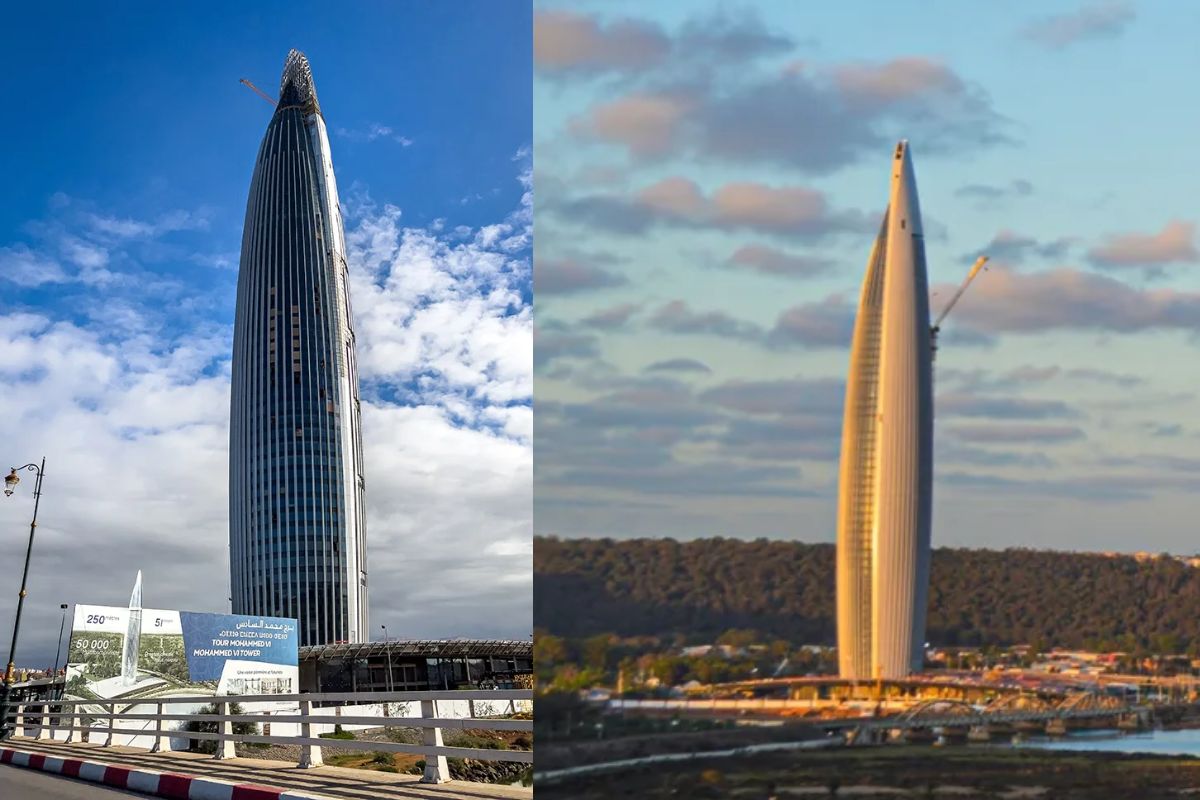


The Mohammed VI Tower asserts itself at the mouth of the Bouregreg River, bringing together a luxury hotel, offices, and apartments, betting on photovoltaic panels and reigniting the debate on historical landscape and gentrification
The Mohammed VI Tower was inaugurated in Rabat, Morocco, as the tallest skyscraper in the country and the third tallest in Africa, standing at 250 meters high with 55 floors, along the banks of the Bouregreg River, in an area that has been transformed in recent years.
The Mohammed VI Tower was designed to serve as a new architectural icon for the Moroccan capital, housing a Waldorf Astoria hotel, offices, high-end apartments, and a panoramic viewpoint, while also provoking criticism from UNESCO for altering the historical landscape of Rabat, recognized as a World Heritage site.
A skyscraper that changes the horizon of Rabat and Salé
The Mohammed VI Tower stands out at the mouth of the Bouregreg River and redefines the urban landscape of Rabat and Salé, with a silhouette visible from over 50 kilometers away.
-
U.S. City Builds Tiny Home Village on Water Company Land to House 136 Homeless People: Inside the Social Housing Units

-
Woman Turns Shipping Container into Home, Embraces Rural Life to Cut Monthly Expenses to Just Over $330
-
France Revamps 530 Social Housing Units with Large Balconies and Glass Facades Without Demolishing Existing Buildings

-
Facing high rent, couple transforms parents’ garage into a fully functional apartment, creating a complete home at a fraction of the market cost.




The reading behind the project is clear: it is not just a tall building, but a statement of presence and ambition from a city and a country that want to occupy space on the contemporary map.
More than just housing people and businesses, the tower serves as a declaration of intentions, within an international projection strategy that attempts to balance tradition and modernity with the promise of sustainability.
Who signs the project and what is the aesthetic of the tower
The architecture is attributed to Moroccan architect Hakim Benjelloun and the Spanish firm Rafael de La Hoz, with a proposed style described as afrofuturistic. Inside, the design is by the Belgian firm Flamant, reinforcing the international character of the venture and the focus on high-end finishes.
The tower rises above a four-level podium and integrates a set designed to concentrate different uses in a single complex, which helps explain why it is not seen merely as a building, but as an urban landmark.
What will function inside the Mohammed VI Tower

The Mohammed VI Tower was conceived as a large mixed-use center. The building is set to house a Waldorf Astoria hotel, offices, high-end apartments, shops, and restaurants, as well as a panoramic viewpoint overlooking Rabat and Salé.
The internal circulation is also part of the project’s impact, with a total of 36 elevators distributed between the tower and the podium to serve the different areas of the complex.
Sustainability and engineering in a 250-meter building
The Mohammed VI Tower has been presented as a work with relevant technical and environmental solutions, including seismic and flood-resistant foundations with a depth of 60 meters, harmonic dampers for wind and vibration, dynamic lighting on the façade, and energy recovery systems.
Photovoltaic panels and rainwater recovery resources were also mentioned, along with international sustainability and environmental efficiency certifications, such as LEED Gold and HQE. The proposal is that height and luxury coexist with concrete measures of energy efficiency and reuse.
A symbol of the Rabat City of Lights plan
The inauguration of the Mohammed VI Tower fits into a larger urban reconfiguration movement. The Bouregreg Valley region has been undergoing changes with a marina, residential areas, a theater, and the Rabat Salé tram system, within the Rabat City of Lights plan, Moroccan Capital of Culture.
The logic is to create a capital that attracts cultural and international attention, without abandoning historical heritage. And it is precisely at this point that the tower becomes a test of limits for the city.
The point of conflict with UNESCO and the fear of gentrification
UNESCO rejected the project because it is located in the estuary of the Bouregreg River, an area where there were no buildings taller than three stories, and because Rabat was declared a World Heritage Site in 2012 for the visual integrity of its historical landscape. The central criticism is that a 250-meter tower in the middle of the estuary irreversibly alters this balance.
Moreover, the concentration of high-end uses in a single complex raises the risk of gentrification around the Bouregreg, with the potential to displace long-standing businesses and residents. This type of urban impact is associated with the so-called Bilbao effect, often discussed in analyses of city regeneration.
In practice, the Mohammed VI Tower is already born as a double symbol: a showcase of modernization for some, a threat to urban identity for others.
Do you think the Mohammed VI Tower strengthens Rabat as a modern capital or compromises the historical landscape that made the city a World Heritage Site?