Portuguese
  Spanish


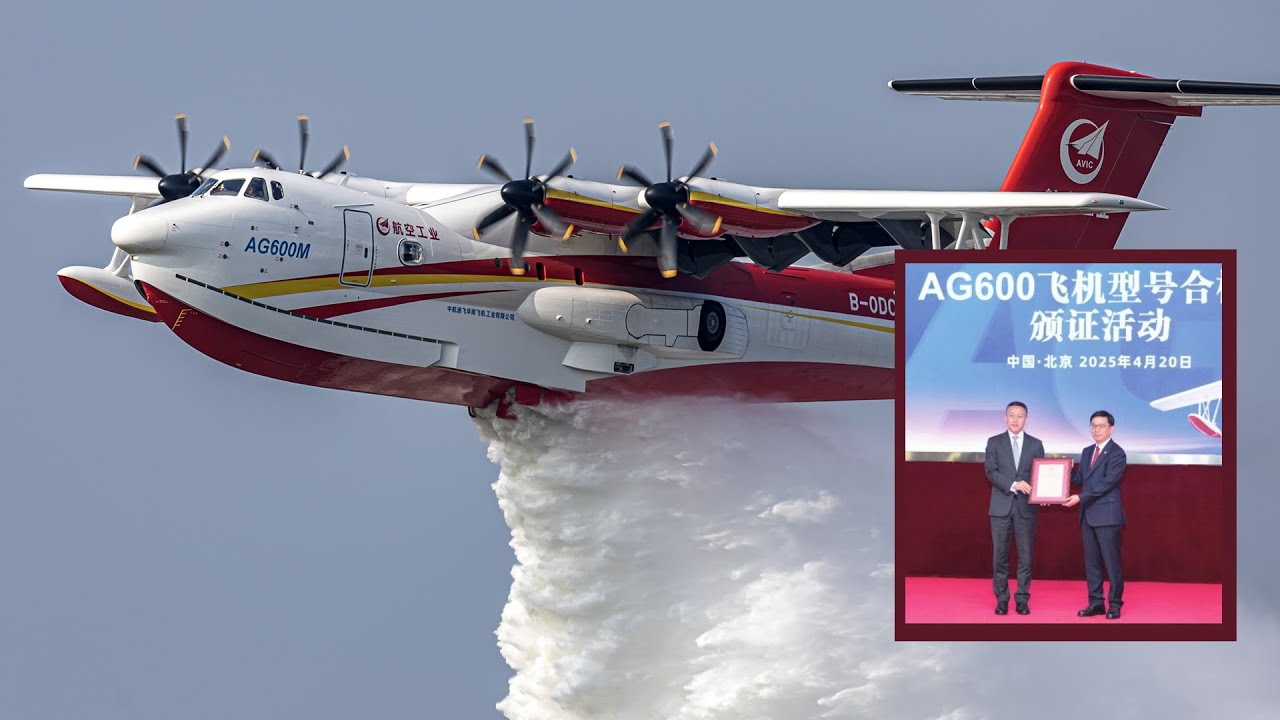

AG600 Kunlong, the world’s largest amphibious aircraft, takes off with 60 tons, lands on the sea, and fights fires with up to 12 tons of water.
On April 20, 2025, the Civil Aviation Administration of China granted the type certificate to the AG600 Kunlong, developed by the Aviation Industry Corporation of China. With this, the model became officially recognized as the world’s largest civilian amphibious aircraft in operation, consolidating years of development focused on large-scale missions. The certification represents validation that the aircraft meets the technical and safety requirements for operational use. In practice, it paves the way for its entry into real missions, including firefighting, maritime rescue, and support for remote regions.
Dimensions and capacity place the AG600 among the largest machines ever built to operate on water
The AG600 Kunlong immediately draws attention with its figures. The aircraft is approximately 38.9 meters long and has a wingspan of 38.8 meters, dimensions comparable to those of medium-sized commercial aircraft.
Its maximum takeoff weight reaches 60 tons, placing it in a category rarely seen in aircraft capable of operating both on land and at sea.
-
Brazil Welcomes Spanish Wamos Air and Nigerian Air Peace, Potentially Transforming International Routes and Increasing Competition

-
Offshore air transport soars in Brazil, surpasses 2.5 million passengers, and reveals how oil has transformed Rio’s airports into key pieces of national logistics.

-
Latin America becomes the “global champion” of aviation taxes, tickets may become more expensive in Brazil, and IATA’s warning exposes risk for flights, tourism, and passengers.
-
Brazil has lost 85 air routes since 2019 and is still flying less than before the pandemic, leaving passengers with fewer destinations, fewer frequencies, and a more limited air network.



This scale allows it to transport large volumes of cargo or water, making the model suitable for operations requiring rapid response and high capacity.
Capacity to drop up to 12 tons of water transforms firefighting
One of the AG600’s primary functions is fighting forest fires. The aircraft can collect water directly from lakes, rivers, or the sea while in motion and store up to 12 tons of water in a few seconds.
It then releases the water over areas affected by fire. This process drastically reduces the time between refueling and operation, increasing efficiency in scenarios where every minute is critical.


The high capacity allows it to cover larger areas in fewer passes, an important factor in large-scale fires.
Amphibious operation allows access to regions where conventional aircraft cannot reach
The AG600’s main differential lies in its ability to operate without exclusively relying on land runways.
The aircraft can:
- Take off and land on conventional runways
- Operate directly on water
- Use coastal areas as a base
This transforms the open sea into an operational extension of aviation, expanding the reach of missions. In regions with limited infrastructure, such as islands, isolated coastal areas, or disaster zones, this capability becomes strategic.
Range of up to 4,500 km expands the aircraft’s role in long-range missions
In addition to its cargo capacity, the AG600 also boasts a significant range. Data released by Chinese authorities indicates a range of approximately 4,500 kilometers, allowing it to cover large areas without the need for frequent refueling.
This range expands the aircraft’s role beyond local operations, enabling regional and international missions.
Applications include:
- High-seas rescue
- Maritime patrolling
- Natural disaster response
- Logistical transport in isolated areas
Project integrates maritime expansion strategy and emergency response
The development of the AG600 is part of a broader context of China’s expansion of air and maritime capabilities.
The aircraft was designed to operate in scenarios such as:
- Search and rescue operations
- Monitoring of maritime areas
- Fire and disaster response
This reflects the need for vehicles capable of operating in complex environments where terrestrial infrastructure is unavailable.
Engineering combines aircraft and vessel characteristics in a single structure
Designing an amphibious aircraft of this scale involves significant technical challenges. The AG600 needs to balance: Aerodynamics for efficient flight, Hydrodynamics for water landing and takeoff, and Reinforced structure to withstand impacts
This combination requires engineering solutions that go beyond those used in conventional aircraft, especially in the lower fuselage and stabilization system.

Historically, amphibious aircraft have had limited use in specific niches. However, recent events, such as an increase in wildfires and the need for rapid disaster response, have driven demand for this type of equipment.
The AG600 emerges at a time when large-scale solutions are once again considered strategic, especially for governments and emergency operations.
The development of aircraft like the AG600 indicates a shift in how air operations can be conducted.
The ability to use the sea as a runway significantly expands the reach and flexibility of missions, reducing dependence on infrastructure. At the same time, it opens new possibilities for logistics, security, and crisis response.
Do you believe amphibious aircraft can become essential in a world with more frequent extreme events?
The advancement of the AG600 Kunlong raises a relevant question about the future of aviation. As extreme weather events become more frequent, the need for rapid and large-scale responses tends to grow.
The combination of large capacity, range, and amphibious operation places this type of aircraft in a strategic position.
The question that remains is direct: will this type of technology be just a specific solution or can it become a central piece in the global response to emergencies and environmental challenges.