






 Portuguese
  Spanish
  4 min of reading
  0 comments


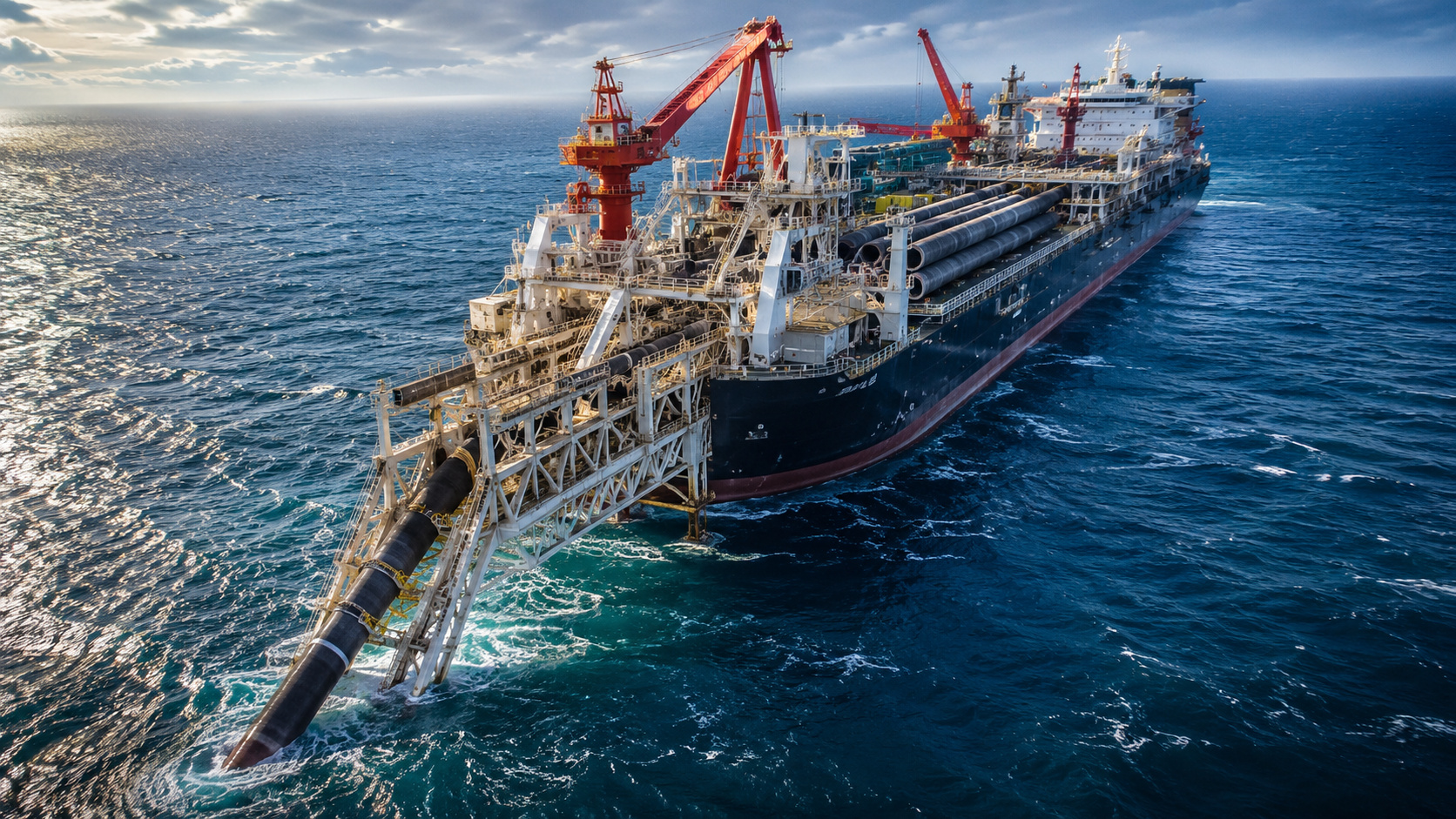
The Solitaire pipe-laying vessel shows how offshore engineering welds giant pipes in sequence. The structure becomes a submarine gas pipeline and submarine oil pipeline. At the bottom of the sea, an invisible operation connects energy, industry, and works of extreme scale
The giant ship Solitaire, from Allseas, is 397 meters long and carries up to 22,000 tons of pipes to assemble pipelines in the ocean. The information was released by Offshore Energy, a maritime sector news portal.
It is not an ordinary cargo ship. The Solitaire functions as a floating pipeline factory, where metal pipes are joined in sequence before descending to the seabed.
The result is a continuous metal line, used in structures like submarine gas pipeline and submarine oil pipeline. What happens is that the ship assembles the pieces at sea and places this line in the right spot.
-
While many ports want to grow, Barcelona has decided to do the opposite and will cut cruise terminals from 7 to 5 after pressure from residents, protests, and crowds.

-
The United States wants to tighten control over submarine cables that carry 99% of international internet, silently cross oceans, total more than 400 routes worldwide, and have become a strategic piece in the competition for data, technology, and suppliers.
-
European Union looks again at Brazilian seafood after a nearly 8-year ban and may unlock a coveted market for lobster, tuna, tilapia, and shrimp.
-
Voltalia secures 322 MW of electrical connection in Pecém and targets data centers with renewable energy, robust network, and dedicated wind projects in Ceará.
The Solitaire not only transports pipes, it assembles submarine pipelines while sailing in the ocean
A common ship carries cargo from one point to another. The Solitaire does something different. It carries the pipes, prepares the pieces, and participates in assembling a large pipeline at sea.


This pipeline is the submarine duct. It functions as a metal path through which energy-related products, such as gas and oil, can pass when the work requires this type of structure.
That’s why the size draws so much attention. A 397-meter ship needs space for pipes, machines, welding areas, control systems, and crew on board.
How 12-meter pipes become 24-meter pieces before descending to the seabed
Within Solitaire, there is an area called the factory of double joints. The name may sound difficult, but the function is easy to understand: it joins smaller pipes to create larger sections.
In this area, individual pipes of 12 meters are welded to form pieces of 24 meters. After that, these sections proceed to the main production line.
This process helps to make the pipeline launch faster. It also improves the repetition of the weld, because the work happens in an organized sequence within the ship itself.
The floating factory uses welding, control, and inspection to transform metal into a continuous line
Offshore Energy, a maritime sector news portal, detailed that the update involves pipe handling equipment on the deck and electrical and instrumentation components. These systems help to power and control the operation.
Goriziane was contracted by Allseas to deliver this part of the modernization. The delivery is expected by January 2026, with installation and commissioning planned to occur later in the same year.
In practice, this stage shows that the pipeline is not just thrown into the sea. It goes through welding, monitoring, handling, and inspection before forming a continuous line at the bottom of the ocean.
Dynamic positioning helps the pipeline launch vessel stay in the right spot
The Solitaire uses full dynamic positioning. In simple terms, it’s a system that helps the vessel stay in the planned position while the operation takes place.
This matters because the pipeline needs to descend with control. If the vessel moves from the spot, the installation may lose alignment and the assembly may not follow the correct sequence.

The vessel can also accommodate 420 people. This number shows the human scale behind the operation, with professionals involved in the maritime routine and technical work.
The update of the Solitaire aims to keep the vessel prepared for deep-water projects
The Solitaire has been in operation since 1998. Even with so many years of service, it continues to be involved in large-scale offshore projects.
Roderik Heerema, project manager at Allseas, stated: “This major investment is a pillar of Allseas’ commitment to maintaining its position as the leading contractor for trunklines and deepwater pipelines, and to advancing installation capabilities and automation in our production processes.”
The statement helps to understand the purpose of the upgrade. Allseas aims to improve pipeline installation and increase automation, meaning more steps controlled by systems and less reliance on repetitive manual tasks.
Subsea gas and oil pipelines rely on an operation that almost no one sees
When a subsea gas or oil pipeline is completed, it practically disappears from public view. The most impressive work happens beforehand, inside ships like the Solitaire.
The vessel transforms separate pipes into a continuous structure. Then, this metal line descends to the seabed, where it becomes part of the infrastructure used in major energy projects.
Therefore, the Solitaire attracts attention not just for its size. It demonstrates how heavy engineering can assemble, in the ocean, a structure that needs to function in a challenging environment far from the coast.
The 397-meter ship reveals a little-known part of subsea construction. Behind every pipeline on the seabed, there is a sequence of welding, control, and precision that begins in a floating factory.
Did you imagine that a subsea pipeline is born from pipes welded inside a giant ship? Comment on what caught your attention the most in this operation.







Be the first to react!