






 Portuguese
  Spanish
  9 min of reading
  0 comments


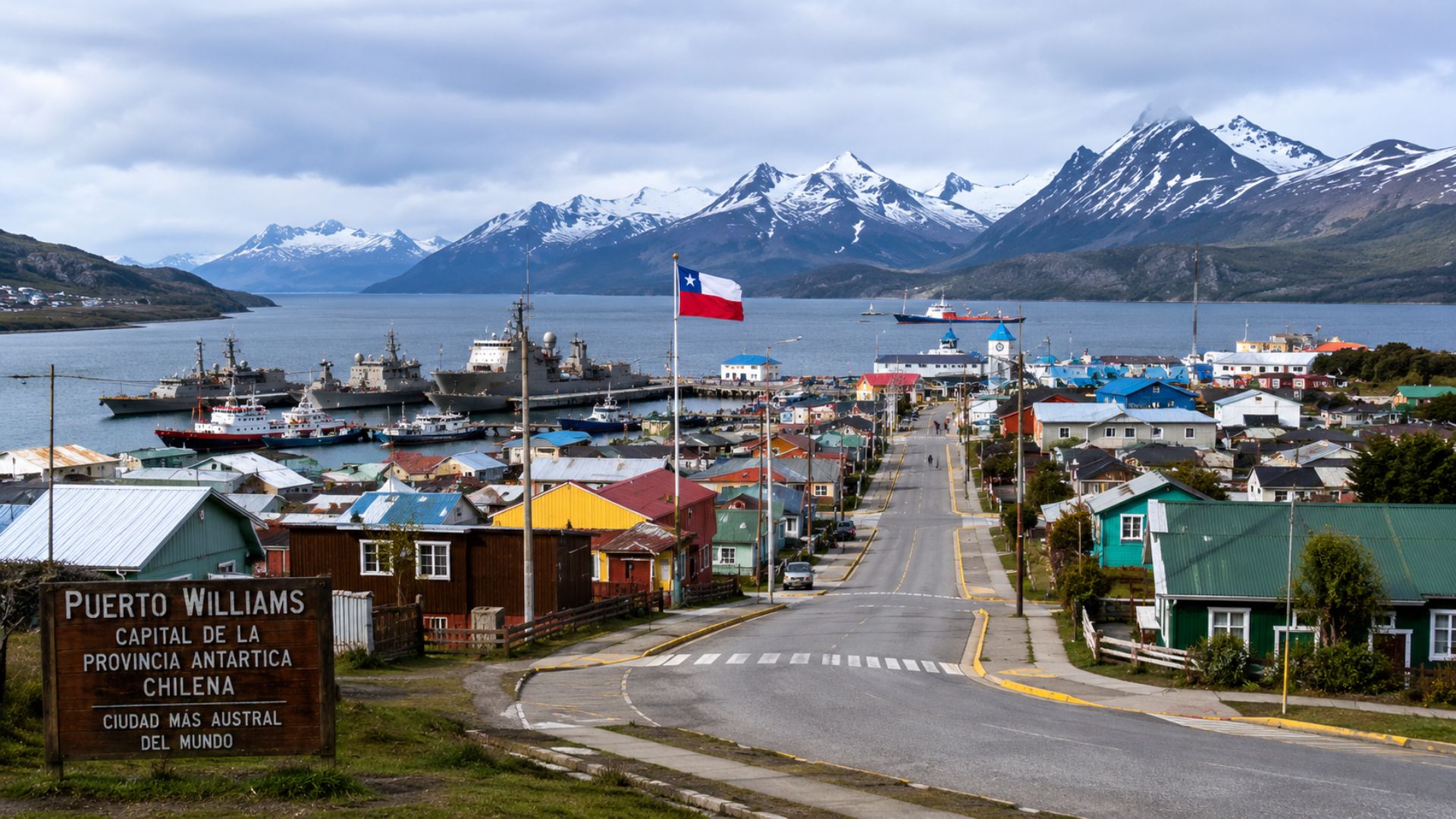
The presence of the Armed Forces translates into visible physical infrastructure at different points in the city. There is a naval hospital in addition to the community hospital, military ships frequently patrol the coast, and the naval base occupies a significant part of the urban space consolidated over the decades.
The city is named after John Williams Wilson, a British-born Chilean Navy officer who participated in the first explorations of the region during the 19th century. This military link has marked the identity of the place since its official founding in 1953 and remains present in the daily culture of its residents to this day.
The title of the southernmost city in the world conquered in 2019

The symbolic dispute between Puerto Williams and Ushuaia for the title of the world’s southernmost city lasted for decades. For a long time, the Chilean settlement was considered only a village, without formal criteria to receive full city status under local legislation.
-
After the divorce, a woman spent four years building a studio apartment with skylights, mirrors, a bathtub hidden under the sofa, and family mementos for a fresh start.

-
The “Rei do Bolão” of Fortaleza made 100 people millionaires at once in the Mega-Sena: the lottery office in Aldeota divided R$ 168 million in a pool and delivers a bet from São Paulo to Dubai.

-
After swapping sewing for cement, a woman from Paraná became a mason, spent 12 years on construction sites, started building her own house, and even gained fame for restoring old Opalas.
-
Tired of relying on a conventional house, a young woman with no construction experience built an off-grid studio apartment with solar energy, rainwater, a biodigester bathroom, and a routine designed to live with more autonomy.



The change occurred in 2019 with an important administrative decision. Puerto Williams was officially elevated to the category of municipality, a condition that allowed it to claim the title of the southernmost city on the planet, taking the position that historically belonged to Ushuaia in Argentina.
The geographical difference between the two localities is undeniable when observing the map. Ushuaia is north of the Beagle Channel, while Puerto Williams occupies the south bank of the same channel, a position that places the Chilean side at a higher latitude towards the South Pole of the planet.
To differentiate the brand of the two destinations, an informal expression emerged among travelers. Ushuaia maintains the tourist slogan of the end of the world, while Puerto Williams became known as the place beyond the end of the world, a description that helps position the new municipality in the international imagination of those seeking extreme destinations during trips to the region.
Complete infrastructure in a small city

Despite its small size, Puerto Williams boasts a surprisingly complete network of urban services. The city has a port, airport, public hospitals, city hall, courthouse, post office, fire department, community center, and even a university campus linked to the main university in Punta Arenas.
The commercial area also serves residents and visitors well. There are at least two larger markets and several mini-markets, restaurants, cafes, and various shops, with prices, according to travelers, similar to those practiced in other regions of continental Chile, which often surprises those who expect much higher values in such an isolated region.
The city also invests in curious small urban amenities for such a remote place. There’s an outdoor gym, a bicycle repair station with tools and an air pump available to the public, social decks, artisanal viewpoints scattered throughout the neighborhoods, and even its own municipal cemetery to serve the local community.
The combination of essential services and carefully maintained aesthetic details gives the municipality the air of a planned city. For travelers arriving from other regions of Latin America, the initial feeling is often one of positive surprise at a community that combines urban organization and neighborly closeness, a rare characteristic in popular tourist destinations.
How to get to the southernmost city in the world


Accessing Puerto Williams is still a logistical adventure for any traveler. There are no roads connecting the city to the South American continent, and the three available routes depend on prior planning and tolerance for unstable weather conditions.
The first option is by sea, on a ferry that departs from Punta Arenas. The crossing takes 30 hours or more, but offers stunning landscapes along the way and is the only alternative for those wishing to transport their own vehicles to the final destination on the island.
The second alternative is a direct flight between Punta Arenas and the local airport. The aerial journey takes about an hour when weather conditions allow for safe takeoff and landing, a situation that doesn’t always occur in a region marked by strong winds and sudden weather changes.
The third option is to cross the Beagle Channel from Ushuaia. Despite appearing close on the map, the two cities face significant bureaucratic and logistical challenges in connecting travelers on smaller vessels that respect international borders and specific immigration protocols between Chile and Argentina.
Urban growth and the scenario for 2048

The city is experiencing a moment of constant expansion visible in different parts of its urban fabric. Comparisons with old Google Street View images show that many important public buildings simply did not exist until about a decade ago.
Courthouse, post office, university, and other structures have been built over the past few years. Currently, streets are being paved, potable water and sewage pipes are being installed in new sections, and urban expansion works are spreading across different regions of the city, which continues to gain permanent infrastructure.
This growth connects to a long-term geopolitical scenario. The Antarctic Treaty comes up for review starting in 2048, and this renewal could reopen international discussions about the future of the icy continent, with possible changes in the balance of power among countries claiming territories in the polar region.
Chile is one of the closest countries to Antarctica and maintains old territorial claims in the area. Investing in the development of Puerto Williams can therefore be seen not only as spontaneous urban growth but also as a strategic strengthening of its position in the extreme south of the planet in the face of potential future reconfigurations of Antarctic geopolitics.
The ferry to Puerto Toro and the southernmost settlement on the planet

Two hours by boat from Puerto Williams lies another special spot on Navarino Island. Puerto Toro is considered the southernmost permanently inhabited settlement in the world, with fewer than 30 permanent residents spread across a community practically isolated from the mainland.
Access to the location is via a free ferry that departs regularly from the city. Reservations are made by email directly with the local municipality, and the vessel transports vehicles, food, fuel, building materials, and everything that sustains life in the island communities along the way.
In Puerto Toro, the infrastructure is even more limited than in Puerto Williams. The school, according to recent reports, serves only two students, and medical care is limited to basic services, with more serious cases requiring evacuation to Puerto Williams or even Punta Arenas, on trips that depend on favorable weather conditions.
The reason for the existence of such a tiny settlement often draws the attention of researchers and travelers. For regional geopolitics experts, the village serves a sovereignty function, with people living in a remote region as a way to mark territory, a model similar to that adopted by the United States on Little Diomede Island, near Russia.
Nature, invasive beavers, and the giant woodpecker

Beyond the urban landscape, Puerto Williams is surrounded by preserved nature that attracts adventurers from various parts of the world. The Cerro Bandera trail is one of the most popular and offers panoramic views of the Beagle Channel, the city, and even Ushuaia on clearer days.
The trail takes about 2 hours of hiking and passes through native tree forests. Some of these species, such as the guindo, can live up to 600 years and belong to the same genus that grew in Antarctica when the continent still had a mild climate, a biological connection that reinforces the region’s prehistoric character.
Those descending the trail often encounter a serious environmental problem. Beavers brought from Canada decades ago to Argentina crossed the Beagle Channel and spread across Navarino Island, felling trees and altering the original ecosystem in a practical demonstration of how invasive species can cause unforeseen impacts on natural environments.
Another illustrious figure of the region is the Chilean giant woodpecker, considered the largest woodpecker species in the world. Seeing the bird in flight requires luck, as it hides easily, but the holes left in trees from its search for larvae are frequent clues to the work of these native animals during walks along the island’s trails.
Safety, trust among neighbors, and daily life

Amidst the isolation and constant military presence, the sense of security in Puerto Williams is considered extremely high. There are almost no recorded crimes, and anyone who commits an infraction must be sent to other locations, as the municipality does not have its own prison.
This environment fosters a relaxed and friendly daily culture. Residents leave bicycles parked unlocked in front of cafes, converse easily with strangers, and offer voluntary rides to visitors who need to travel between distant points in the city during their stay.
This pattern of social trust among neighbors is rare in other parts of Latin America and is usually more common in small communities in Asia and some regions of Europe. In Puerto Williams, this environment coexists with the traditional joy of Latin culture, a combination especially valued by travelers coming from larger urban centers.
Brazilian culture also reached the end of the world in an unexpected way. Businesses in the city frequently play Brazilian music, and some stores display products of surprising international origin for such an isolated location, showing that cultural globalization knows no geographical boundaries, even when the destination is almost 3,000 kilometers from the national capital.
And you, would you face a trip to Puerto Williams to visit the southernmost city in the world, even knowing that you would need to endure a 30-hour ferry ride or a short flight dependent on the unpredictable weather of Chilean Patagonia?
Tell us in the comments if you knew there is a Chilean city further south than Ushuaia, if you follow topics of Antarctic geopolitics, and how you imagine the future of this small municipality will be in the coming decades, especially with the revision of the Antarctic Treaty scheduled for 2048. The discussion helps to understand how Brazilians are viewing these extreme destinations that are almost at the end of the entire planet during this new era of increasingly accessible international travel.
Puerto Williams is the southernmost city in the world, located on Navarino Island, in the extreme south of Chile. The municipality has about 3,000 inhabitants, boasts a sub-Antarctic climate, hosts a strong presence of the Chilean Navy, and officially gained the title of the planet’s southernmost city in 2019, taking the position from Ushuaia, in neighboring Argentina.
The discussion about which is the last urban point on the planet before Antarctica usually ends with references to the Argentine city of Ushuaia, known worldwide as the end of the world. There is another municipality, however, that has officially claimed this position since 2019 and occupies an even more southerly position: Puerto Williams, a Chilean city with about 3,000 residents on Navarino Island, at the tip of Patagonia.
The locality is in a region so close to the icy continent that the local climate is classified as sub-Antarctic, with strong winds and the need for several layers of clothing even in summer. Despite its small size, the town has complete infrastructure, a significant military presence, and has been registering constant growth in urban works that signal a more consolidated future in the long term, within the strategic context of Antarctic geopolitics.
Where Puerto Williams is located and why it is strategic

The city is located in the north of Navarino Island, an area belonging to the commune of Cabo de Hornos, within the Magallanes and Chilean Antarctica Region. On the other side of the Beagle Channel, Argentine territory appears, with the city of Ushuaia visible in the distance on clear days.
Its geographical position makes the location extremely sensitive in terms of sovereignty. Puerto Williams is close to Cape Horn, the Drake Passage, and important maritime routes in the extreme south of the continent, a set of factors that justifies the historical and current presence of the Chilean Navy in the region with strong military action.
The presence of the Armed Forces translates into visible physical infrastructure at different points in the city. There is a naval hospital in addition to the community hospital, military ships frequently patrol the coast, and the naval base occupies a significant part of the urban space consolidated over the decades.
The city is named after John Williams Wilson, a British-born Chilean Navy officer who participated in the first explorations of the region during the 19th century. This military link has marked the identity of the place since its official founding in 1953 and remains present in the daily culture of its residents to this day.
The title of the southernmost city in the world conquered in 2019
The symbolic dispute between Puerto Williams and Ushuaia for the title of the world’s southernmost city lasted for decades. For a long time, the Chilean settlement was considered only a village, without formal criteria to receive full city status under local legislation.
The change occurred in 2019 with an important administrative decision. Puerto Williams was officially elevated to the category of municipality, a condition that allowed it to claim the title of the southernmost city on the planet, taking the position that historically belonged to Ushuaia in Argentina.
The geographical difference between the two localities is undeniable when observing the map. Ushuaia is north of the Beagle Channel, while Puerto Williams occupies the south bank of the same channel, a position that places the Chilean side at a higher latitude towards the South Pole of the planet.
To differentiate the brand of the two destinations, an informal expression emerged among travelers. Ushuaia maintains the tourist slogan of the end of the world, while Puerto Williams became known as the place beyond the end of the world, a description that helps position the new municipality in the international imagination of those seeking extreme destinations during trips to the region.
Complete infrastructure in a small city
Despite its small size, Puerto Williams boasts a surprisingly complete network of urban services. The city has a port, airport, public hospitals, city hall, courthouse, post office, fire department, community center, and even a university campus linked to the main university in Punta Arenas.
The commercial area also serves residents and visitors well. There are at least two larger markets and several mini-markets, restaurants, cafes, and various shops, with prices, according to travelers, similar to those practiced in other regions of continental Chile, which often surprises those who expect much higher values in such an isolated region.
The city also invests in curious small urban amenities for such a remote place. There’s an outdoor gym, a bicycle repair station with tools and an air pump available to the public, social decks, artisanal viewpoints scattered throughout the neighborhoods, and even its own municipal cemetery to serve the local community.
The combination of essential services and carefully maintained aesthetic details gives the municipality the air of a planned city. For travelers arriving from other regions of Latin America, the initial feeling is often one of positive surprise at a community that combines urban organization and neighborly closeness, a rare characteristic in popular tourist destinations.
How to get to the southernmost city in the world
Accessing Puerto Williams is still a logistical adventure for any traveler. There are no roads connecting the city to the South American continent, and the three available routes depend on prior planning and tolerance for unstable weather conditions.
The first option is by sea, on a ferry that departs from Punta Arenas. The crossing takes 30 hours or more, but offers stunning landscapes along the way and is the only alternative for those wishing to transport their own vehicles to the final destination on the island.
The second alternative is a direct flight between Punta Arenas and the local airport. The aerial journey takes about an hour when weather conditions allow for safe takeoff and landing, a situation that doesn’t always occur in a region marked by strong winds and sudden weather changes.
The third option is to cross the Beagle Channel from Ushuaia. Despite appearing close on the map, the two cities face significant bureaucratic and logistical challenges in connecting travelers on smaller vessels that respect international borders and specific immigration protocols between Chile and Argentina.
Urban growth and the scenario for 2048
The city is experiencing a moment of constant expansion visible in different parts of its urban fabric. Comparisons with old Google Street View images show that many important public buildings simply did not exist until about a decade ago.
Courthouse, post office, university, and other structures have been built over the past few years. Currently, streets are being paved, potable water and sewage pipes are being installed in new sections, and urban expansion works are spreading across different regions of the city, which continues to gain permanent infrastructure.
This growth connects to a long-term geopolitical scenario. The Antarctic Treaty comes up for review starting in 2048, and this renewal could reopen international discussions about the future of the icy continent, with possible changes in the balance of power among countries claiming territories in the polar region.
Chile is one of the closest countries to Antarctica and maintains old territorial claims in the area. Investing in the development of Puerto Williams can therefore be seen not only as spontaneous urban growth but also as a strategic strengthening of its position in the extreme south of the planet in the face of potential future reconfigurations of Antarctic geopolitics.
The ferry to Puerto Toro and the southernmost settlement on the planet
Two hours by boat from Puerto Williams lies another special spot on Navarino Island. Puerto Toro is considered the southernmost permanently inhabited settlement in the world, with fewer than 30 permanent residents spread across a community practically isolated from the mainland.
Access to the location is via a free ferry that departs regularly from the city. Reservations are made by email directly with the local municipality, and the vessel transports vehicles, food, fuel, building materials, and everything that sustains life in the island communities along the way.
In Puerto Toro, the infrastructure is even more limited than in Puerto Williams. The school, according to recent reports, serves only two students, and medical care is limited to basic services, with more serious cases requiring evacuation to Puerto Williams or even Punta Arenas, on trips that depend on favorable weather conditions.
The reason for the existence of such a tiny settlement often draws the attention of researchers and travelers. For regional geopolitics experts, the village serves a sovereignty function, with people living in a remote region as a way to mark territory, a model similar to that adopted by the United States on Little Diomede Island, near Russia.
Nature, invasive beavers, and the giant woodpecker
Beyond the urban landscape, Puerto Williams is surrounded by preserved nature that attracts adventurers from various parts of the world. The Cerro Bandera trail is one of the most popular and offers panoramic views of the Beagle Channel, the city, and even Ushuaia on clearer days.
The trail takes about 2 hours of hiking and passes through native tree forests. Some of these species, such as the guindo, can live up to 600 years and belong to the same genus that grew in Antarctica when the continent still had a mild climate, a biological connection that reinforces the region’s prehistoric character.
Those descending the trail often encounter a serious environmental problem. Beavers brought from Canada decades ago to Argentina crossed the Beagle Channel and spread across Navarino Island, felling trees and altering the original ecosystem in a practical demonstration of how invasive species can cause unforeseen impacts on natural environments.
Another illustrious figure of the region is the Chilean giant woodpecker, considered the largest woodpecker species in the world. Seeing the bird in flight requires luck, as it hides easily, but the holes left in trees from its search for larvae are frequent clues to the work of these native animals during walks along the island’s trails.
Safety, trust among neighbors, and daily life
Amidst the isolation and constant military presence, the sense of security in Puerto Williams is considered extremely high. There are almost no recorded crimes, and anyone who commits an infraction must be sent to other locations, as the municipality does not have its own prison.
This environment fosters a relaxed and friendly daily culture. Residents leave bicycles parked unlocked in front of cafes, converse easily with strangers, and offer voluntary rides to visitors who need to travel between distant points in the city during their stay.
This pattern of social trust among neighbors is rare in other parts of Latin America and is usually more common in small communities in Asia and some regions of Europe. In Puerto Williams, this environment coexists with the traditional joy of Latin culture, a combination especially valued by travelers coming from larger urban centers.
Brazilian culture also reached the end of the world in an unexpected way. Businesses in the city frequently play Brazilian music, and some stores display products of surprising international origin for such an isolated location, showing that cultural globalization knows no geographical boundaries, even when the destination is almost 3,000 kilometers from the national capital.
And you, would you face a trip to Puerto Williams to visit the southernmost city in the world, even knowing that you would need to endure a 30-hour ferry ride or a short flight dependent on the unpredictable weather of Chilean Patagonia?
Tell us in the comments if you knew there is a Chilean city further south than Ushuaia, if you follow topics of Antarctic geopolitics, and how you imagine the future of this small municipality will be in the coming decades, especially with the revision of the Antarctic Treaty scheduled for 2048. The discussion helps to understand how Brazilians are viewing these extreme destinations that are almost at the end of the entire planet during this new era of increasingly accessible international travel.


-

-

-

6 people reacted to this.