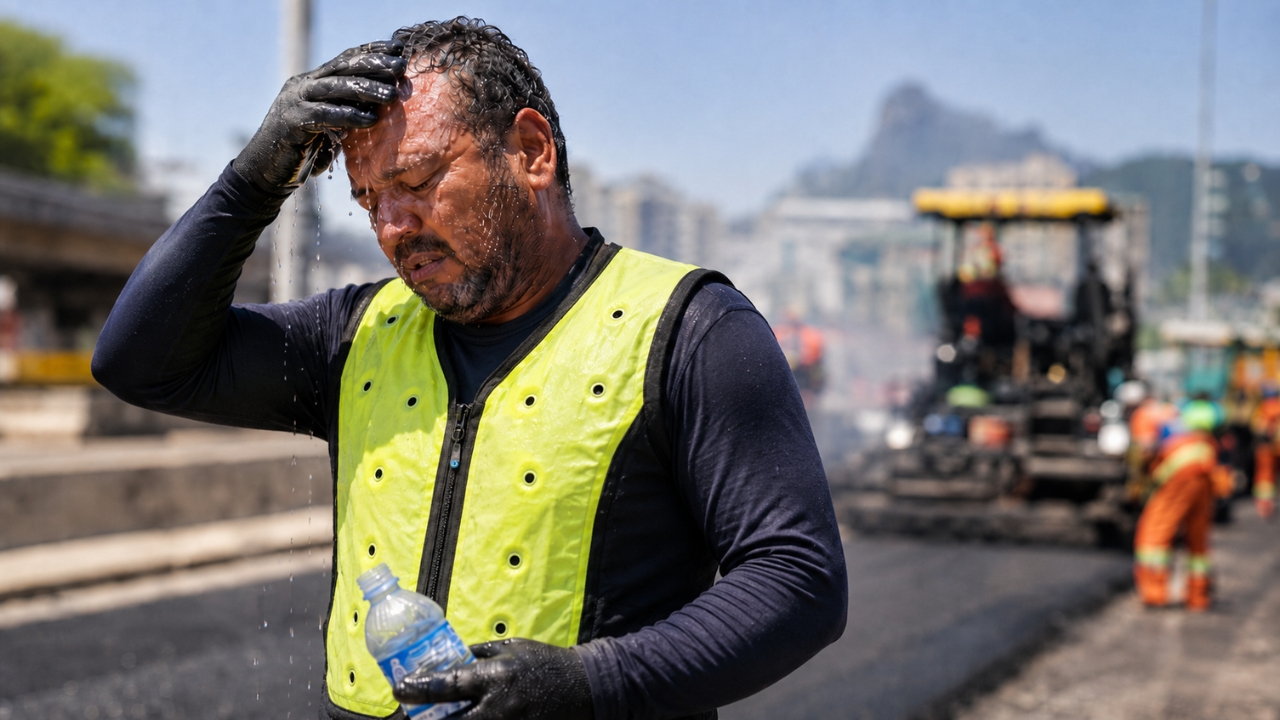

Heat sensation of 58°C in Rio, workers fainting on sites and companies ignoring the problem. Inuteq, a company that according to its own site positions itself as a world leader in personal cooling, developed a vest that, according to technical specifications released by the company, weighs between 650 and 800 grams when activated and maintains cooling for up to 8 consecutive hours
The heat on construction sites is not discomfort, it is a risk of death. While governments debate regulations and employers ignore complaints, a company from the Netherlands has developed a solution that can be worn, activated in a minute, and used for an entire work shift: the Inuteq evaporative cooling vest, now a global reference in thermal protection for workers.
The heat killing workers: the numbers Brazil cannot ignore

According to the Brazilian Trade Union Center (CSB), based on data from the International Labour Organization (ILO), more than 2.41 billion workers worldwide are exposed to the risk of excessive heat. The direct result is a silent tragedy: 22.9 million occupational injuries and almost 19,000 deaths per year across the globe.
The construction industry is at the center of this crisis. In 2023, according to a survey published by the Brazilian Trade Union Center (CSB), five construction workers died in just one week in Europe due to exposure to high temperatures. In Brazil, according to data from the National Association of Occupational Medicine (ANAMT), the construction industry is the second sector with the highest number of deaths from work accidents in the country.
-
What is the dark substance found in the sand of Ipanema Beach? Civil Police conduct an examination, collect samples of the material, and initiate an investigation to identify the composition, clarify the origin, and verify if there was an environmental crime.

-
The beer that was hidden for 3,000 years has returned to the world: scientists find yeast preserved in Ancient Egyptian vessels and recreate a pharaoh’s drink to discover the lost taste of an ancient civilization.
-
NASA spotted a giant “surfboard” crossing the Moon’s orbit at 11,500 km/h, and the truth behind the mysterious object required a 0.338 millisecond photo to be revealed.

-
Brazilian project based on nanotechnology transforms the recovery of degraded areas in the Amazon, receives international recognition, and uses research in 9 states to accelerate the growth of native species and increase carbon capture.




Complaints in Brazil have exploded, and companies still ignore them
According to data from the Public Ministry of Labor (MPT), formal complaints related to extreme heat in the workplace have increased almost fivefold between 2022 and 2024, rising from 154 to 741 complaints. In the first two months of 2025 alone, there were already 194 new reports.
Workers report exhaustion, loss of concentration, and fainting. Most companies have still not adopted any concrete measures to combat the effects of heat on construction sites, and the most common complaint remains the lack of fresh water and shaded areas.
The climate scenario worsens everything. The Alerta Rio system, as reported by the agency AFP, recorded a thermal sensation of 58.5°C in Rio de Janeiro during a recent heat wave, the highest index since measurements began in 2014. For those working exposed to the sun, this number is not a statistic, it’s a daily reality.
The solution that arrived from the Netherlands: wearable technology against heat
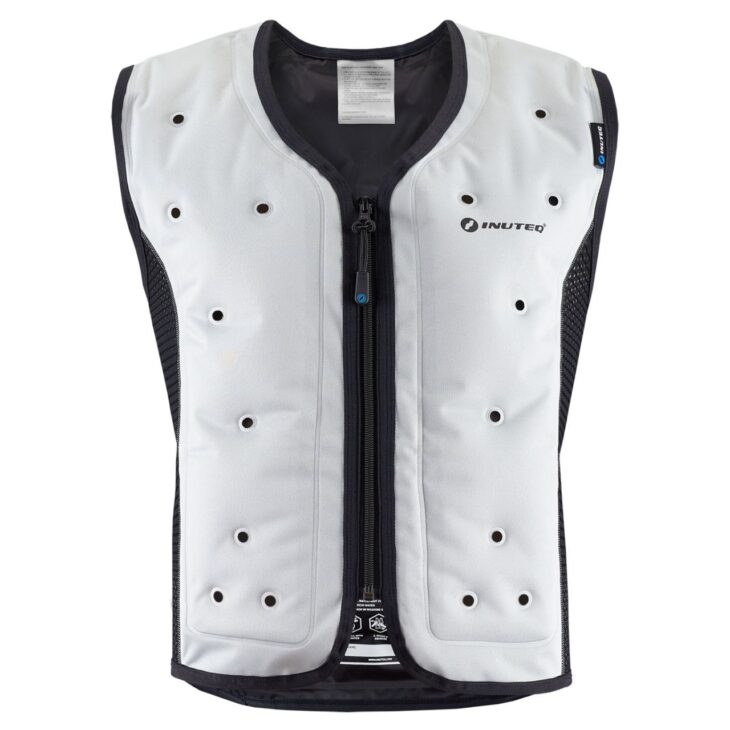
Inuteq, a Dutch company based in Deventer, Netherlands, is today, according to official information from the company itself, the world leader in the development of personal cooling solutions. The company manufactures vests, shirts, accessories, and helmets with different cooling technologies, used from construction to Formula 1.
The flagship for industrial environments is the INUTEQ-H2O® system. According to technical specifications released by Inuteq, the vest combines three layers of specialized fabric for water distribution, controlled evaporation, and total dryness in contact with the skin. The result, according to the company: reduction of up to 15°C in perceived temperature compared to the surrounding air, with the effect maintained for 2 to 8 consecutive hours depending on the temperature and humidity of the environment. Even when fully activated, the equipment weighs between 650 and 800 grams.
How it works in practice: one minute of activation for an entire shift
Activation is straightforward. The worker immerses the vest in water for up to 2 minutes, removes the excess, and wears it. The physical process of evaporation begins to draw heat from the body immediately, without the need for electricity, gel, or chemicals.
For environments with extreme exposure, the Bodycool 2BSafe line is certified by the ISO 20471 Class 2 and ANSI Class 2 standards, international safety standards for high-visibility workwear, according to Inuteq. Meanwhile, the Bodycool Smart-X model, which uses a different technology called INUTEQ-DRY®, extends the cooling effect for up to 3 consecutive days without reactivation, according to technical specifications released by the company itself, depending on the environmental weather conditions.


From the construction site to the F1 cockpit: the same technology in two extremes
The proof that the technology works in the most hostile environments on the planet came from Formula 1. In partnership with Adidas, as per the official statement from the sports brand, Inuteq developed the CLIMACOOL system for drivers like George Russell and Kimi Antonelli, whose cockpits reach 55 to 60°C during a race. According to laboratory tests released by Adidas, the set creates almost double the impact on body temperature compared to using just a conventional vest.
The same technology that protects elite drivers can protect the worker at the top of the slab at 1 PM, under direct sunlight, without shade and without excuses.