





 Portuguese
  English
  Spanish
  5 min of reading
  0 comments


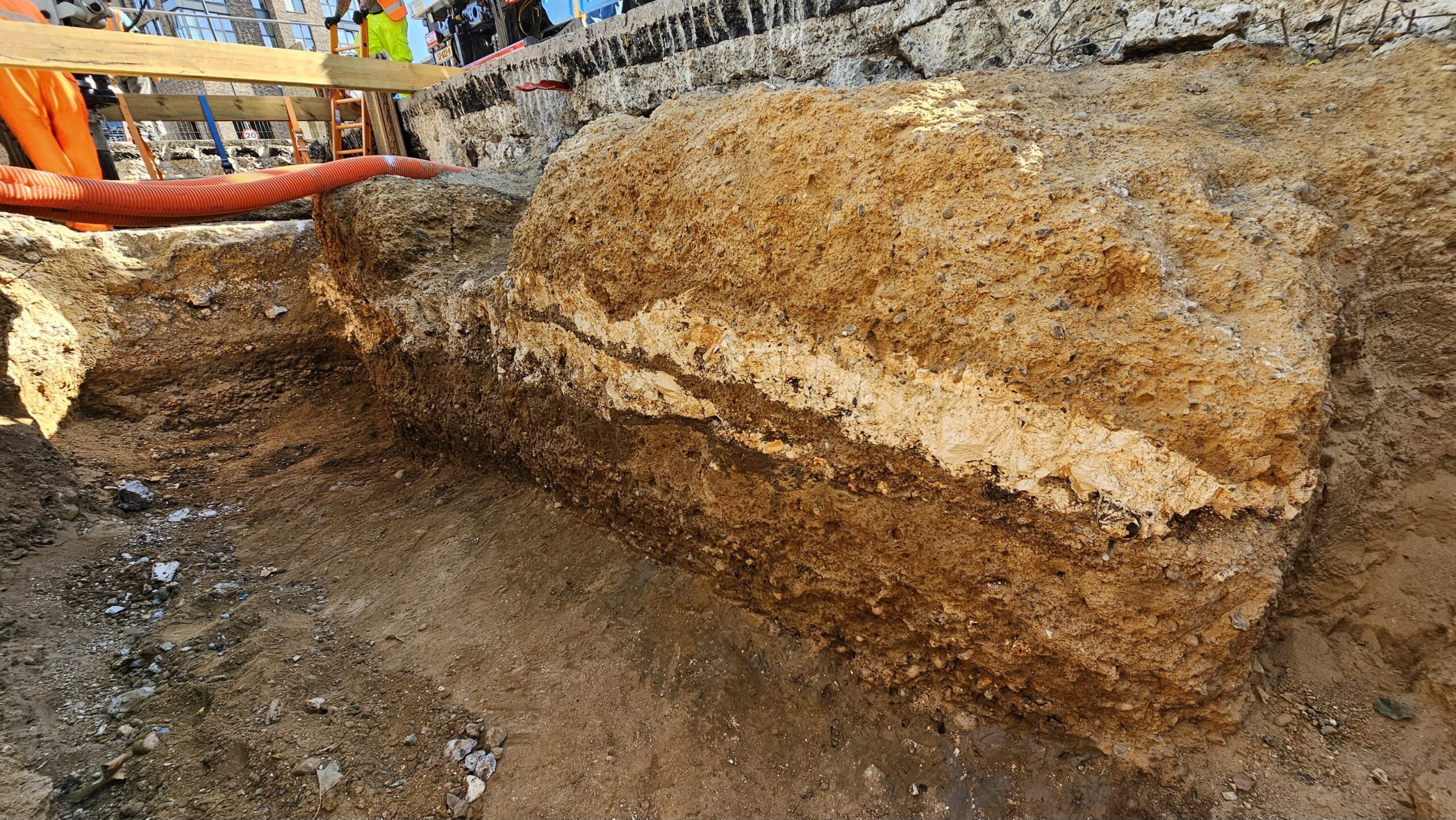
Works in London revealed a 2,000-year-old Roman road preserved under modern asphalt, confirming the historical route of the famous Watling Street.
In 2024, teams working on the expansion of Southwark’s low-carbon heating network under the busy Old Kent Road in London found an extraordinarily preserved section of the ancient Watling Street, one of the most important roads built by the Romans after the invasion of Britain in 43 AD. According to the Southwark Council, in a publication dated November 12, 2024, the section was identified by archaeologists from the MOLA, Museum of London Archaeology, in works linked to Veolia, the archaeological consultancy RPS, and the local council itself.
The find attracted attention because, although historians already knew that the ancient Roman route should pass through the region, there was a lack of physical evidence capable of precisely confirming its path under modern London. The discovery provided the first material proof that parts of the nearly 2,000-year-old Roman road survived directly under its current successor, with a preserved section of 5.8 meters wide by 1.4 meters high, formed by layers of compacted gravel, chalk, sand, and stone.
For decades, archaeologists knew the road should be there, but they couldn’t prove exactly where
Watling Street was built shortly after the Roman invasion of Britain, which began in 43 AD. The road connected the Roman port of Dubris, now Dover, to the city of Londinium, now London, and then continued towards the interior of England. It became one of the most important routes of Roman rule in the region.
-
Few people know this, but Nestlé created a campaign that paid R$ 162 to pet owners with pets named Nescau, Galak, Chokito, or KitKat, turning dog and cat names into advertising within the home.

-
Instead of just opening more shelters, Alagoas created a social rent of up to R$ 800.00 with an equipped house, bedding, and weekly support for those trying to leave the streets.
-
A Russian city that supplies Brazilian soy is being swallowed by the ground itself, provides 40% of the potassium chloride imported by Brazil, and has 390 km² of caves at a depth of 450 meters collapsing.

-
Remote worker builds a solar and electric boat of about 11 meters by himself using marine plywood, fiberglass, and eight solar panels on the roof to live freely sailing the Baltic Sea.



The Romans had a distinctive characteristic when building roads: they sought extremely straight routes. Therefore, archaeologists already had good estimates of the road’s course. Even so, the physical confirmation of the exact path under Old Kent Road remained a challenge for decades.


According to the specialists involved in the project, there were hypotheses based on previous studies, but there was a lack of direct archaeological evidence showing that the Roman road passed exactly under the modern road.
The discovery happened by chance during a project aimed at low-carbon energy
The curious thing is that the team was not looking for a Roman road. The excavations were part of a project by the Southwark Council and the company Veolia to expand a low-carbon urban heating network that should serve about 3,000 additional residences in the region.
During the work, archaeologists from the Museum of London Archaeology (MOLA) accompanied the excavations to record possible historical remains.
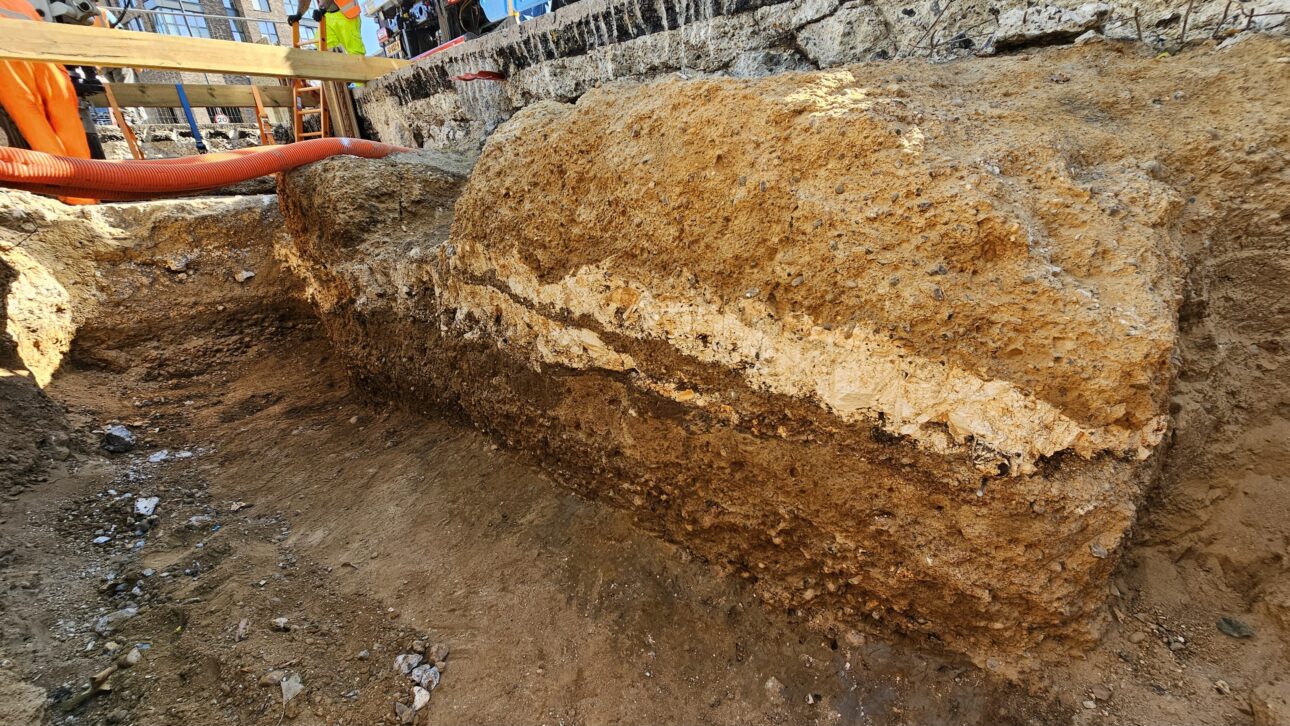
It was in this process that the ancient structure emerged. What initially might have seemed just a layer of stones turned out to be an impressively preserved section of the ancient Roman road. The quality of the preservation surprised even the specialists involved in the project.
The Roman road found is almost 6 meters wide and still preserves its construction layers
One of the reasons for the archaeologists’ enthusiasm is the state of conservation of the find. The discovered section measures approximately 5.8 meters wide and about 1.4 meters high, allowing a clear observation of the different layers used by Roman engineers during construction.

The researchers identified a solid base of compacted gravel, sealed by two layers of chalk. On top of these was another layer of compacted sand and gravel.
These structures allowed archaeologists to study details of the engineering techniques used approximately two millennia ago.
The most impressive thing is that the base of the modern road rests practically on the Roman structure, showing a physical continuity between two infrastructures separated by about twenty centuries.
The road connected London to the port of Dover and helped integrate Britain into the Roman Empire
The importance of Watling Street goes far beyond a simple road. After the Roman invasion, it became one of the main corridors for the movement of soldiers, merchants, messengers, and goods. The route connected London to the ports of the English Channel, allowing communication between Britain and the rest of the Roman Empire.
Through it passed military legions responsible for the Roman occupation, commercial caravans transporting products between cities, and travelers who covered hundreds of kilometers at a time when roads were strategic elements for territorial control.
This importance explains why Watling Street continued to influence British infrastructure even after the end of Roman rule.
The Roman road directly influenced modern highways in England
One of the most interesting discoveries related to Watling Street is that its legacy remains alive. Several modern highways follow routes very close to those defined by Roman engineers two thousand years ago. The Old Kent Road itself is part of this historical process of continuity.
Infrastructure experts often note that many modern roads take advantage of corridors established centuries or even millennia ago, because these routes had already been chosen considering geography, accessibility, and travel efficiency.
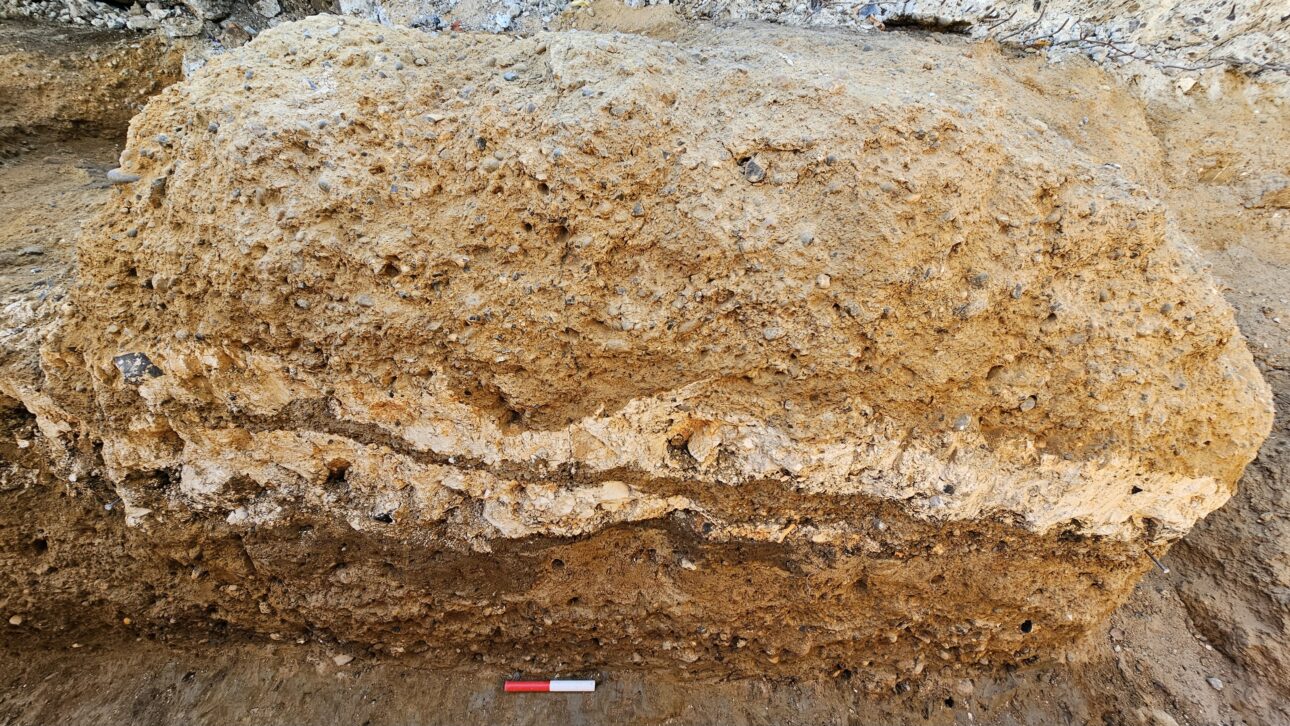
In the case of Watling Street, the discovery showed that the connection between past and present is even more direct than previously thought: in certain sections, the modern road is literally built on the ancient Roman road.
The preservation surprised archaeologists because the region has undergone centuries of construction and urbanization
Another aspect that drew attention was the fact that the road survived. Over the last few centuries, the region has received sewage networks, underground cables, tram lines, successive pavements, and numerous urban interventions. Even so, a significant part of the Roman structure remained intact.
Archaeologists highlighted that the survival of such a large section is considered remarkable precisely because the area has been constantly modified since the Middle Ages.
The discovery ended up offering a rare opportunity to study Roman construction techniques directly in a contemporary urban context.
The discovery helps to rewrite the archaeological map of London
According to the specialists involved, the find has scientific relevance because it redefines part of the understanding of the route of Watling Street in the Southwark area.
The identification of the road provides concrete data for future research on the Roman occupation of London and the urban evolution of the city over the centuries.
Furthermore, the discovery reinforces a fascinating characteristic of London: much of its history remains hidden beneath streets, buildings, and modern infrastructure systems.


Be the first to react!