






 Portuguese
  Spanish


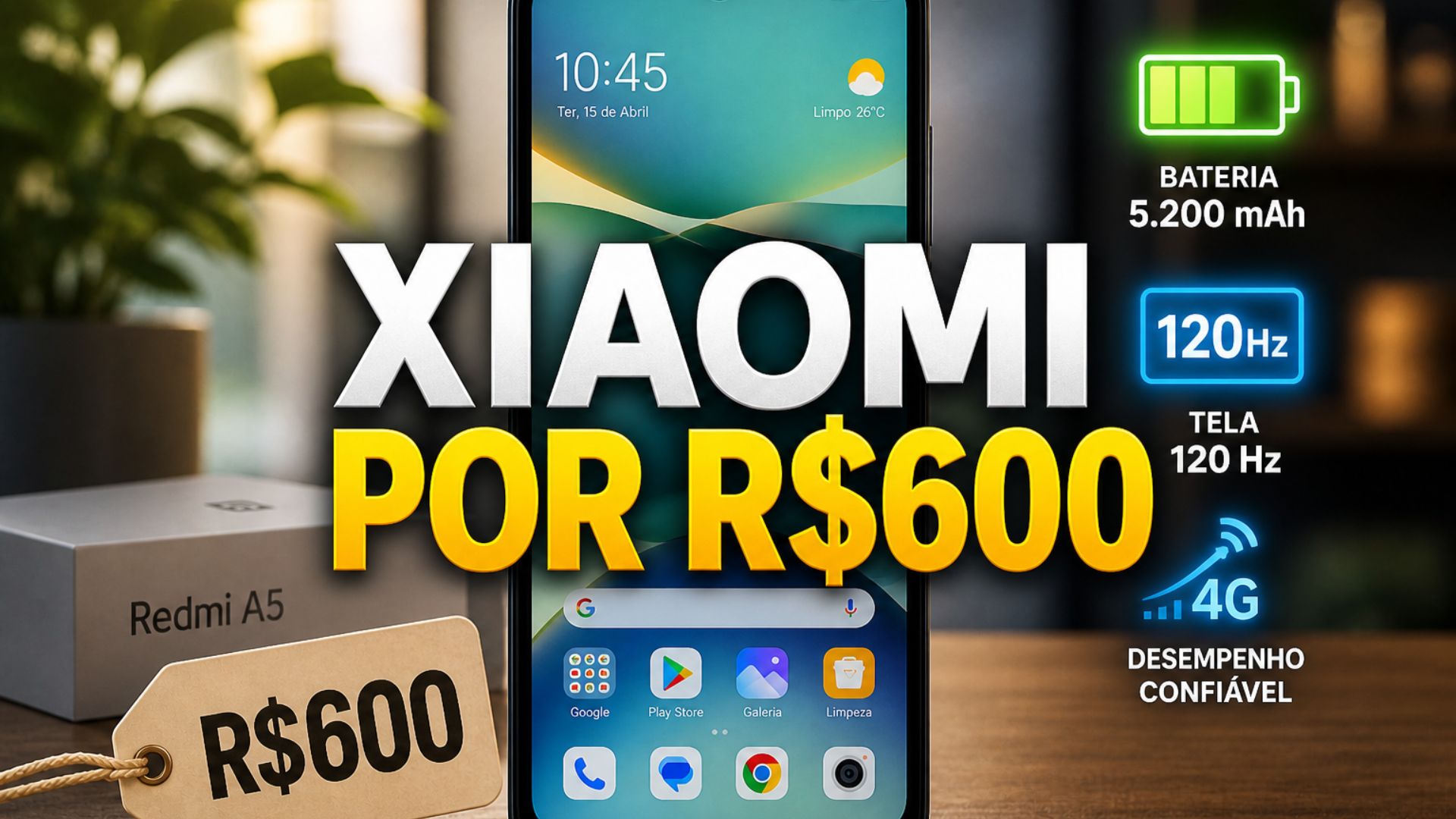

Presence among the world’s best-sellers reveals the strength of basic cell phones in emerging markets, driven by affordable price, long-lasting battery, and sufficient performance for daily tasks, even without 5G connectivity or a high-performance spec sheet.
The Redmi A5, Xiaomi’s entry-level phone, appeared in ninth position among the world’s best-selling smartphones in a Counterpoint Research survey published in April 2026, based on the Global Handset Model Sales Tracker from November 2025.
By achieving this result, the 4G model began to share space with more expensive devices from Apple and Samsung, demonstrating how basic devices still maintain relevance in markets where price remains a decisive factor in choice.
In Brazil, the device is found at online retailers for prices close to R$ 610, depending on the available version, the store responsible for the sale, and also the commercial conditions applied at the time of purchase.
-
Brazilian Researcher Develops Protein Supplement from Tilapia Waste, Combining Innovation and Sustainability with Economic Potential

-
Women in São Paulo Unknowingly Tracked by Coin-Sized Tags Hidden in Cars and Belongings, Raising Stalking Concerns
-
Near a $750 million AI data center in Brazil, a resident’s well runs dry, leaving her unable to afford the $25,000 needed for repairs.

-
16-Year-Old from Brazil’s Sertão Wins Young Scientist Award for AI Predicting Rainfall with 94.5% Accuracy to Aid Farmers


In this context, the combination of reduced price, a 5,200 mAh battery, a large 6.88-inch screen with up to 120 Hz refresh rate, and 4 GB of RAM helps sustain the growing interest in the model.
4G Cell Phones Still Dominate Emerging Markets
Although the advancement of 5G is constant in several regions, the Redmi A5’s presence in the global ranking shows that technological migration still occurs unevenly between countries and consumer profiles.

In many markets, especially in emerging regions, factors such as device cost and actual coverage availability end up being more decisive than access to the latest networks.
Counterpoint Research data indicates that the Redmi A5’s performance was primarily driven by sales in Latin America, the Middle East, and various countries on the African continent.
In these locations, entry-level cell phones remain relevant because they meet practical demands, including basic communication, use of light applications, social media, videos, and battery autonomy for long periods away from the charger.
Thus, the 4G limitation does not prevent the adoption of the device, as most users find this connectivity a sufficient experience for daily digital activities.
Furthermore, the continued presence of affordable models among the best-sellers also helps explain why lines like the Galaxy A frequently appear in global sales rankings.
5,200 mAh Battery and 120 Hz Screen Attract Attention
Even with a basic proposal, the Redmi A5’s technical specifications gather characteristics that stand out within its price range, especially when considering the priorities of the target audience for this type of device.
Among the main points, the 5,200 mAh battery stands out for offering extended autonomy, favored by the use of an HD+ screen and a processor focused on simple tasks, which contributes to more controlled energy consumption.
The 6.88-inch LCD screen features a resolution of 1,640 x 720 pixels and a refresh rate of up to 120 Hz, a feature that improves fluidity during navigation in compatible applications and system interfaces.
Despite not featuring AMOLED technology, present in more expensive models, the visual experience gains in smoothness during scrolling and transitions, which directly impacts the user’s perception of performance.
Responsible for the device’s operation, the Unisoc T7250 is an octa-core chip manufactured on a 12-nanometer process, with a maximum frequency of 1.8 GHz and a clear focus on efficiency for daily activities.

For this reason, its performance handles tasks such as messaging, calls, browsing, using maps, and playing videos, but it was not designed for demanding games or more complex applications.
In terms of connections, the Redmi A5 includes 4G support, dual-band Wi-Fi, Bluetooth 5.2, a headphone jack, and simultaneous use of two SIM cards with microSD card expansion.
Who is the Redmi A5 for?
Within its proposition, the Redmi A5 primarily serves users looking for an affordable phone for essential daily tasks, without requiring high performance in multitasking or graphic processing.
Profiles such as students, seniors, professionals who need a second device, or consumers with more basic usage will find a functional alternative in this model within a more restricted budget.
Still, some limitations should be considered, especially regarding performance in more demanding scenarios or with multiple applications open simultaneously.
The version with 4 GB of RAM and 128 GB of storage may show slowdowns in certain situations, while the use of eMMC 5.1 memory indicates slower speed compared to more recent standards.
Running Android 15 Go Edition, the device adopts an optimized version of the system, designed precisely for devices with more modest resources and lower processing capacity.
This choice reinforces the model’s proposition but also limits its use to simpler activities, without directly competing with mid-range or premium smartphones.
Simple camera for everyday use


Following the same line as the rest of the technical specifications, the Redmi A5’s camera setup was designed to handle basic captures without focusing on advanced photography or more elaborate content production.
On the rear, the device features a 32 MP main sensor accompanied by an auxiliary lens, while the 8 MP front camera is aimed at selfies and video calls.
Both sensors allow recording in Full HD resolution, limited to 30 frames per second, which meets common needs without offering advanced stabilization or processing features.
In good lighting conditions, performance tends to be sufficient for casual captures and sharing on social media, maintaining consistency with the device’s proposition.
Low price boosts Redmi A5 sales
Among all factors analyzed, the price remains the main competitive differential of the Redmi A5, especially when compared to models with more advanced specifications and significantly higher values.
Offers in Brazilian retail indicate prices close to R$ 610 for entry-level versions, although the price may vary according to the seller, availability, and commercial conditions adopted.
Meanwhile, Xiaomi’s official store presents the model with a higher reference price, which highlights the difference between suggested values and those practiced in marketplaces.
Consumer reviews on sales platforms often highlight points such as battery life, cost-benefit, and suitability for basic use, while also pointing out predictable limitations in performance and image quality.
Redmi A5 Technical Specifications
The Redmi A5 features a 6.88-inch LCD screen, HD+ resolution of 1,640 x 720 pixels, a refresh rate of up to 120 Hz, and typical brightness of 450 nits.
Its dimensions are 171.7 x 77.8 x 8.26 mm, with a total weight of 193 grams, maintaining a common standard among large-screen devices.
Equipped with the Unisoc T7250 processor, the model uses 12 nm architecture and reaches a frequency of up to 1.8 GHz, prioritizing energy efficiency in basic tasks.
Configurations include 3 GB or 4 GB of RAM memory options, with 64 GB or 128 GB of storage, in addition to support for expansion via microSD card.
In terms of cameras, the device features a 32 MP rear sensor with an auxiliary lens and an 8 MP front camera, both capable of recording videos in Full HD resolution.
The 5,200 mAh battery supports 15 W charging via USB-C, while the adopted operating system is Android 15 Go Edition.
The model does not support 5G or NFC in global versions, maintaining a focus on accessibility and reduced cost for emerging markets.
Colors include options such as blue, green, gold, and black, varying according to the nomenclature adopted in the Brazilian market.


