Portuguese
  Spanish


During an oil exploration survey, the oil company discovers a shipwreck in the Gulf of Mexico: Shell’s sonar detected, more than 1,300 meters deep, a 19th-century shipwreck forgotten at the bottom of the sea, later revealed in detail by a submarine robot.
The scene is something out of a movie. One of the world’s largest oil companies sweeps the ocean floor with sonar in search of oil and gas, and what appears on the screen is not a deposit, but the unmistakable outline of a ship’s hull that sank about 200 years ago. This is exactly what happened when the oil company discovers a shipwreck in the Gulf of Mexico during the mapping of its own concession area, more than 1,300 meters below the surface.
The story was detailed by Maritime Executive and by American federal agencies. The strange target on the sea floor appeared in 2011, during a Shell oil exploration survey off the coast of Texas. What no one imagined was that this point on the sonar held a 19th-century shipwreck with a copper-lined hull, cannons, and even navigation instruments, stopped and almost untouched in the icy darkness of the deep ocean.
A strange target on Shell’s sonar
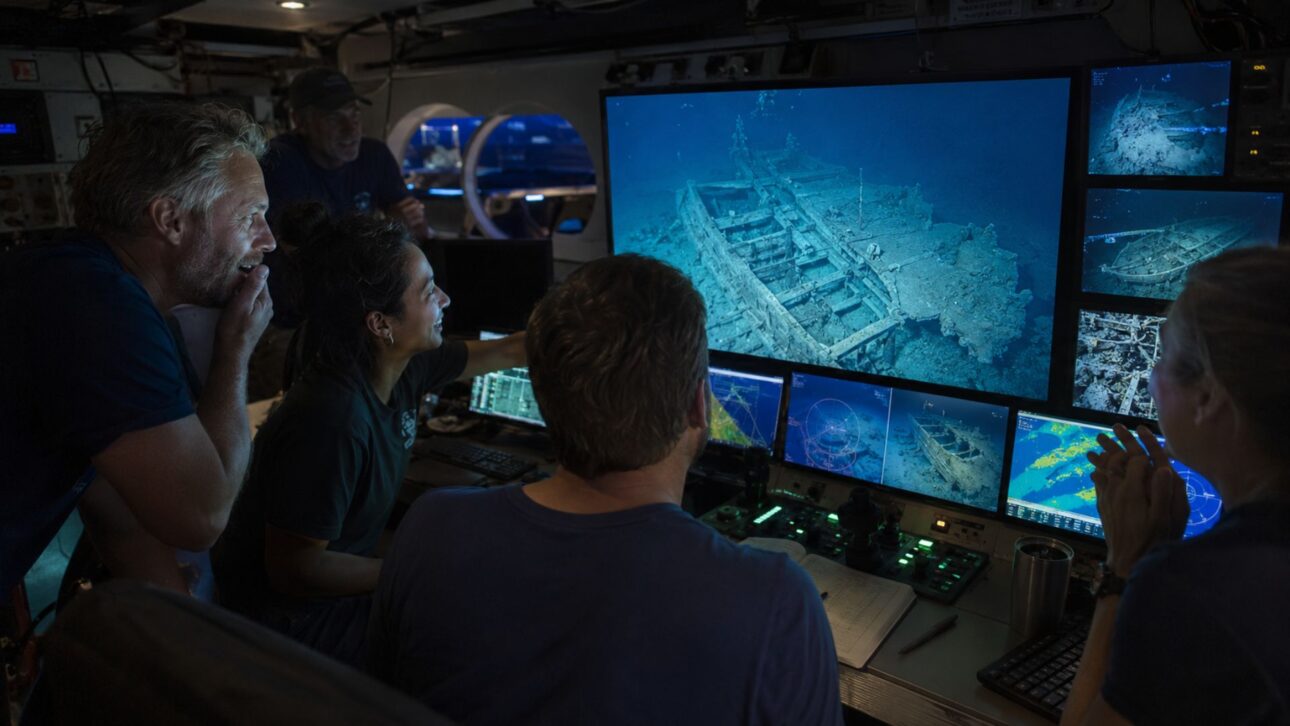
Before installing any structure on the seabed, companies map the terrain with side-scan sonar to see obstacles, relief, and risks. In 2011, it was during one of these oil exploration sweeps that Shell saw a shape emerge that did not match the flat bottom around it.
-
At 17, she hand-painted her first watercolor design for school uniforms; her brand grew without investors, sold 135,000 pieces, and aims for $3 million in revenue by 2026.

-
Brazilian Entrepreneur Turns Door-to-Door Jewelry Sales into a Family Business Empire with Over 70 Stores

-
$75 Million Bridge in Brazil Opens to Connect Cities, Create Jobs, and Cut Travel Time from 30 to 2 Minutes; Spanning 1.24 km, It’s Among the Country’s Largest and Ends Decades of Ferry Queues.
-
Brazilian Farmer Builds 8-Ton Tractor from Army Truck Engine, Plants Over 100 Hectares of Soybeans




The outline was too sharp to be natural. The sonar image showed a hull about 25 meters long and almost 8 meters wide, with the typical shape of a vessel. Faced with such a target, the company did what the law requires: it notified the authorities. Shell reported the find to the Bureau of Ocean Energy Management, the BOEM, and the United States offshore regulatory agency.
Here lies the detail that makes the case special. When an oil company discovers a shipwreck in the Gulf of Mexico within its own concession, it cannot simply continue drilling. The site enters a queue for scientific investigation, and that’s how an anonymous point on the sonar became one of the most talked-about underwater archaeological finds in the region.
The paradox: the oil company found history within the oil area
There is a delightful irony in this story. The same technology created to find fossil fuel on the seabed ended up unearthing a piece of navigation history. The search for future energy stumbled upon a shipwreck from the past, in the same piece of ocean. It’s the kind of coincidence that only oil exploration in deep waters can produce.
It makes sense when you understand how the industry operates. Oil companies see the seabed with a level of detail that few have, because they depend on it to work. The sonar that looks for promising geological structures also records any anomaly, and a 25-meter ship hull is quite an anomaly. Therefore, when an oil company discovers a shipwreck in the Gulf of Mexico, the credit, unintentionally, goes to the oil engineering itself.
The result is that Shell, without any archaeological intention, became responsible for revealing a 19th-century shipwreck that might have remained hidden forever. No ordinary diver reaches that depth, and no historical expedition had reason to sweep that particular point. It took oil exploration passing through there for the sea to reveal the secret.
1,300 meters deep and a green copper hull
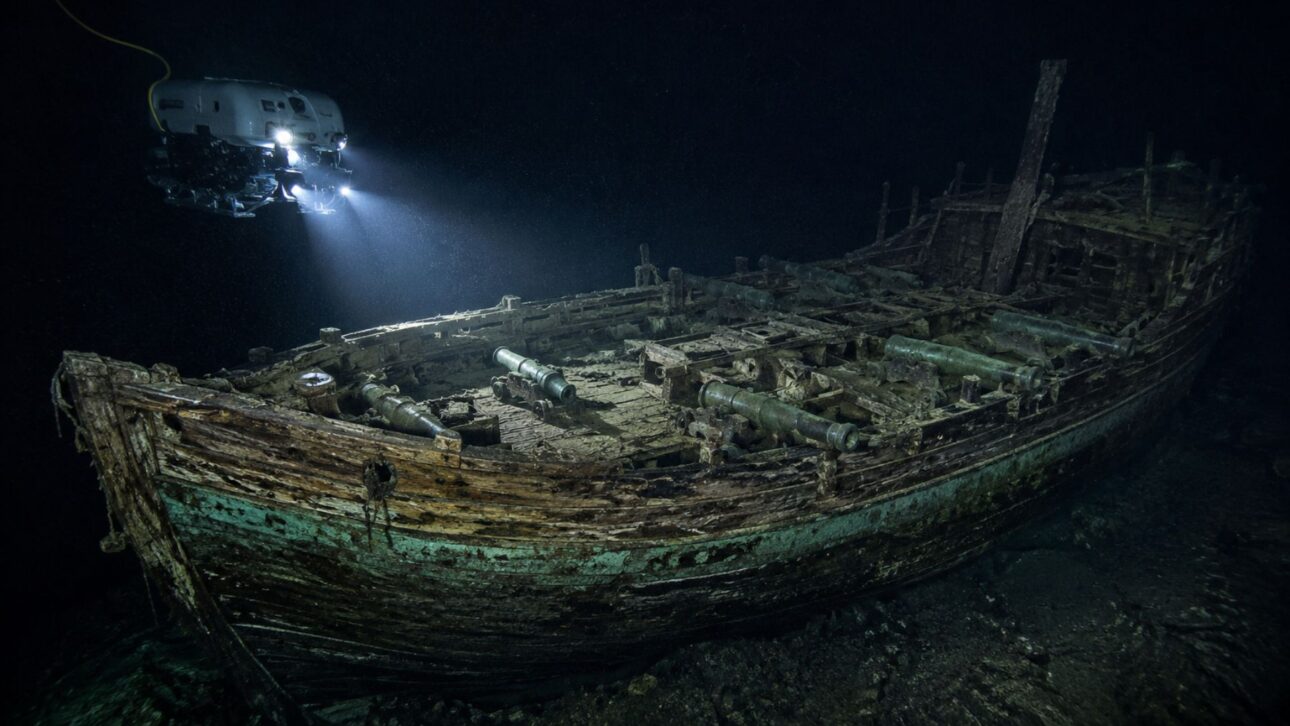
The shipwreck is about 1,330 meters, or 4,363 feet, below the surface, in an environment of total darkness, constant cold, and crushing pressure. It is precisely this extreme environment that preserved the site for two centuries. Down there, far from the waves and light, time passes differently.
From the original wooden structure, little remains, but what is left tells the story. The hull was lined with copper below the waterline, a technique used at the time to protect the wood from organisms that bore into the vessel. Over time, the copper oxidized and gained that greenish color, forming a kind of shell that maintained the ship’s outline even after much of the wood disappeared. It’s like a ghost mold of the original ship resting on the seabed.
This green hull is the calling card of the 19th-century shipwreck. The presence of the copper lining, along with the objects scattered around, helped researchers estimate the age of the vessel. Everything points to a ship from the first half of the 19th century, making it a time capsule from an era when the Gulf of Mexico was bustling with trade routes and disputes.
What the submarine robot found in the dark
Finding the shipwreck was just the beginning. To investigate it, science came into play. In April 2012, the research vessel Okeanos Explorer, from the American agency NOAA, conducted the first detailed exploration of the site, named Monterrey Shipwreck. The tool of the moment was a submarine robot, the remotely operated vehicle Little Hercules, capable of descending where no human can safely reach.
What the submarine robot revealed impressed the specialists. Scattered around the site were an anchor, several cannons, muskets, glass bottles, ceramic plates, and navigation instruments, all preserved by the depth. According to BOEM, each object helps to piece together the portrait of life on board and maritime activity in the Gulf of Mexico two centuries ago.
The high-definition images sent by the submarine robot allowed the study of the 19th-century shipwreck without touching or damaging the site. The technology that the oil industry uses to inspect pipelines and platforms is the same that underwater archaeology uses to visit shipwrecks. Again, the seabed showed that the tools of oil and history are closer than they seem.
A 19th-century shipwreck full of mysteries
Despite all the study, the ship holds secrets. It is not certain what the name of the vessel was, where it came from, or where it was going when it sank. The evidence suggests a 19th-century shipwreck linked to the busy trade routes and possibly the tensions and piracy that marked the Gulf of Mexico during that period.
The mystery grew even larger afterward. In subsequent expeditions, researchers discovered that the Monterrey was not alone: there were two other shipwrecks nearby, in the same stretch of the seafloor. The proximity raised the hypothesis that the vessels might have sunk together, in the same event, perhaps a storm or a battle. A 19th-century shipwreck turned into three, and the enigma multiplied.
This is the part that keeps the case alive. Each artifact brought to the surface by the underwater robot is a clue, but none complete the whole picture. The 19th-century shipwreck discovered by chance by Shell continues to be studied, and it may never provide all the answers about who those people were and what they were doing so far from the coast.
Why an oil company becomes an archaeologist unintentionally
The Monterrey case is not a strange exception; it is almost a silent rule of the industry. Every time an oil company discovers a shipwreck in the Gulf of Mexico, it adds to a list that grows as oil exploration advances into increasingly deeper waters. The Gulf, a stage for centuries of navigation, is a ship graveyard scattered across the seafloor.
There is even a legal mechanism behind this. In the United States, companies operating on the seabed are required to report any possible archaeological site they encounter, and BOEM maintains records of these targets. It was this requirement that turned a oil exploration find into a federal scientific project, with a NOAA expedition and underwater robot dives.
The result is an unlikely partnership between oil and history. The industry that many people associate only with environmental impact ends up, in these cases, indirectly funding the discovery of submerged heritage. When an oil company discovers a shipwreck in the Gulf of Mexico, science gains a site it would never reach on its own, and the public gains a fascinating story.
From the Gulf to Brazil: the seafloor holds more than oil
What happened in the Gulf of Mexico directly interests a country like Brazil, which has much of its wealth in the sea. Brazilian oil exploration, especially in the pre-salt layer, depends on the same type of meticulous mapping of the seafloor that revealed the Monterrey. Where there is high-resolution sonar scanning the seabed, there is a chance for the past to appear.
The lesson is that the deep ocean is an archive, not a void. Beneath the water’s surface that hides energy reserves lie shipwrecks, ruins, and stories that humanity doesn’t even know it has lost. An intact 19th-century shipwreck at 1,300 meters depth proves that the seafloor is still one of the planet’s least explored frontiers.
That’s why stories like this stick. They unite the most modern, the submarine robot and the cutting-edge sonar, with the oldest, a 200-year-old wooden and copper hull. And they show that sometimes, while searching for the fuel of the future, we accidentally stumble upon treasures of the past.
When the search for oil meets time standing still
In the end, the story of when an oil company discovers a shipwreck in the Gulf of Mexico is more than just a shipwreck. It’s a reminder that all technology has uses its creators did not foresee, and that the seabed continues to surprise those who dare to look closely at it. Shell went in search of oil and found a frozen piece of navigation history.
The Monterrey Shipwreck remains down there, with its green hull and silent cannons, now much less secret than it was. Thanks to a strange target on the sonar and a brave submarine robot, a 19th-century shipwreck has once again become part of our history, without ever having left its place.
And you, did you imagine that an oil giant could be responsible for finding a 200-year-old shipwreck at the seabed? Do you think that oil exploration should have more obligations to reveal and protect these submerged treasures it finds along the way? Tell us in the comments what impresses you most about this discovery.