






 Portuguese
  Spanish


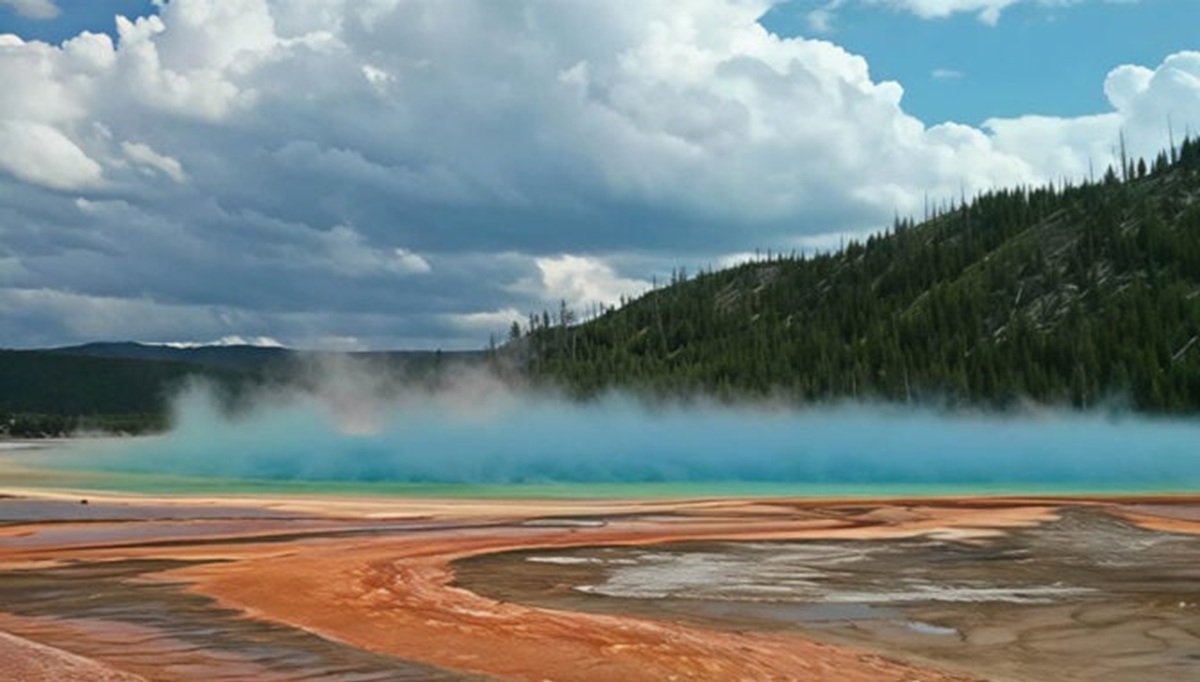


The magmatic system of Yellowstone proves to be much more sophisticated than a simple hotspot in the Earth’s mantle. The connection between the sinking of oceanic plates and continental volcanic activity offers a new perspective on the deep processes that shape the surface of our planet and sustain one of the largest volcanoes on Earth.
Scientists have identified a surprising origin for the heat that fuels the Yellowstone supervolcano, challenging traditional geological theories about the region.
According to new research, the magma reservoir of the park is not sustained solely by a vertical and deep mantle plume, but rather by an unexpected energy source linked to the subduction of oceanic plates beneath the North American continent. This discovery alters the understanding of how the volcanic system remains active and how it may evolve over geological eras.
The influence of the Farallon Plate on the magmatic system
A detailed analysis of the underground structure revealed that remnants of the ancient Farallon Plate, which sank beneath the west coast of the United States millions of years ago, play a crucial role.
-
Scientists warn that melting ice is triggering an alarming chemical transformation in preserved areas, and the first signs are already concerning researchers worldwide.

-
China placed 198 robotic legs under a 7,600-ton school and made the building walk 62 meters in 18 days, rotating the historic structure as if a concrete structure had gained feet to escape demolition.

-
Distributor confirms the premiere of ‘Dark Horse’, Bolsonaro’s film, in 650 cinemas with 99% of copies dubbed.
-
9-year-old boy who could only hold a plank for 6 minutes in physical education class trained alone for 6 months, without needing encouragement from his parents, until he broke the world children’s record with 61 minutes and 5 seconds.


Instead of a direct rise of hot material from the Earth’s core, the Yellowstone supervolcano receives heat through a complex dynamic where this fragmented oceanic plate disrupts the flow of the mantle. This process creates convection currents that channel hot magma to the surface, keeping the magma chamber beneath the national park in a state of geological alert.
The interaction between the descending plate and the surrounding mantle generates thermal instability that pushes the molten material upward. This mechanics explains why the center of thermal activity has shifted across the northwest United States over time, leaving a trail of ancient calderas. The study suggests that, without this specific tectonic interference, the Yellowstone supervolcano might not have the thermal intensity that characterizes it today, transforming the perception of how the system is “fed.”
Advances in seismic modeling and subsurface visualization
To reach these conclusions, geologists used advanced seismic tomography techniques, functioning similarly to an ultrasound examination of the interior of the planet.
The shock waves from distant earthquakes have allowed mapping of the variations in density and temperature beneath the crust, revealing the exact position of fragments of oceanic plates. This data confirmed that the heat from the Yellowstone supervolcano is intrinsically linked to these deep geological debris, which act as a catalyst for the melting of rocks.
Computational modeling has allowed the simulation of mantle movement over eighteen million years, replicating the exact trajectory of the Yellowstone hot spot. The results showed that the heat flow is not just a static column, but a dynamic current influenced by the underground tectonic architecture.
This new insight into the Yellowstone supervolcano provides scientists with a more precise tool to monitor internal pressure and fluid movement beneath the park’s surface.
Implications for monitoring and geological risks
Although the discovery of a new energy source is significant, researchers emphasize that this does not indicate an imminent eruption or a sudden increase in danger. The Yellowstone supervolcano system operates on time scales of hundreds of thousands of years, and constant monitoring has not detected any anomalous changes in recent activity.
Knowledge about the thermal source, however, allows long-term predictions about the behavior of the caldera to be more grounded in actual physical data.
Understanding that Yellowstone volcanism is driven by a combination of mantle plumes and subducted plate interactions may help explain other continental volcanic systems around the world.
The study redefines the Yellowstone supervolcano as a natural laboratory to study how recycled oceanic crust can dictate volcanic activity at the heart of a continent. The findings continue to be analyzed to refine risk maps and theories about the evolution of North America.
With information from Gizmodo


