






 Portuguese
  Spanish
  4 min of reading
  0 comments


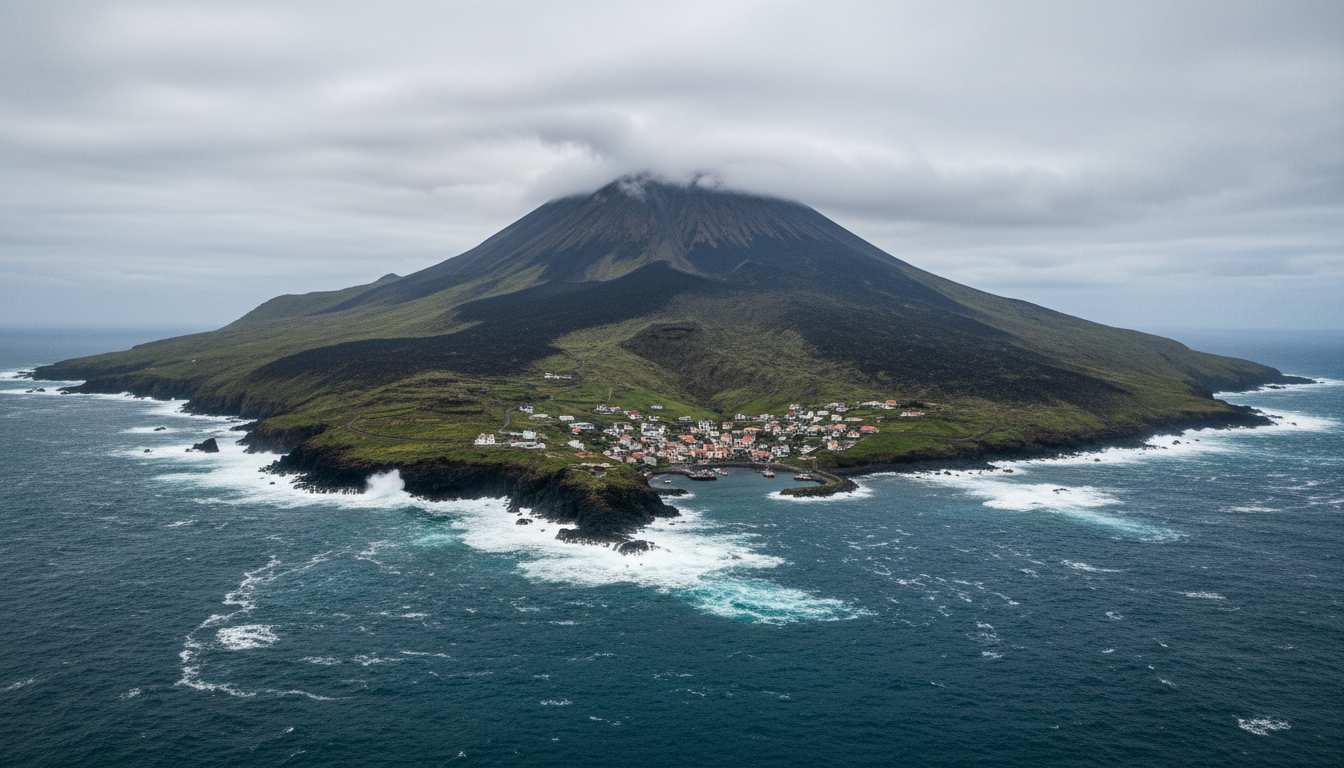
Tristan da Cunha is almost 3,000 kilometers from any continent and is home to the most isolated community on the planet with only 275 residents
In the middle of the South Atlantic Ocean, over 2,800 kilometers from the nearest coast, there is a volcanic island where 275 people live almost completely disconnected from the rest of the world.
Tristan da Cunha is officially the most remote inhabited territory on the planet, according to geographical records and international organizations.
The island is 2,816 kilometers from South Africa and 3,360 kilometers from South America.
-
Bali transformed volcanoes into a sacred system with 5 rice terraces, water temples, and 19,500 hectares, but the ancient engineering that supports farmers now faces tourism, construction, and the risk of losing its living landscape on the volcanic island.

-
Two young inventors create a terracotta brick that uses water, air, and solar energy to cool cities, and the idea points to buildings that stop worsening urban heat.

-
Without power for millions, Madagascar receives a proposal for a floating hydroelectric plant inspired by the baobab that promises clean energy, greenhouses, and tourism, but still needs to be realized.
-
China has a giant rice terrace carved over 1,300 years in the mountains, with up to 3,000 terraces, 82 villages, and 445 km of canals, but the ancestral work that overcame droughts now faces growing tourism, landslides, and rural abandonment.


There is no airport. The only way to get there is by boat, on a journey that takes at least seven days.
Anyone wishing to visit must request special permission from the island’s administration at least 40 days in advance.
Seven surnames for 80 families: how Tristan da Cunha became one of the most endogamous communities in the world
One of the most surprising curiosities of the island is that the entire population shares only seven surnames.
Glass, Green, Hagan, Lavarello, Repetto, Rogers, and Swain are the only existing family records.
The approximately 80 families living there descend from a very small group of original settlers.
The extreme isolation over centuries has created one of the most genetically homogeneous communities in the world.
The residents live in the village of Edinburgh of the Seven Seas, located in the northwest part of the island.
The name has already caused confusion: mail intended for the village has ended up in Edinburgh, Scotland.

Tristan da Cunha is a volcanic island with a peak of 2,062 meters that has forced the evacuation of all residents to England
The island has a diameter of 13 kilometers and is dominated by Queen Mary’s Peak, an active volcano standing 2,062 meters high.
In the 1960s, an eruption forced the complete evacuation of the population to England.
After months living in the United Kingdom, most residents chose to return to the island, preferring isolation to urban life.
The archipelago that bears the name of the main island consists of six islands: Tristan da Cunha, Gough, Nightingale, Inaccessible, Middle Island, and Stoltenhoff.
Of these, only Tristan da Cunha is inhabited.
- Location: South Atlantic, 2,816 km from South Africa
- Population: 275 people, ~80 families
- Surnames: only 7 (Glass, Green, Hagan, Lavarello, Repetto, Rogers, Swain)
- Diameter: 13 km
- Peak: Queen Mary’s Peak, 2,062 m (active volcano)
- Access: only by boat, 7+ days
- Status: British Overseas Territory (since 1816)
No credit cards and no supermarket: the economy of Tristan da Cunha operates with lobsters, potatoes, and cash pounds
The economic life in Tristan da Cunha is as different as its geography.
The residents primarily live off lobster fishing and potato cultivation.
Community food exchanges supplement daily sustenance.
Debit and credit cards are not accepted in any establishment on the island.
Visitors need to bring cash pounds, although some places also accept dollars, euros, and South African rand.
Boat tickets cost approximately $1,000 for a round trip.
In addition to money, it is necessary to present a return ticket, health insurance, and proof of sufficient resources.

Discovered by Portuguese and annexed by the British: the history of Tristan da Cunha since the 19th century
The name of the island comes from Portuguese navigators who discovered it during the great maritime expeditions.
Despite the Lusitanian origin of the name, the island was annexed by the British in 1816.
Since then, it has remained a British Overseas Territory.
The administration of the island operates semi-autonomously, with its own rules that include the requirement of prior authorization for any visitor.
On stormy days, Tristan da Cunha becomes completely inaccessible — neither boats nor communication work normally.
Like other places that defy geographical logic, such as the submerged city in the hinterlands of Pernambuco, Tristan da Cunha shows that there are human communities in corners of the planet that seem impossible.

The question everyone asks: why do 275 people choose to live in the most isolated place on Earth?
When the residents were evacuated to England in the 1960s, most could have stayed.
They had access to hospitals, schools, commerce, and all the conveniences of modern life.
Still, they chose to return to the volcanic island without an airport, without fast internet, and without credit cards.
For those who live there, isolation is not a limitation — it is a choice.
The community is close-knit, crime is virtually non-existent, and the pace of life follows the natural cycle of the seasons and fishing.
Viagem e Turismo details how to get there and what to expect, while National Geographic presents seven curious facts about the destination.
In the end, Tristan da Cunha reminds us that, in a hyper-connected world, there are still 275 people who prefer to live 7 days away from everything.


Be the first to react!