






 Portuguese
  Spanish


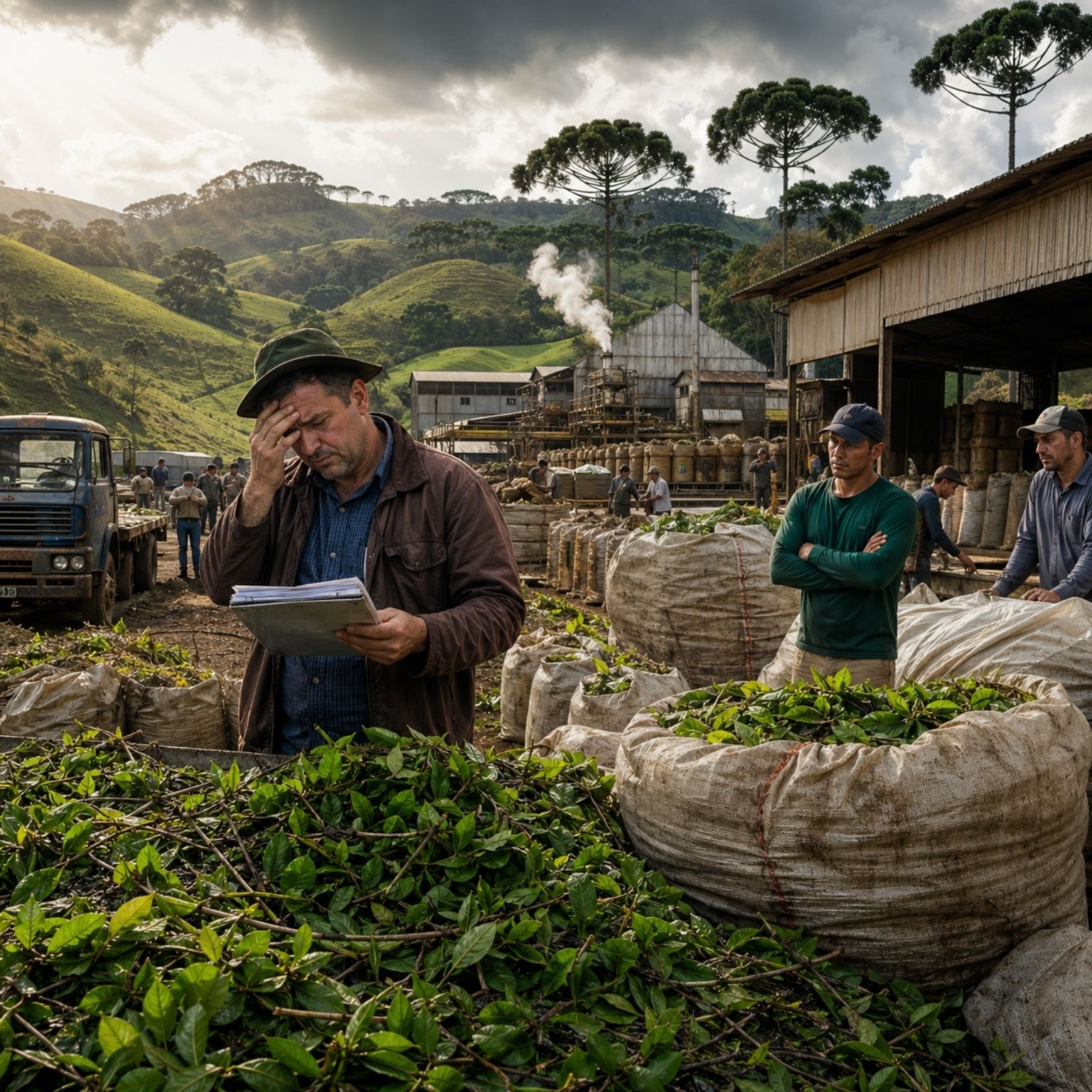

Planalto Norte Yerba Mate on alert with super harvest, industries under pressure, and labor shortage, expanding the crisis throughout the regional chain.
Yerba mate is experiencing a period of strong pressure in the Planalto Norte of Santa Catarina, a region traditionally recognized as one of the country’s largest producers. The expansion of cultivation, high productivity, and the difficulty of distributing production to the domestic market and for export have plunged the sector into a crisis that already affects rural producers, industries, and the functioning of the entire chain.
The scenario is striking because the region shifted from a period where it gained market share due to drought in other producing areas to an opposite reality, marked by oversupply. Now, with a super harvest in the four Brazilian states mentioned in the report, in addition to Paraguay and Argentina, yerba mate is abundant in several markets simultaneously, driving down competitiveness and amplifying the burden of old problems, such as the lack of skilled workers.
What’s Behind the Yerba Mate Crisis in Planalto Norte

The current crisis is directly linked to the expansion of cultivation. According to the report, many rural producers have increasingly opted for yerba mate, setting aside other activities such as dairy cattle, sheep, chickens, and other crops. The result has been a sharp increase in production at a time when the market can no longer absorb everything that is being harvested.
-
After Two Years of Water Scarcity, Brazilian Farmer Finds Well on Her Land, Boosting Mango and Passion Fruit Production in Central Brazil

-
Cashew Becomes Billion-Dollar ‘Superfood’ in Ivory Coast: 1.6 Million Hectares of Monoculture Encroach on Forests as Families Trade Food for Nuts

-
In Rural Brazil, José Sirval Operates a Water-Powered Mill Grinding 125 Kilograms of Corn Daily Using His Great-Grandfather’s Century-Old Monjolo
-
From Market Stall to Agribusiness: Patagonian Fruit Grower Owns 550 Hectares and Processes 18 Million Kilos of Pears and Apples Annually, Exporting Directly to Brazil


This movement has shifted the balance of the chain. Yerba mate, which previously gained more space due to climatic difficulties in other regions, now competes in a scenario of abundance. What was once an advantage for Planalto Norte has turned into oversupply, with a direct impact on prices, commercialization, and industry margins.
Why the Super Harvest in Brazil, Paraguay, and Argentina Worsened the Problem
The report makes it clear that the current crisis does not originate solely within Santa Catarina. The problem is growing because there was overproduction in different areas simultaneously. With high harvests in Brazil, Paraguay, and Argentina, yerba mate became abundant in several markets, reducing room for distribution and weakening the sector’s ability to react.
This point is decisive because, in previous years, drought in other producing regions paved the way for Planalto Norte to have greater consumption in the domestic market and stronger export power. Now the opposite has happened. Since there was no shortage of product from competitors, the Santa Catarina region lost some of that advantage and became more exposed to price competition.
What Changes in Practice for Industries and Producers
On the industrial side, the yerba mate crisis manifests as difficulty in competing. According to the report, large industries cannot reduce shelf prices at the same rate as smaller players can package cheaper raw materials and place the product on the market at lower values.
This directly affects the traditional yerba mate market. Larger industries face commercial pressure, lose competitiveness, and confront a tougher environment to sustain operations, margins, and market presence. For producers, the effect is also significant, as overproduction does not find sufficient outlet and compromises the value of what was planted.
Cheaper Competition Pressuring the Domestic Market

Another important factor mentioned in the report is the entry of lower-cost yerba mate from Argentina for processing by Brazilian yerba mate companies. This cheaper product further weakens the domestic market for large industries, which are already operating in an environment of oversupply and strong commercial pressure.
In practice, this amplifies the feeling of crisis because the problem is no longer just about producing too much. The sector also starts to face external competition with more aggressive pricing, which hinders the reaction of local companies and alters the dynamic of value formation in a historical chain in the South of the country.
Labor shortage becomes another bottleneck for yerba mate
Even with high productivity, the data indicates that the yerba mate crisis is not limited to overproduction. The lack of specialized labor also weighs on the sector. There is a shortage of qualified people to perform field work, a lack of guidance and availability of workers to meet the pace of the harvest, and this harms both producers and the industry.
The impact is broad. When there aren’t enough people for the harvest, the producer loses harvest period and volume extracted. Afterwards, the chain also feels the consequence, because the necessary quantity to supply production does not arrive as it should. In other words, the sector simultaneously deals with a surplus of product on the market and operational difficulties within its own activity.
Why other jobs are attracting more workers
The data also shows that the competition for labor is linked to workers’ choices. According to reports, many people have preferred to work in other activities, such as tobacco, because it offers slightly higher profitability and a shorter work period.
This displacement helps explain why there is a shortage of people in the field for yerba mate harvesting and why the difficulty is not restricted to one link in the chain. When a worker chooses another activity, the field loses strength, the producer feels the impact, and the industry also starts to face a lack of volume at a time when it needs to maintain its production process.
The differentials that maintain confidence in Planalto Norte yerba mate


Despite the crisis, producers in the region continue to bet on the quality of the local product as a way to face the difficult phase. The data highlights that Planalto Norte yerba mate is shaded, smooth, produced on what is considered good land, and without the impact of the drought that affected other locations in previous years.
This set of characteristics supports the image of a high-standard yerba mate, appreciated in Brazil and abroad. Furthermore, production linked to the Atlantic Forest is presented as a product strongly associated with sustainability, a factor that reinforces value, regional identity, and differentiation potential amidst cheaper competition.
What this crisis reveals about a traditional region of the country
The yerba mate crisis in Planalto Norte shows how a traditional region can be simultaneously affected by oversupply, international pressure, difficulty competing on price, and labor shortages. This is not an isolated problem of one harvest or a specific industry, but a pressure that spreads throughout the entire production process.
At the same time, the sector tries to react, supported by an asset that still weighs heavily: the reputation of the local product. In a chain affected by competition and a stagnant market, the quality of Planalto Norte yerba mate appears as the main argument to sustain value and try to overcome a moment that is already impacting one of the most traditional regions of the country.
Do you believe that the quality of Planalto Norte yerba mate will be enough to help producers and industries overcome this crisis?


