





 Portuguese
  English
  Spanish
  4 min of reading
  0 comments


New Light Trick Boosts Efficiency of Ultra-Thin Solar Panels, Amplifying Their Capture by Up to 10,000 Times
Solar energy has always been seen as one of the most promising solutions for the climate crisis and the transition to renewable sources. However, the efficiency of commercial solar panels still leaves much to be desired.
For many, silicon, the predominant material in these cells, is almost synonymous with technological innovation. However, despite being the second most abundant element in the Earth’s crust and essential in so many industries, silicon has its limitations when it comes to light capture.
But this is about to change, thanks to an innovative study conducted by a team of researchers at the University of California, Irvine (UC Irvine).
-
Solar energy covered rooftops and deserts, but now it’s preparing a mountain of old glass: up to 78 million tons of photovoltaic panels could become waste by 2050 as the world races to recycle the shiny skin of the energy transition.

-
Company launches floating solar platform at sea to test bifacial panels and generate renewable energy in coastal waters

-
Solar energy should lead the planet by 2035, but artificial intelligence keeps fossil fuels alive.

-
Solar panels at sea can generate up to 12% more energy than land-based plants, study finds: Researchers from Taiwan discovered that offshore solar panels take advantage of the natural cooling of water to increase electrical efficiency, reduce heat losses, and expand renewable energy production in regions with limited available land space.





The New Discovery: Changing Light, Not Silicon
Normally, silicon is classified as a “indirect bandgap semiconductor.” In simple terms, this means that when it interacts with light, it is not efficiently absorbed, making it difficult to produce highly effective solar cells.
For silicon to “absorb” more light, thicker layers would need to be used, which increases cost and inefficiency due to charge carrier recombination.
But researchers at UC Irvine found a way to circumvent this obstacle. Instead of changing the chemistry of silicon, they focused on the light itself. They performed an innovative technique that transforms how light interacts with silicon.
By capturing photons—the particles of light—in small protrusions near the material, they were able to give new properties to light, making it much more effective at stimulating electrons in silicon.
“Normally, photons do not have the momentum needed to trigger indirect optical transitions in semiconductors like silicon, meaning they rely on lattice phonons to maintain momentum. This makes silicon less efficient.
But what if we could change that?” explains Eric Potma, a chemistry professor at UC Irvine and a co-author of the study.
This change in the interaction of light with silicon increased light absorption by an impressive factor of 10,000, without the need for chemical alterations to silicon. And best of all, this method can be adapted for applications beyond solar cells.
A Simpler and More Efficient Approach
To better understand the importance of this discovery, think of solar cells as a physics textbook. Traditionally, textbooks talk about “vertical optical transitions,” where light interacts with a material, only altering the energy state of its electrons.
But the new method allows photons to modify both the energy states and momentum of electrons, something that textbooks never mention.
This is like “tilting the textbook,” says Ara Apkarian, another co-author of the study, highlighting how much this approach can change the game. By allowing diagonal transitions, the material can absorb or emit light much more efficiently.
Other Applications with Solar Panels
With climate change making the transition to renewable energy sources more urgent, this discovery could not be more timely.
Solar energy plays a crucial role in this process, but traditional solar cells are large and expensive, and not as efficient as they could be.
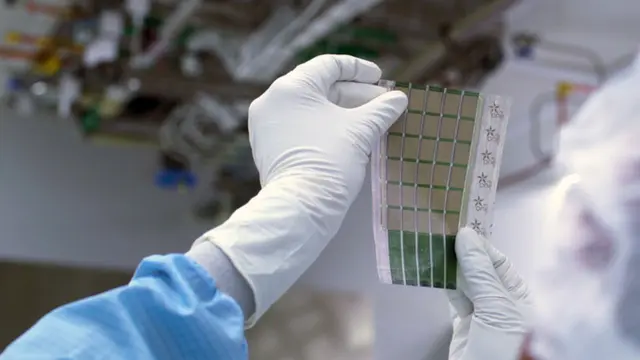
Now, ultra-thin solar cells made with modified silicon could become more viable. The new manufacturing techniques at sub-1.5 nanometer scale, which researchers hope to apply, could allow for the creation of more efficient thin-film solar cells, which are much cheaper to produce and can be applied in a variety of devices, from thermoelectric clothing to vehicles and portable devices.
This means that soon, we could have smaller and more powerful devices capable of capturing and converting light more effectively, without the limitations of current models.
Imagine a smartphone that charges using only ambient light or clothes that generate solar energy to power their own devices.
Conclusion: A Bright Future for Solar Energy
The new study from UC Irvine opens doors to a future where solar energy is not only more accessible but also more efficient and powerful.
By changing the interaction of light with silicon, researchers have taken a significant step toward improving solar cells and expanding the use of this technology.
What once seemed a limitation of silicon is now transforming into an opportunity to innovate and change how we generate and use energy.
This discovery could not only impact the field of solar energy but also give a significant boost to electronics, smart clothing, and many other areas that rely on the efficient conversion of energy.
We are undoubtedly on the verge of a revolution in the use of renewable energy sources. And the key to this may lie in a simple, yet brilliant, adjustment in the way light interacts with matter.










Be the first to react!