Portuguese
  Spanish


Published on May 25, 2026, the story of the 10-year-old girl showcases the Integral Center for Bilingual Elementary Education of Pilar, in Alagoas, where she presented school rules in English to adults and helped a video surpass 3.3 million views on social media.
A 10-year-old girl drew attention on social media by showcasing the English she learned at the first free bilingual school in the North and Northeast. The student appears speaking naturally to adults visiting the unit in Pilar, a city near Maceió, in Alagoas.
The story was published by Só Notícia Boa on May 25, 2026, and highlighted the video’s impact, which had already surpassed 3.3 million views. The case gained traction for showing, in a simple and direct way, how a public education policy can bring Brazilian children closer to opportunities once seen as distant.
Free bilingual school became an opportunity showcase in Alagoas
The student attends the Integral Center for Bilingual Elementary Education of Pilar, Professor Maria Euda de Melo Omena. The unit is located in the city of Pilar, in Alagoas, and is presented in the report as the first free bilingual school in the North and Northeast.
-
Mother discovers she may have won £12 million in the lottery but faces an agonizing wait after the shopkeeper threw the ticket in the trash.

-
A couple bought a house in Sheffield and, when removing the carpet from the hallway, found a trapdoor leading to a secret 23 m² basement with a 2-meter ceiling height, a discovery that eliminated the need for an expensive extension and, according to them, added £70,000 to the property’s value.

-
A nurse bought for 20,000 a 1955 house abandoned by a hoarder in Texas, and months later, rain revealed a buried pool in the backyard valued at $160,000, which he restored himself for about $10,000, a fraction of the cost of building a new one.
-
The United Kingdom is transforming dog feces left on trails into gas to light a streetlamp through an unlikely and surprising project that shows how even one of the most rejected wastes in cities can generate energy.


The highlight was not only for the language proficiency but for the child’s confidence in explaining the school routine to adults. The scene went viral because it showed a public school student using English as a real communication tool, not just as content memorized for a test.
Presentation to adults showed poise outside the classroom
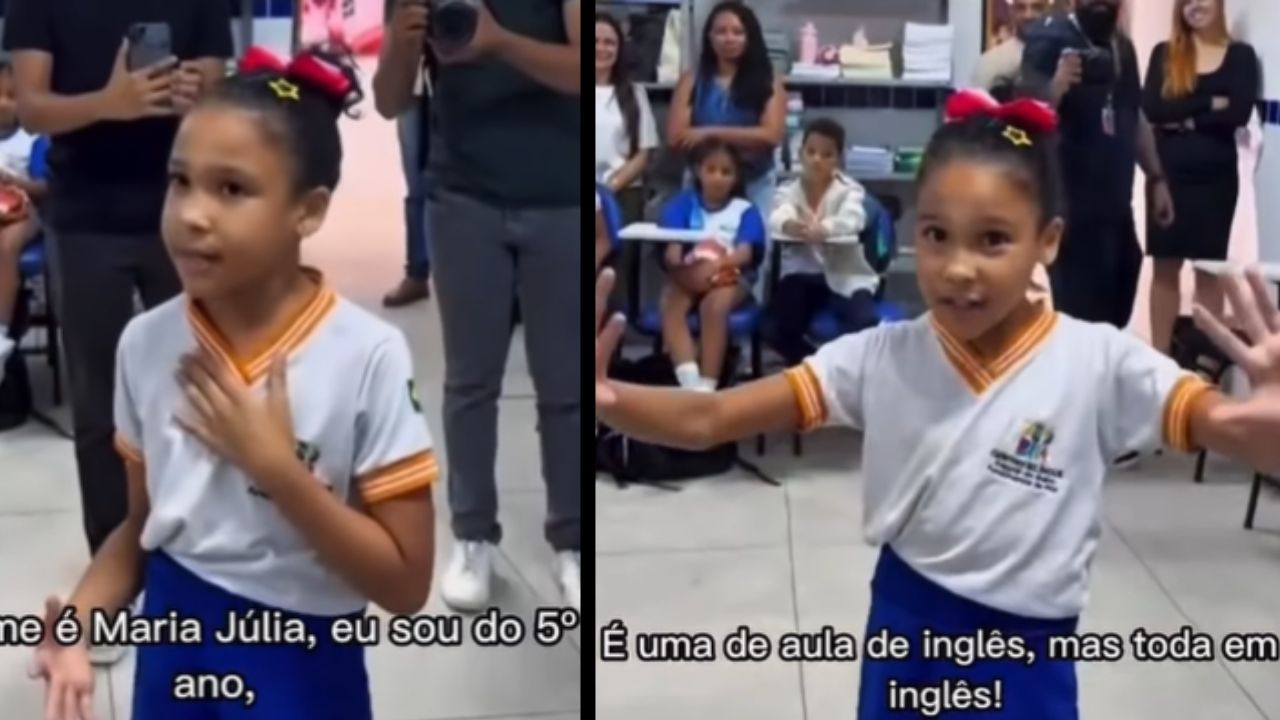
During the visit to the school, the 10-year-old girl explained, in English, one of the rules of the bilingual environment: students should not speak Portuguese during the English class. She mentioned that this rule helps maintain immersion in the language.
The student also said that she learns by playing with friends, a point that helps explain the naturalness perceived in the video. The speech drew attention precisely because it seemed spontaneous, confident, and connected to the child’s daily experience within the school.
Video surpassed 3.3 million views on social media
The buzz on social media was one of the central elements of the story. According to the report, the video featuring the student’s presentation surpassed 3.3 million views, attracting comments from teachers, parents, and internet users impressed with the performance.
The number reinforces the visual and emotional appeal of the scene. A 10-year-old girl speaking English confidently in a bilingual public school sparked pride, surprise, and debate about the difference that access to structured education can make in childhood.
Watch the video by clicking here.
English in public school changes perception about the future
The case gained traction because it touches on a larger discussion: access to English is still unequal in Brazil. For many families, learning another language with quality seems to depend on private courses, high fees, or opportunities outside the public school.
The experience in Pilar shows another path. When the structure arrives early, within elementary education, the language ceases to be a privilege and becomes part of the routine. Public education, when it receives investment and method, can open doors that previously seemed reserved for a few.
Naturalness of speech caught teachers’ attention
The report highlighted that the student seemed to think in English, not just repeat memorized phrases. This detail was also noticed by internet users, especially English teachers, who reacted with pride and surprise at the child’s fluency.
This type of reaction helps explain why the video went viral. The audience didn’t just see a school presentation, but a practical demonstration of learning. The girl’s confidence in front of adults turned a school visit into an example of educational achievement.
School name reinforces the public context of the story
The Bilingual Comprehensive Elementary Education Center of Pilar, Professor Maria Euda de Melo Omena, appears as the central setting of the article. The name of the unit is important because it provides context and prevents the story from seeming like just an isolated social media video.
The school is located in Pilar, a town in Alagoas near Maceió. By associating the scene with the location and institution, the story gains journalistic dimension: it’s not just a child who went viral, but a bilingual public education experience with visible impact.
Comments on social media became a gauge of the impact
After the video was published on Só Notícia Boa’s Instagram, the comments highlighted pride, emotion, and surprise. Teachers and followers praised the student’s fluency, spontaneity, and communication.
The reaction shows how education stories have strong engagement potential when they present concrete results. The 10-year-old girl became a topic because she personified a question many people ask: what could change in the country if more children had access to public schools with this level of opportunity?
Bilingual education can be more than language classes
The bilingual education shown in the case goes beyond memorizing words. According to the report’s description, the proposal involves interaction, immersion rules, games, and practical communication in English within the school routine.
This approach helps the child use the language in real situations. When learning happens naturally, the student stops seeing English as a barrier and starts treating it as a tool for expression, interaction, and future.
The video that moved also raises a bigger question
The story of the 10-year-old girl from Pilar went viral because it combines public education, childhood, opportunity, and visible results. In just a few seconds, the presentation in English showed that talent and learning can appear anywhere when the right structure reaches children.
Now, the question that remains is simple: do you think free bilingual schools should spread to more Brazilian cities, especially in regions where access to English is still limited? Leave your opinion in the comments.