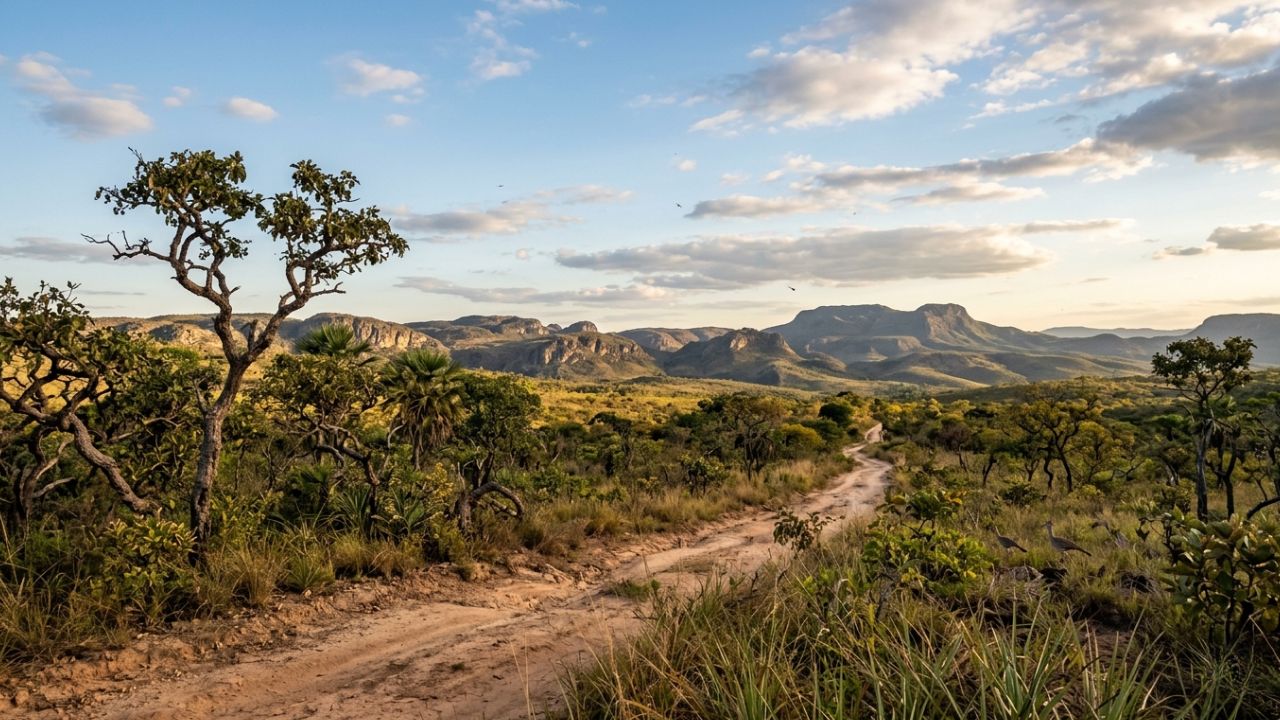

Beneath the Cerrado soil, an invisible heritage has stored carbon for thousands of years, but heatwaves, droughts, and degradation threaten to disrupt this balance and further accelerate the climate crisis.
In 2026, a study published in the scientific journal New Phytologist placed the Brazilian Cerrado at the center of an invisible climate alert. The research, released on March 12 by Agência FAPESP, showed that wet fields and veredas can store up to 1,200 tons of carbon per hectare, about six times the biomass stock of typical Amazonian forests.
The most concerning fact is that part of this carbon has been stored in the soil for thousands of years. According to Agência FAPESP, dating indicates an average age of 11,000 years, with records up to 20,000 years, in a slow process favored by the lack of oxygen in water-saturated soils.
Next, understand why this Cerrado “underground vault” has entered scientists’ radar and why drought, extreme heat, and degradation can transform a natural reserve into a source of greenhouse gases.
-
He has never read a line of code, but he already knows how to work: the French company UMA presented in Paris the Northstar, its first AI-powered humanoid robot designed for factories and warehouses, capable of copying tasks just by observing an employee in action.

-
A young Kenyan engineer collects plastic waste from the streets and transforms it into robots that translate physics lessons into sign language in real-time, a machine made with old bottles that teaches what was missing to deaf children left out of science.

-
What is the dark substance found in the sand of Ipanema Beach? Civil Police conduct an examination, collect samples of the material, and initiate an investigation to identify the composition, clarify the origin, and verify if there was an environmental crime.
-
The beer that was hidden for 3,000 years has returned to the world: scientists find yeast preserved in Ancient Egyptian vessels and recreate a pharaoh’s drink to discover the lost taste of an ancient civilization.




Cerrado wetlands store carbon on a scale far beyond what was imagined
The Cerrado often appears in environmental debates as an agricultural frontier, the cradle of waters, and the world’s most biodiverse savanna. But the study published in New Phytologist adds a less visible dimension: beneath the veredas and wet fields lies an ancient climate reservoir.
The research was led by Larissa S. Verona, affiliated with the State University of Campinas and the Cary Institute of Ecosystem Studies. According to the Cary Institute, the work is the first in-depth assessment of carbon stocks in groundwater-fed Cerrado wetlands.


These areas are known as wet fields and veredas. They don’t attract as much visual attention as a dense forest, but their waterlogged soils accumulate organic matter for long periods. The logic is simple and concerning. When the soil remains waterlogged, less oxygen is available. This reduces the decomposition of organic matter and allows carbon to remain trapped in the subsoil for thousands of years.
The Cerrado’s underground vault can store carbon accumulated since before modern human civilization
The age of the carbon found is one of the strongest parts of the research. Members of the Max Planck Institute team in Germany used radiocarbon dating to measure how long this material had been accumulated in the soils. The result indicated an average age of 11,185 years. In some cases, carbon had been stored for over 20,000 years, according to the Cary Institute’s disclosure.
This completely changes the scale of the problem. A degraded forest can take decades to recover some of its ecological functions, but a carbon stock formed over millennia does not return quickly. Larissa Verona explained to Agência FAPESP that the soil carbon of a Cerrado wetland would not be recovered within a human lifetime, precisely because it was stored over tens of thousands of years.
Therefore, the image of the “underground vault” works well to explain the risk. Carbon is stored beneath the landscape, protected by water, soil, and low decomposition. When this balance is disrupted, the reserve ceases to function as climate protection and can become a source of emissions.
Drought, heat, and drainage can transform stored carbon into CO₂ and methane emissions
The study’s central warning is not just that the Cerrado stores a lot of carbon. The critical point is that this carbon can escape if wetlands are dried, drained, or degraded. According to Agência FAPESP, these ecosystems are vulnerable to changes in the water regime caused by agricultural expansion, deforestation, wetland drainage, small dams, and intensive water use for irrigation.
Even preserved areas in fragments can suffer impact. Changes in the surroundings can reduce the water table level and transform soils into sources of carbon emissions. The Cary Institute also points out this risk. If stocks are disturbed by agricultural expansion, drainage, and drying associated with climate change, stored carbon can convert into greenhouse gases.
The situation becomes more serious because the dominant vegetation in many of these areas is composed of grasses. When the soil dries, this material decomposes more easily than woody plants, accelerating carbon release.
About 70% of measured emissions occurred in the hot and dry season
The team also measured carbon dioxide and methane emissions in different seasons. For this, they used a trace gas analyzer connected to structures installed in the soil. The result showed a sensitive data point: about 70% of annual emissions of CO₂ and CH₄ occurred during the dry season, according to Agência FAPESP.
This is important because the Cerrado already experiences marked dry periods. If climate change intensifies hotter and drier seasons, the stability of this carbon could come under even greater pressure.
The Cary Institute states that as the Cerrado becomes hotter and drier, a larger portion of soil carbon tends to decompose, increasing greenhouse gas emissions. The study also indicates low carbon stability compared to other tropical peatlands. This reinforces the vulnerability of this stock when the environment loses water.
Mapping indicates that veredas and wet fields may occupy an area six times larger than previously thought
Another strong point of the research is the potential size of these areas. As veredas and wet fields appear in fragmented patches, their extent was difficult to estimate accurately. Scientists combined remote sensing and machine learning to map the potential distribution of these environments. The estimate pointed to 167 thousand km² in the Cerrado.
This area would be at least six times larger than previously thought. It would also be equivalent to about 8% of the biome and 2% of Brazilian territory, according to Agência FAPESP. The Cary Institute presented the number as 16.7 million hectares. The institution emphasizes that the team continues to refine the mapping and estimates.
This means that the climatic role of the Cerrado’s wetlands may have been underestimated for a long time. Carbon was not in large visible trees, but hidden in moist, deep, and little-studied soils.
The Cerrado is a cradle of waters, and the loss of these areas threatens more than just carbon
The Cerrado is the second largest biome in South America and occupies about 26% of Brazil, according to the Cary Institute. The institution also describes the biome as the most biodiverse savanna in the world. In addition to biodiversity, the Cerrado plays a strategic hydrological role. According to Amy Zanne, a senior scientist at the Cary Institute, the biome is home to the headwaters of approximately two-thirds of Brazil’s major waterways, including the Amazon.
Agência FAPESP also calls the Cerrado a “cradle of waters.” The report states that the biome contributes two-thirds of the water supply to large hydrographic basins, especially in the South and Southeast regions. Therefore, the loss of wetlands is not just a carbon problem. It also affects springs, rivers, biodiversity, and water security.
When the water table drops, the impact spreads. The soil loses moisture, decomposition increases, and the landscape ceases to fulfill some of its ecological functions.
Agricultural expansion and degradation put pressure on the country’s most threatened biome
Territorial pressure on the Cerrado is one of the factors that make the discovery even more urgent. Professor Rafael Silva Oliveira, from Unicamp, told Agência FAPESP that the biome was chosen as Brazil’s main agricultural frontier for large-scale commodities. He also highlighted that, unlike the Amazon and the Atlantic Forest, the Cerrado is not recognized as national heritage in the Constitution. Under certain conditions, the legal preservation requirement can be as low as 20%.
The problem, according to Oliveira, is believing that preserving APPs next to rivers is enough to maintain the biome’s ecological functions. For him, it is necessary to understand landscape connectivity. This connectivity is decisive for veredas and wet fields. Even if a fragment remains intact, the conversion of the surrounding area can alter water flow and compromise the entire system.
From August 2025 to January 2026, areas under deforestation alert in the Cerrado totaled 1,905 km², according to Deter/Inpe data cited by Agência FAPESP. The number was below the 2,025 km² of the previous period, but still reveals high pressure on the biome.
Almost half of the Cerrado already has anthropogenic use, according to data cited by FAPESP
FAPESP Agency also cites a MapBiomas survey showing that 47% of the Cerrado was occupied by areas of anthropogenic use in 2024. Of this total, 24% corresponded to pastures and 13% to agriculture. These data help explain why the discovery is concerning. The oldest carbon is not isolated from decisions about land, water, irrigation, and agricultural conversion.
The threat does not only appear when a ‘vereda’ (palm swamp) is directly destroyed. It can also arise when the surrounding landscape changes and the water regime is altered. If the water level drops, the soil becomes more exposed to the air. With more oxygen, organic matter decomposes more quickly and can release carbon accumulated over millennia. It is at this point that the “vault” can open. What once functioned as an underground reserve begins to enter the atmospheric cycle.
Wetlands already have legal protection, but remain little recognized
FAPESP Agency reports that the Cerrado harbors springs, including natural outcrops of the water table. These environments are protected by the Forest Code, Law No. 12,651/2012, as Permanent Preservation Areas. Nevertheless, researchers indicate that these ecosystems remain neglected. Formal protection alone does not guarantee adequate mapping, efficient enforcement, and recognition of the climatic function of these areas.
The Cary Institute states that Brazilian law already protects wetlands fed by groundwater. Still, in some regions, up to 50% of these areas have already been degraded. This contrast is central. The Cerrado may have one of the largest carbon reserves in open tropical ecosystems, but part of this stock remains outside the focus of climate policies.
Carbon protection strategies usually focus on forests. According to Amy Zanne, open ecosystems like the Cerrado tend to fall off the radar, despite their old and dense stocks.
Study with 12 researchers changes the weight of the Cerrado in the Brazilian climate debate
The article published in New Phytologist brings together 12 authors, including Larissa S. Verona, Amy E. Zanne, Susan Trumbore, Paulo N. Bernardino, Guilherme M. Alencar, Thalia Andreuccetti, David Herrera, João C. F. Cardoso, Demetrius Lira-Martins, Guilherme G. Mazzochini, Natashi Pilon, and Rafael S. Oliveira.
The scientific publication is titled Vast, overlooked peat and organic soils in Brazil’s Cerrado: carbon storage, dynamics, and stability. EurekAlert reports that the article was published on March 12, 2026, in the journal New Phytologist. The study does not state that the entire Cerrado stores more carbon than the entire Amazon. The discovery is more specific and, for that very reason, technically relevant.

It shows that certain wetland areas of the Cerrado have exceptional soil carbon density. In some cases, these stocks far exceed the average biomass of typical tropical forests in the Amazon per hectare. The main message is that Brazil may be underestimating a hidden climate reserve. It is not in the tree canopies, but in the moist soil, in the ‘veredas’ (palm swamps), in the waterlogged fields, and in the water table.
If this system is degraded, the damage could extend beyond the biome. The loss involves ancient carbon, greenhouse gas emissions, water security, biodiversity, and the stability of landscapes that sustain large Brazilian basins.
Do you think the Cerrado is still treated as a supporting actor in the Brazilian environmental debate, even though it hides one of the country’s most important underground carbon vaults? Leave your opinion in the comments.