Portuguese
  Spanish


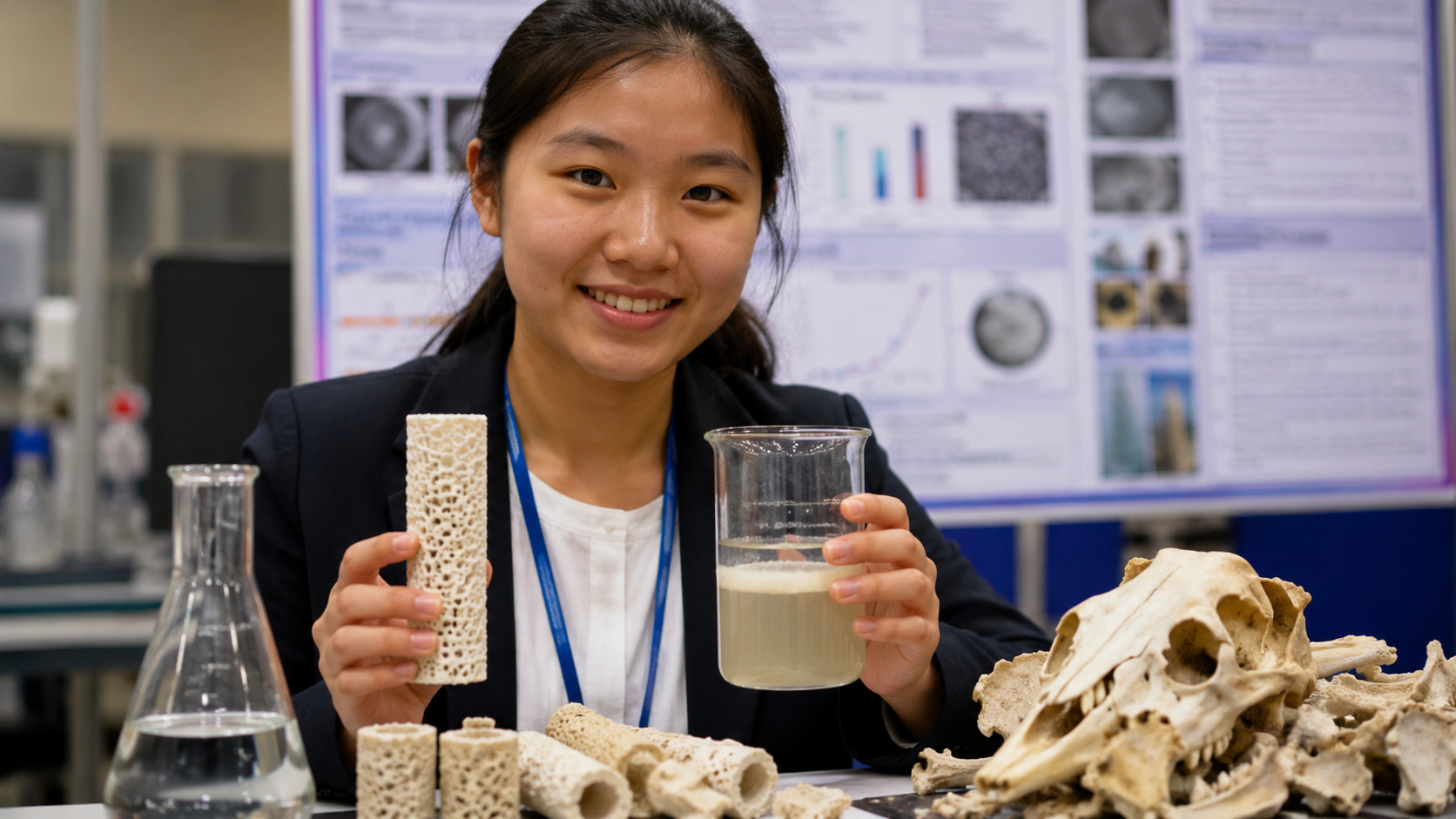

Tina Jin won the top prize at the Thermo Fisher JIC 2024 with a filter made from animal bones capable of making water drinkable.
At 14 years old, Tina Jin, from San Jose, California, won the $25,000 ASCEND Award, the top prize at the Thermo Fisher Scientific Junior Innovators Challenge 2024, a competition described by the Society for Science as the leading national STEM research contest for middle school students in the United States. The recognition came after the young girl demonstrated that animal bones can function as a water filtration material.
The strength of the research lies not only in the unusual idea but in the problem it tries to address. According to the official announcement of the award, Tina decided to create an affordable and scalable filtration system after discovering that one in three people worldwide do not have access to clean water and that many available systems are expensive or rely on hard-to-obtain parts.
Water filter with animal bones was born from a simple observation and became an award-winning scientific project
The origin of the project began at home, but the development was scientific. In an interview published by the Society for Science, Tina shared that she spent weeks trying to find a natural material that could serve as a filter until she realized, during a dinner, that the porous structure of cow bones resembled that of membranes used in filtration systems. It was this insight that initiated the research.
-
Entrepreneur Secures $15 Million to Transform Steel Mill Waste into Concrete Material, Builds Demo Plant in the U.S. with a Goal of 10,000 Tons Annually

-
World’s Most Powerful X-Ray Laser, 3.4 km Long and Emitting 27,000 Flashes Per Second, Unveils Atoms in Motion in Germany

-
Former SpaceX Rocket Engineer Develops Fast-Growing Grass Panels to Replace Wood in Construction, Secures $47.5 Million Funding
-
A Simple Finger Movement Gains Attention for Its Potential Role in Alzheimer’s Prevention




From there, the student turned a daily perception into an experiment. Instead of following the path of more expensive industrial components, she opted for an abundant, natural, and typically discarded material, with the goal of creating a solution that could be reproduced in poorer contexts with less access to technology.
This combination of material simplicity and social ambition helped to strengthen the project. The filter was not presented merely as a school curiosity but as a practical proposal to tackle a global problem with low-cost and widely available raw materials.
How the porous bone became a water filter and caught the attention of the main STEM competition in the USA
The technical differential of the project lies precisely in the bone structure. The Society for Science highlights that Tina sought a natural alternative for filtration and found in bones a porous surface capable of acting similarly, in principle, to materials used in purification systems.
In the official announcement of the award, the organization states that Tina used natural materials and common household supplies to build the filter. This reinforces one of the central points of the research: the attempt to create a water treatment technology that does not depend on a complex industrial chain to be assembled.
This aspect helps explain why the work attracted so much attention. Instead of presenting just a laboratory experiment that is difficult to replicate, Tina proposed a system that directly addresses the reality of communities where access to commercial filters may be limited by price or logistics.
Independent tests indicated that Tina Jin’s filter reached potability standards
The credibility of the project grew because Tina did not stop at the hypothesis. According to PR Newswire, the research underwent third-party tests conducted by the San Jose Water Company, and the results showed that the filter met potability standards. This is the point that takes the invention from the realm of a promising idea to the field of practical validation.
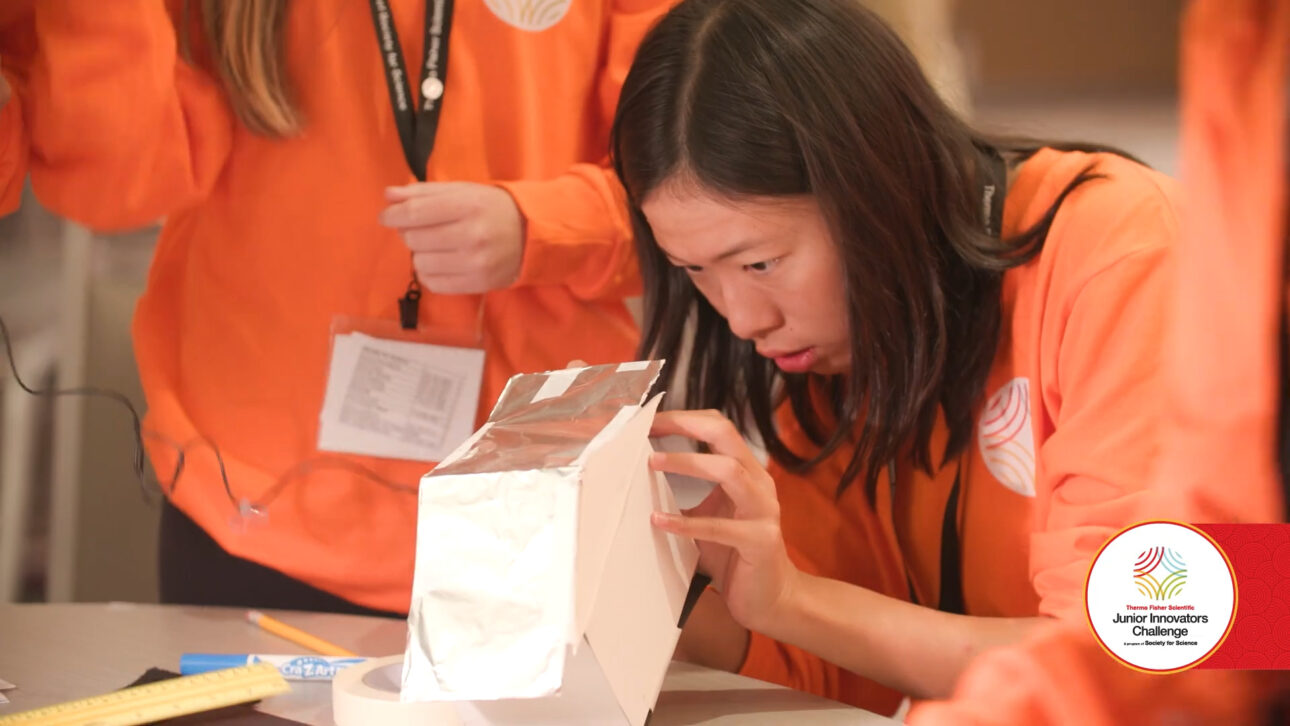
SocietyforScience/Playback
This means that the work was not highlighted just for appearing creative. The recognition is based on the fact that there was external verification indicating that the filtered water reached a level considered safe within the technical criteria used in these tests.
For a scientific competition of this magnitude, this detail makes a huge difference. In applied research, it is not enough to suggest that something might work; it is necessary to show, with method and proof, that the solution delivers measurable results. And it was precisely here that Tina’s project gained weight.
Thermo Fisher JIC gathered nearly 2,000 candidates and placed Tina Jin at the top of the competition
The magnitude of the achievement helps measure the feat. The official announcement states that the winners of the Thermo Fisher JIC 2024 were chosen from 30 finalists, who had been selected from nearly 2,000 applicants from 48 states, as well as American Samoa, Guam, Northern Mariana Islands, Puerto Rico, and the U.S. Virgin Islands.

The winners were determined by a panel of scientists, engineers, and educators. In addition to the analysis of individual projects, the 30 finalists also faced team challenges focused on critical thinking, creativity, communication, and collaboration in different areas of science and engineering.
Among these challenges, the organization mentions activities such as creating home automation systems with Raspberry Pi Pico, diagnosing sickle cell anemia, and using biocubes to analyze ecosystems. In other words, Tina did not win just for having a good idea: she excelled in a highly competitive environment, designed to test research, reasoning, and scientific performance on various fronts.
Solution for Potable Water Made with Animal Waste Combines Low Cost, Reuse, and Social Impact
Tina’s project draws attention because it connects two problems at once. On one side, the disposal of organic waste that would normally go to the trash. On the other, the difficulty of accessing potable water in regions where more sophisticated technologies may be too expensive.
By using animal bones as the base of the filter, the student showed that a common waste can gain value as a purification tool.
It was this reach that led the president and CEO of the Society for Science, Maya Ajmera, to highlight that Tina applied her STEM skills to develop a response to a global problem: access to potable water. The statement reinforces that the project was recognized not only for its inventiveness but for its potential human impact.
New Generation of Young Scientists Also Already Testing Filters with Fruit Peels and Reduction of E. coli
Tina’s research does not appear in isolation. In the official list of finalists of the Thermo Fisher JIC 2025, the Society for Science presented a project by Christine and Jingwei Guo that investigated the use of fruit peels as a filtering material to remove heavy metals from water.
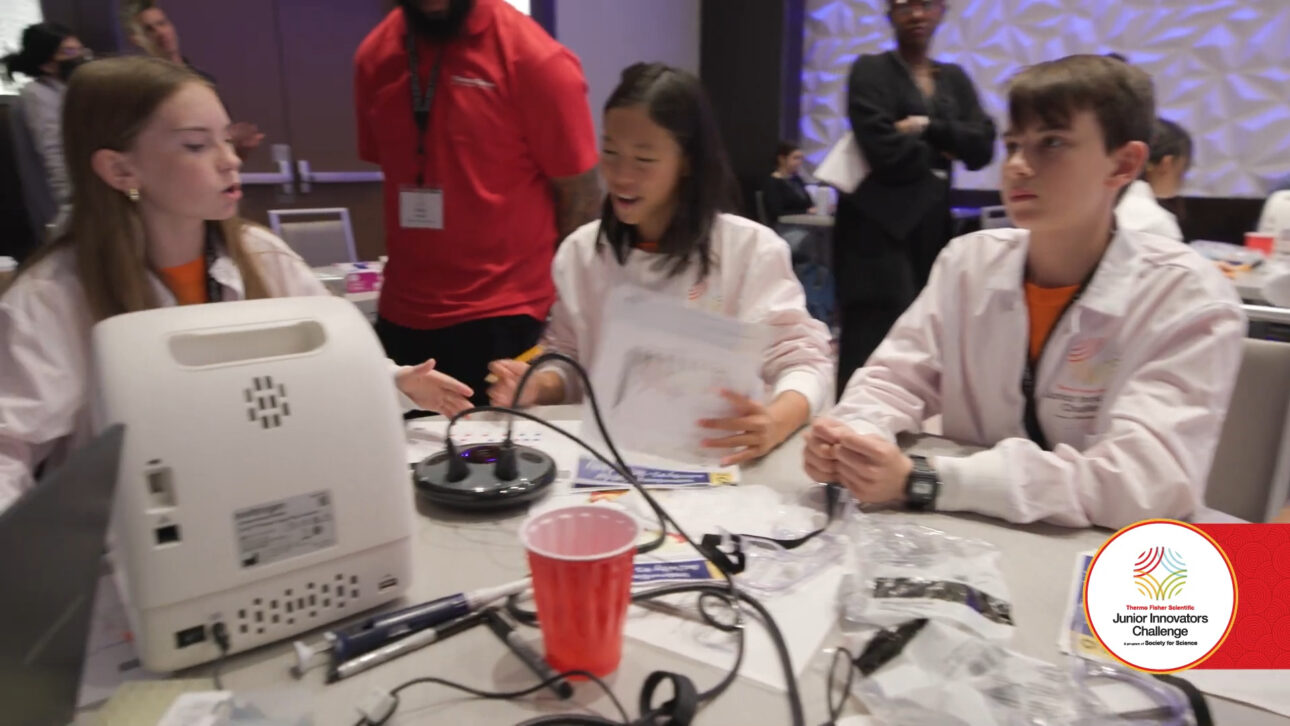
SocietyforScience/Reproduction
According to the organization’s description, tests with orange, lemon, banana, and pomelo peels showed a reduction in heavy metals. In some combinations, the materials managed to filter contaminants to levels better than the standard of the EPA, the United States Environmental Protection Agency.
Tina Jin’s Story Shows How School Science Can Tackle a Real Global Problem
Tina’s journey is significant because it challenges the idea that relevant innovation always depends on large laboratories or numerous teams. In her case, the combination was different: careful observation, a real problem, unlikely material, and experimental validation.
The result was a research project capable of winning the main national STEM competition for elementary education in the United States and, at the same time, opening space for a serious discussion about low-cost solutions for water filtration. This explains why the story moved beyond the science fair circuit and gained much greater prominence.
In the end, what makes this case so strong is not just the author’s age, but the logic of the invention. A teenager looked at a residue that almost everyone would discard and saw in it a possible answer to one of the planet’s most urgent problems: access to clean water.