






 Portuguese
  Spanish


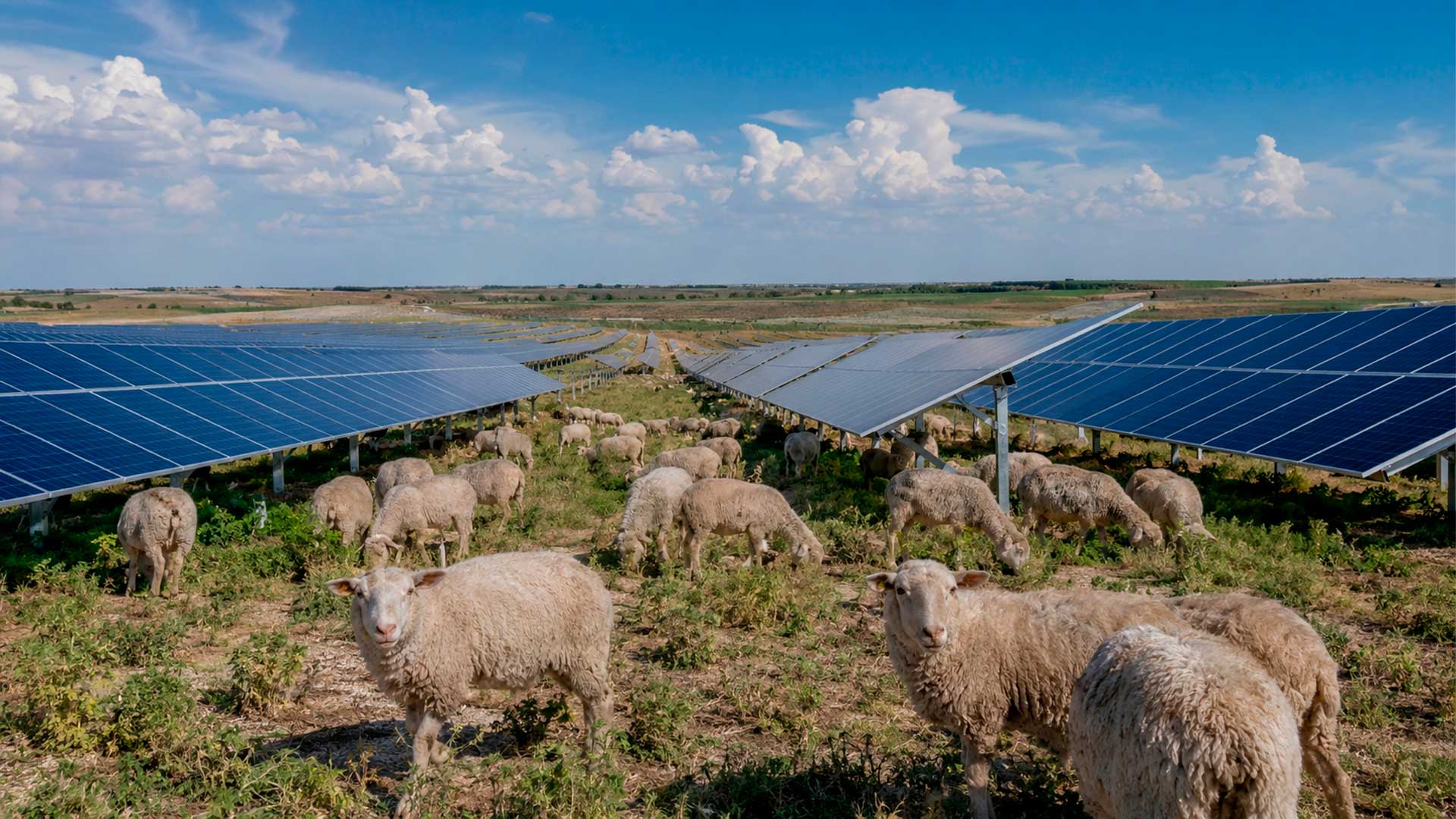

In one of the largest solar plants in the United States, weed cutting has stopped relying solely on machines and is now done by herds that roam under the modules, reducing maintenance costs and creating a new source of income for ranchers.
In Texas, a state historically linked to oil, an unusual scene has become part of the routine of a large solar plant: thousands of sheep grazing between rows of photovoltaic panels. The practice, known as solar grazing, uses animals to control vegetation in areas where mowers do not always easily enter.
The case gained traction at the Orion Solar Belt, a project by SB Energy in Buckholts, in Milam County, about two hours from Dallas. The facility occupies approximately 1,600 hectares and has a capacity of 900 MW, with about 1.3 million solar modules.
The solution seems simple but solves an expensive problem for large-scale photovoltaic plants. Tall grass can hinder inspections, block access, interfere with cables, and increase the risk of fire in dry periods.
-
Distant Galaxy Shaped Like a Giant Jellyfish Sheds Gas, Forming New Stars as It Moves Through Hot Cosmic Gas

-
Nearly 40% of Treated Water in Brazil is Lost Before Reaching Homes; Companies Use Satellites, AI, Helium, and Innovative Tech to Improve Access in Remote Areas

-
Steel Sphere Cylinder Achieves 14% Damping in Tests, Functions Without Sensors or Electricity, and Can Reduce Vibrations in Skyscrapers, Bridges, and Sensitive Equipment with US Patent Registered
-
Artist’s 15-Meter Lighthouse in the Mojave Desert, 160 km from the Sea, Intrigues Visitors with 19 km Range After Years of Bureaucracy



Instead of keeping teams running fuel-powered machines over a large area, the company started using about 3,000 sheep to keep the vegetation under control. As reported by the Associated Press, the animals can move through narrow gaps between the panels and work in rain or shine, without relying on gasoline.
What led a giant solar plant to swap mowers for sheep


The Orion Solar Belt began commercial operation in 2024 and comprises three solar projects by SB Energy. According to the company itself, the complex has 900 MW and uses more than 1.3 million modules manufactured in the United States, as well as steel and other national components.
The energy from the project is directly linked to the expansion of data centers. Google’s data center in Midlothian appears as an anchor client of the project, within a larger movement of clean energy purchases by large technology companies.
Even in a high-tech installation, the problem of vegetation remains physical and daily. Grass grows, seeds spread, rains accelerate the advance of weeds, and maintenance needs to happen before the area becomes difficult to access.
This is where the sheep come in. They eat the low vegetation, easily move under the panels, and reduce the need for mowers. For the plant, this means less fuel, less noise, and less mechanical operation in an area full of metal structures, cables, and panels.
Solar grazing has become a business for ranchers who previously depended only on wool and meat
The use of sheep in solar plants has also opened a new income stream for local farmers. In Texas, rancher JR Howard turned the demand for vegetation management into a specialized business, Texas Solar Sheep.
The company began serving solar farms in 2021 and grew along with the expansion of photovoltaic projects in the state. According to the Associated Press, Howard’s operation grew from a small family business to a structure with over 8,000 sheep and 26 employees.
This model changes the logic of traditional livestock farming. Instead of relying solely on the price of wool, meat, or common pasture leasing, the producer gets paid to provide maintenance services within an energy infrastructure.
The advance comes at a time when sheep farming faces tight margins in the United States. The Texas sheep and lamb herd fell to 655,000 head in January 2024, a 4% drop from the previous year, according to U.S. Department of Agriculture data cited by the AP.
For rural communities, the presence of animals also helps reduce visual and symbolic resistance to large solar plants. Instead of fields completely fenced off and occupied only by equipment, part of the agricultural activity continues on the land.
The technique already appears in hundreds of solar plants in the United States
The case of Texas is not isolated. According to the American Solar Grazing Association, in October 2024 there were about 113,050 sheep grazing on 129,000 acres of solar areas in the United States, spread over more than 500 locations. The entity points out that the practice appears both in large-scale plants and in smaller, community, and distributed projects.
The number shows that solar grazing is no longer a curious experiment. It has become part of the maintenance operation in an industry that needs to deal with increasingly larger areas.
The growth of solar energy in Texas helps explain this advance. According to the U.S. Energy Information Administration, in 2024 the state was the second-largest producer of solar energy in the United States, behind only California.
This data draws attention because Texas also continues as a powerhouse of fossil fuels. The Railroad Commission of Texas reported that the state produced 2,003,844,281 barrels of oil in 2024, the first time it surpassed the 2 billion barrel mark in one year.
The coexistence of oil, gas, solar energy, wind energy, and battery storage has turned the state into a practical laboratory for energy transition driven by demand, cost, and scale. In the case of sheep, the innovation is not in the animal, but in its use within an industrial energy chain.
Other countries also test the same path in photovoltaic parks
The idea already appears outside the United States. In Portugal, Iberdrola announced in 2023 the use of almost 300 sheep in photovoltaic parks, including the Algeruz II plant, in the Setúbal district, with 28 MW of installed capacity. The company associated the model with ecological land maintenance, reduced fire risk, and the creation of new spaces for livestock farmers.
In practice, solar grazing tries to address a frequent criticism against large photovoltaic projects: the use of open lands that could previously serve agriculture. When well planned, the same land starts to generate electricity and maintain a rural activity.
But there are limits. Not every plant is suitable for herds, and management requires fences, water, shade, health monitoring, and control of animal stocking. If there is an excess of sheep, the soil can become compacted and the vegetation may lose its recovery capacity.
It is also not about replacing all conventional maintenance. Technicians are still needed for electrical inspection, cleaning, module monitoring, and repairs. The sheep are involved in a specific part of the operation: the continuous control of low vegetation.
The rural detail that became a piece of a billion-dollar infrastructure
What seems like a bucolic scene, with animals walking under solar panels, reveals a practical adaptation of the energy industry. The plant needs to produce electricity, reduce operational costs, and keep the land safe. The livestock farmer needs area, income, and predictable contracts.
In the Orion Solar Belt, the two ends met. The same space that was once open field now gathers solar modules, cables, investors, data centers, and a herd that performs an ancient task: eating grass.
The difference is the context. Now, every meter of controlled vegetation helps keep a 900 MW plant operational, installed in one of the most important states on the U.S. energy map.
Solar grazing still depends on long-term studies on soil, biodiversity, and operation in different climates. Even so, the numbers show that the practice has moved from improvisation to the routine of hundreds of solar projects.
Do you think this model could work in large solar plants in Brazil, especially in rural areas of the Northeast and Midwest? Leave your comment and say whether the use of sheep in solar panels seems like a practical, economical solution or just a limited alternative for specific cases.


