Portuguese
  Spanish


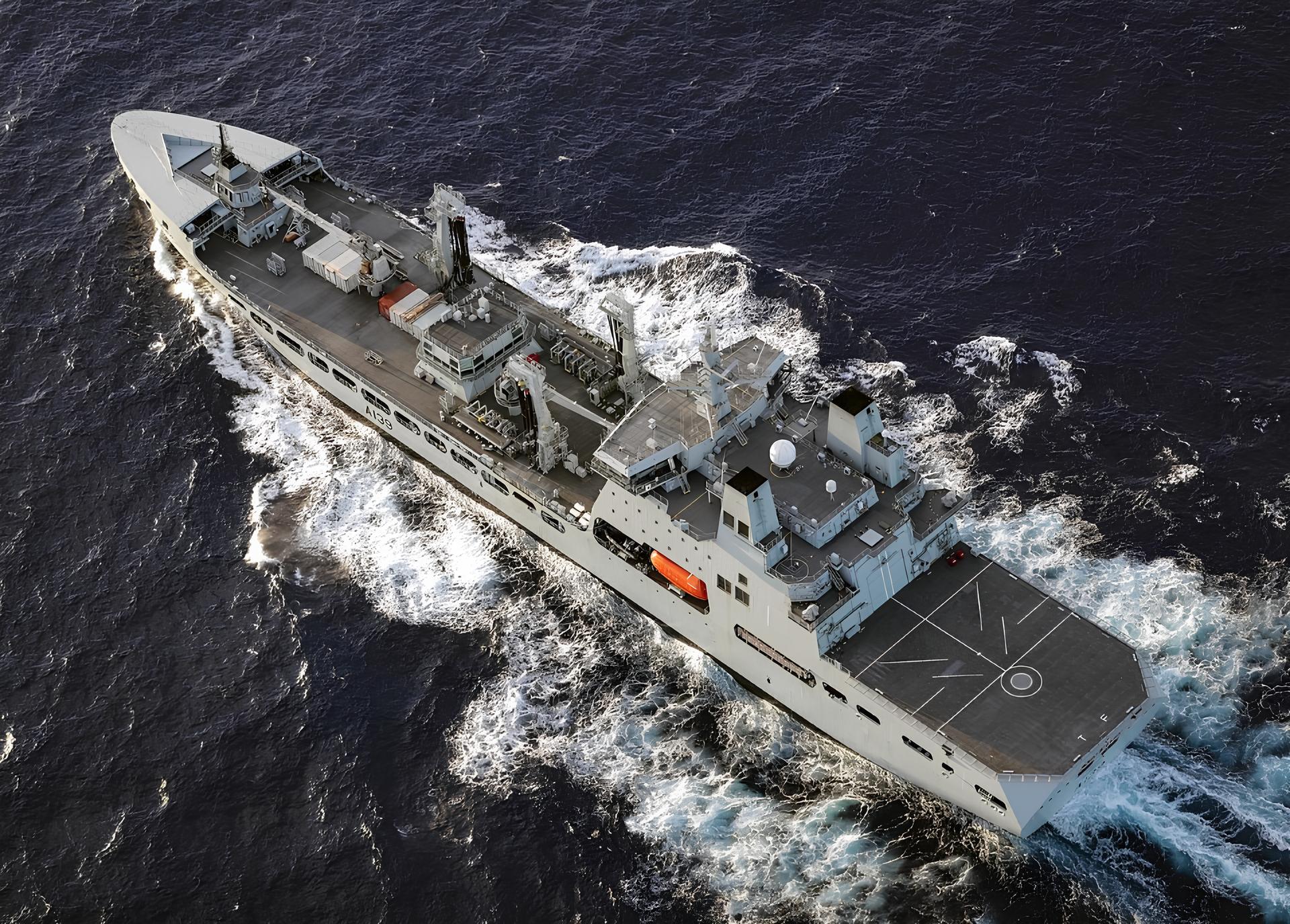

The Tide class ships of the Royal Navy carry up to 19,000 m³ of fuel and enable global naval operations without returning to port.
In 2017, the UK Ministry of Defence announced the arrival of the RFA Tidespring, the first ship of the Tide class, in the UK for customization before entering service with the Royal Fleet Auxiliary (RFA), the logistical arm that supports the operations of the Royal Navy. In the official statement published on April 3, 2017, the British government described the ship as part of a new generation of support vessels designed to keep warships supplied during global operations, 24 hours a day, all year round.
According to official data released by the British government on April 3, 2017 and reinforced by the institutional magazine Desider from Defence Equipment & Support on May 10, 2017, the Tide class ships have a displacement of about 39,000 tons, approximately 201 meters in length, and the capacity to carry up to 19,000 cubic meters of fuel and 1,300 cubic meters of fresh water. This volume allows naval groups to operate for long periods at sea, keeping aircraft carriers, destroyers, and frigates supplied without the need for constant returns to port bases.
The impact of this capability is direct on British military strategy. Without replenishment tankers like those of the Tide class, a modern fleet loses operational autonomy and becomes much more dependent on ports, forward bases, or vulnerable logistical routes. The Royal Navy itself describes the class as essential for providing fuel and fresh water to British ships around the world, while documents from Defence Equipment & Support, published on July 8, 2019, confirm that the RFA Tidespring achieved its date of entry into service back in 2017.
-
Brazil’s Largest Navy Ship, NAM Atlântico, Transforms into Field Hospital During National Crises

-
Brazilian Navy Demonstrates Strength in Naval Exercise with Over 20 Nations, Deploys Frigate Independência in Anti-Submarine and Air Defense Scenarios, and Joins Historic Formation with 26 Ships from 14 Allied Navies off the U.S. Coast

-
BAE Systems to Supply New Bofors 40Mk4 Cannons to the Brazilian Navy
-
Ukraine Bets on Swedish Gripen E Jets to Counter Russia, But 16 Fighters Won’t Arrive Until Late 2020s; Kiev to Use C/D Models for Pilot Training and Operations Amid Ongoing Missile and Drone Threats


The invisible gear that sustains aircraft carriers and global operations
Although they rarely receive public attention comparable to that of aircraft carriers or nuclear submarines, Tide class ships play a critical role in the operation of any modern navy.
In practice, they are responsible for performing the so-called “Replenishment at Sea” (RAS), or replenishment at sea. This process allows the transfer of fuel, water, and supplies from one ship to another while both are in motion, often in open water and under complex operational conditions.


This capability eliminates the need to interrupt missions for return to ports, keeping combat ships on constant patrol. In long-duration operations, such as those conducted in the Persian Gulf, North Atlantic, or Indo-Pacific, this function becomes indispensable.
Without ships like those of the Tide class, naval power projection simply would not exist in the form it is known today.
Tide class ships have naval engineering focused on at-sea transfer
The design of the Tide class ships was developed specifically to maximize logistical efficiency and safety during underway replenishment operations.
With approximately 200.9 meters in length and 28.6 meters in width, these vessels provide sufficient stability to conduct cargo transfers between ships even in adverse sea conditions. The structure includes multiple refueling stations, allowing for simultaneous service to different vessels.
The process involves reinforced hoses, pressure control systems, and quick-connect mechanisms that ensure continuous fuel transfer without leaks or interruptions. This level of engineering is essential for military operations, where any failure can compromise entire missions.
Additionally, the ships are equipped with modern navigation and positioning systems that allow for precise alignment with receiving vessels during the transfer process.
Logistical capacity that sustains entire combat groups
The numbers for the Tide class reveal the scale of their operational importance. The ability to carry up to 19,000 m³ of fuel means that a single ship can refuel multiple warships throughout a mission.
This fuel includes different types, such as naval diesel and aviation fuel, necessary for helicopters and aircraft embarked on aircraft carriers. The presence of 1,300 m³ of fresh water is also crucial, as ships on prolonged operations rely on this resource for human consumption and internal systems.
In addition to fuel and water, these vessels also transport additional supplies, spare parts, and logistical equipment, further enhancing their relevance.
In practice, a single Tide class ship can sustain an entire naval force for weeks without any external support.
Integration with the aircraft carrier HMS Queen Elizabeth
One of the main objectives of the Tide class was to directly support the new British aircraft carriers of the Queen Elizabeth class, such as the HMS Queen Elizabeth (R08) and the HMS Prince of Wales (R09).
These aircraft carriers represent the core of the United Kingdom’s power projection capability, operating F-35B aircraft and complete strike groups. To maintain these operations, a constant flow of fuel and supplies is necessary.
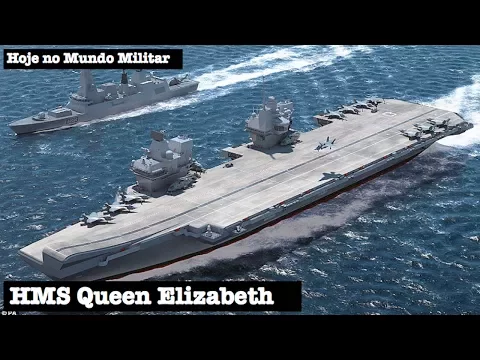
The Tide class ships were designed specifically to fulfill this role, ensuring that the aircraft carriers can operate for long periods in any region of the world without the need for immediate return to bases.
This integration is one of the pillars of modern British naval strategy, which seeks to maintain a global presence even with a fleet smaller than that of powers like the United States.
International construction and cost optimization
The Tide class ships were built by the South Korean Daewoo Shipbuilding & Marine Engineering (DSME), one of the largest shipbuilders in the world. This decision reflected a strategy of cost reduction and acceleration of the delivery schedule.
After construction, the ships were brought to the United Kingdom for final adaptation, installation of military systems, and integration with the Royal Fleet Auxiliary. This hybrid model allowed for the combination of industrial efficiency with specific military requirements.
The result was a class of highly efficient ships, with a relatively lower cost compared to projects fully developed in national military shipyards.
Global operation and strategic presence
Since their entry into service, the Tide class ships have been used in operations around the world, including missions in the Persian Gulf, Atlantic, and Indo-Pacific.
An example is the RFA Tidespring, which participated in support operations for strike groups and maritime security missions. Another ship of the class, the RFA Tiderace, has also been employed in long-duration missions, reinforcing British presence in strategic regions.
These operations demonstrate the importance of the class not only as logistical support but as a central element of the United Kingdom’s global presence strategy.
Crew, automation, and operational efficiency
Despite their size, the Tide class ships operate with a relatively small crew, usually around 63 personnel from the Royal Fleet Auxiliary, in addition to additional staff for specific operations.

This is made possible thanks to a high level of automation and modern control systems, which reduce the need for human intervention in various functions.
This operational efficiency reduces costs over the ship’s life cycle and increases operational flexibility, allowing vessels to remain on mission for long periods without the need for large crews.
Difference between tankers and combat ships
It is important to emphasize that, despite their size and importance, Tide-class ships are not designed for direct combat. Their role is logistical, functioning as support for warships.
However, this does not mean they are vulnerable. These vessels have basic defense systems, including machine guns and protection systems against asymmetric threats.
Additionally, they typically operate accompanied by combat ships, ensuring safety during missions in high-risk areas.
A key piece of modern warfare that almost nobody sees
Tide-class ships represent a clear example of how modern warfare relies on advanced logistical systems as much as on sophisticated weaponry.
While aircraft carriers and destroyers receive attention for their firepower, it is vessels like these that ensure that these platforms can operate continuously. The ability to keep an entire fleet moving without the need to return to port redefines the reach and persistence of naval operations.
And have you ever stopped to think that an entire fleet depends on invisible ships like this to keep operating?
The presence of ships like the Tide class raises an important reflection on the role of logistics in modern warfare. Without them, even the most technologically advanced forces would have limited reach and constant dependence on land infrastructure.
In light of this, what do you consider the true decisive element in military operations: combat power or the ability to sustain that power over time?