Portuguese
  Spanish


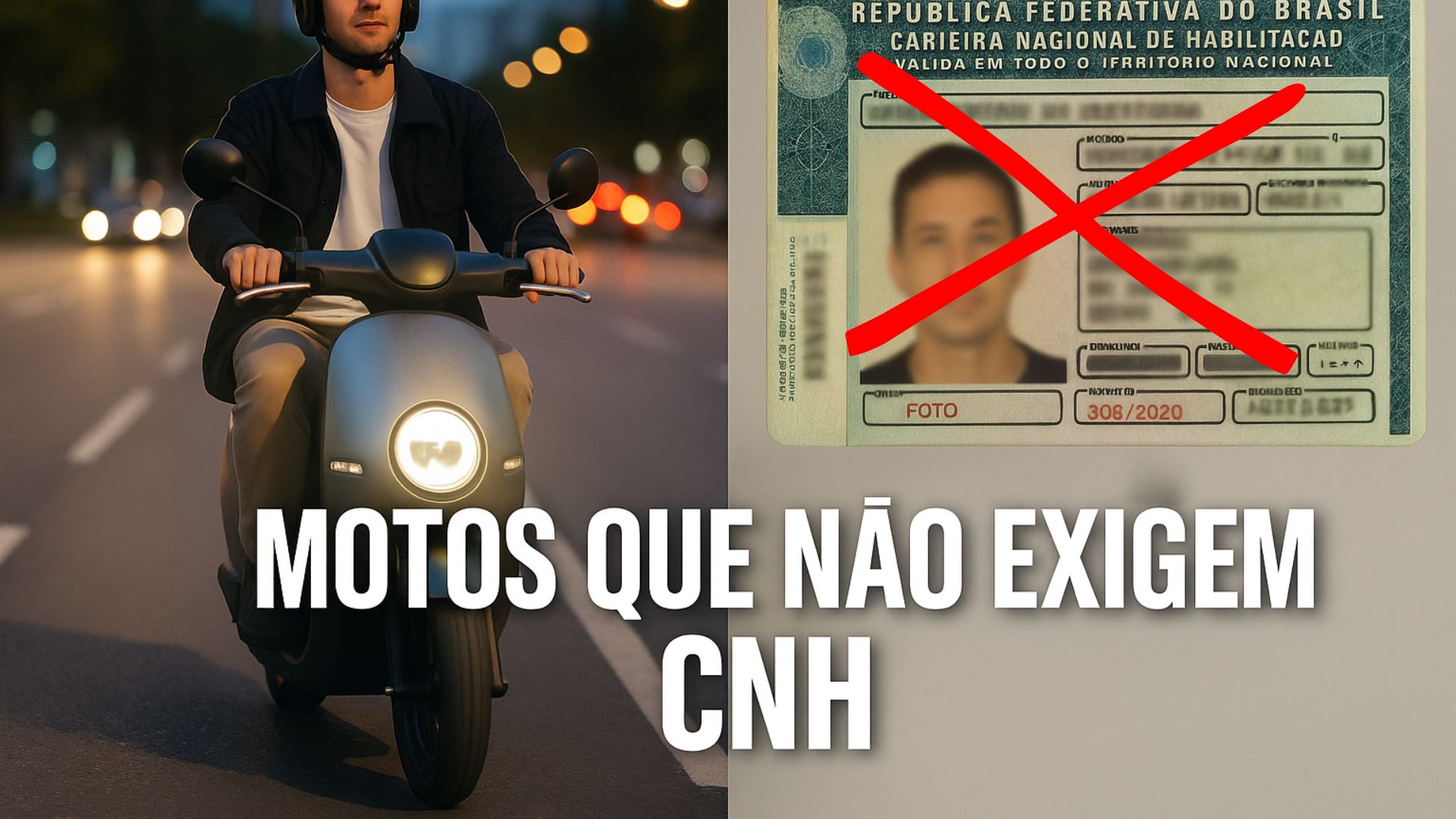


Four Models of Two-Wheeled Vehicles Catch Attention for Dispensing with the Driver’s License. Understand What the Technical Criteria Allowing This Release Are, What the Resolution of the CONTRAN Says, and Which Limits Differentiate E-Bikes, Scooters, and Mopeds.
The Resolution No. 996/2023 of the CONTRAN defined, with objective parameters of power and speed, which light vehicles can circulate without a National Driver’s License and which require specific authorization.
The regulation classifies regular bicycles, bicycles with pedal-assist, and self-propelled personal mobility devices among those that do not require a driver’s license.
On the other hand, mopeds — often sold as “fifties” and very similar to motorcycles — require ACC (Authorization to Drive Moped) or category A, in addition to registration and a license plate.
-
Brazilian Company from Caxias do Sul Among World’s Leading Brake Friction Material Manufacturers, Present in Over 125 Countries

-
Kia K4 Launches in Portugal with 7-Year Warranty, Targets Volkswagen Golf with 1.0 Turbo Engine, Unavailable in Brazil

-
Uber Women Expands Across Brazil: Female Riders Can Now Choose Women Drivers, Schedule Rides, and Set Automatic Preferences

-
Brazil Plans to Launch Ethanol-Fueled Hybrid Cars in 2026 as an Alternative to Fully Electric Vehicles




What Changes with the National Rule
By standardizing concepts valid throughout the country, the CONTRAN aimed to reduce doubts from the public and regulatory agencies.
Regular bicycles remain exempt, as they are exclusively human-powered.
Electric bicycles, however, are only equated to bicycles when they meet four technical criteria: motor of up to 1,000 W, activation only when the rider pedals (pedal-assist), absence of manual throttle, and limit of 32 km/h for motor propulsion.
Under these conditions, there is no requirement for a driver’s license, registration, or license plates, and circulation must comply with the rules applicable to bicycles.
Self-propelled personal mobility devices — such as scooters, hoverboards, and the like — may also dispense with a driver’s license, provided they comply with the general limits defined by the resolution: nominal power of up to 1,000 W, maximum manufacturing speed of 32 km/h, width of up to 70 cm, and wheelbase of up to 130 cm.
There is a technical exception: self-balancing unicycles may have a motor of up to 4,000 W, provided the other dimensional limits are maintained.
The circulation of these devices is subject to the rules established by the local traffic authority and, like bicycles, does not require registration.
Why Some Models Look Like Motorcycles and Still Dispense with a Driver’s License
Despite their appearance, some of the entry-level urban vehicles sold in Brazil technically qualify as electric bicycles or self-propelled equipment.
The decisive point is how the power reaches the wheels and how much power is allowed by law.
If there is a throttle on an electric bicycle, it ceases to be classified as a bicycle for legal purposes.
If the power or maximum manufacturing speed exceeds the stated limits, the vehicle is classified as a moped or motorcycle/motoneta, with other requirements.
This distinction explains why there are “four 0 km motorcycles” in the price range of R$ 10,000 that, in practice, do not require a driver’s license.
Models marketed as robust e-bikes or low-power electric scooters, without a throttle (in the case of e-bikes) and within the power limits, fall into the category that dispenses with a driver’s license.
In parallel, mopeds with 50 cc or electric ones up to 4 kW and maximum speed of 50 km/h require ACC or category A, in addition to registration, licensing, and a license plate.
Where They Can Circulate and What Items Are Mandatory
The circulation of electric bicycles and self-propelled equipment follows the same guidelines as bicycles.
The local traffic authority may authorize traffic on sidewalks and pedestrian areas at up to 6 km/h, on cycle paths and bike lanes as per signage, or on roads with regulated speed of up to 40 km/h, according to technical studies.
For e-bikes, the regulation requires a buzzer, front, rear, and side night signaling (including on pedals), left rearview mirror, tires in good condition, and electronic speed limiter.
Self-propelled equipment must have at least a buzzer, night signaling, and a speed limiter.
There are also two specific provisions.
In e-bikes, the “walk assistance” feature is permitted: the motor can assist without pedaling, limited to 6 km/h, useful for pushing the vehicle uphill.
In the sporting use of electric bicycles on arterial roads, highways, and thoroughfares, the assisted speed of the motor can reach 45 km/h, provided circulation is authorized by the responsible agency.
Mopeds Require ACC and Have a Deadline for Registration
When the vehicle is a moped — with two or three wheels, up to 50 cc in the case of combustion, or up to 4 kW if electric, and maximum speed of 50 km/h — the requirements change.
The owner must arrange for registration in the Renavam, licensing, and license plate.
To operate it, one needs ACC (Authorization to Drive Moped) or category A.
The resolution set a deadline to regularize mopeds manufactured or imported until the regulation came into effect: inclusion in the Renavam must occur between November 1, 2023, and December 31, 2025.
After this date, circulation on public roads is prohibited.
The moped driver must wear a helmet and other mandatory equipment, and circulation is restricted to urban roads and highways with a shoulder, barring specific local regulations.
Examples in the R$ 10 Thousand Range and How They Fit
In the entry-level market, there are models that fit within the budget and illustrate the legal differences.
Among the combustion “fifties,” Shineray Jet 50 and Phoenix 50 rank among the most well-known.
Reference prices indicate a starting level of R$ 10,6 thousand for the Jet 50S and R$ 8,8 thousand for the Phoenix S, not including shipping and local costs.
Bull K-Spirit NG 50 and Bull F5 Plus NG also appear in offers around R$ 10 thousand to R$ 11 thousand, varying by region and dealership.
All of these, as mopeds, require ACC or A and registration. In the electric category, there are urban scooters and larger-frame e-bikes priced close to R$ 10 thousand.
An example is the Shineray PT1, positioned as a light electric scooter, with prices around R$ 6,9 thousand.
The legal classification, however, depends on the specific technical sheet: if the model has a throttle and exceeds the limits of e-bike or self-propelled equipment, it will be classified as an electric moped and will require ACC, registration, and license plate.
If it meets the maximum power and speed and fits the dimensions, it may dispense with a driver’s license.
Therefore, it is essential to check the nominal power data, the maximum manufacturing speed, and the presence or absence of a throttle before purchase.
Enforcement, Fines, and Local Rules
Enforcement considers what is stated in the federal resolution and the municipal or state regulations.
Driving a car or motorcycle without a license results in a serious infraction, with a fine of R$ 880.41 and administrative measures provided in the Traffic Code.
For bicycles and self-propelled equipment, the focus is on complying with speed limits and using mandatory equipment.
Municipalities may define where these vehicles can circulate and specific limits, including restricting or allowing use on sidewalks and local roads, provided technical criteria are met.
In Technical Summary
To dispense with a driver’s license, the vehicle must be within design limits.
E-bikes with up to 1,000 W, without a throttle, and with the motor acting only when pedaling, up to 32 km/h, are considered bicycles.
Scooters and similar devices, with up to 1,000 W, 32 km/h maximum speed, and reduced dimensions, are also exempt.
Self-balancing unicycles have an exception for power but must comply with the other measurements and local regulations.
If any limit is exceeded, it becomes a moped — and then ACC or A, registration, and license plate are once again required.
Before opting for a “0 km” model near R$ 10 thousand, it’s worth checking the technical identification plate from the manufacturer and confirming how the product is classified in the Renavam.