






 Portuguese
  Spanish


In a riverside community 25 km from Manaus, Professor Clércio de Almeida set up a solar energy system with discarded electronic scrap and ended the days without classes at São João do Tupé school, where the lack of electricity constantly interrupted classes and even halted the children’s meals.
Some people look at a pile of old electronic equipment and see trash. Professor Clércio de Almeida looked and saw a solar power plant. In a riverside community 25 km from Manaus, where power outages were so frequent that the school would go days without classes, he gathered discarded devices, panels, batteries, and controllers and assembled a solar system that truly works. The result is solar energy with electronic scrap, made from what others threw away, keeping the São João do Tupé Municipal School open.
The case was featured by the magazine Brasil Energia, which followed the turnaround in the riverside community. The project was presented in 2026 at the Amazonas Oil, Gas, and Energy fair, one of the largest in the sector in the region, as proof that the energy transition in the Amazon can arise from simple and creative solutions. In São João do Tupé, the lack of electricity that used to stop the school became a case of innovation.
How electronic scrap became a solar energy system
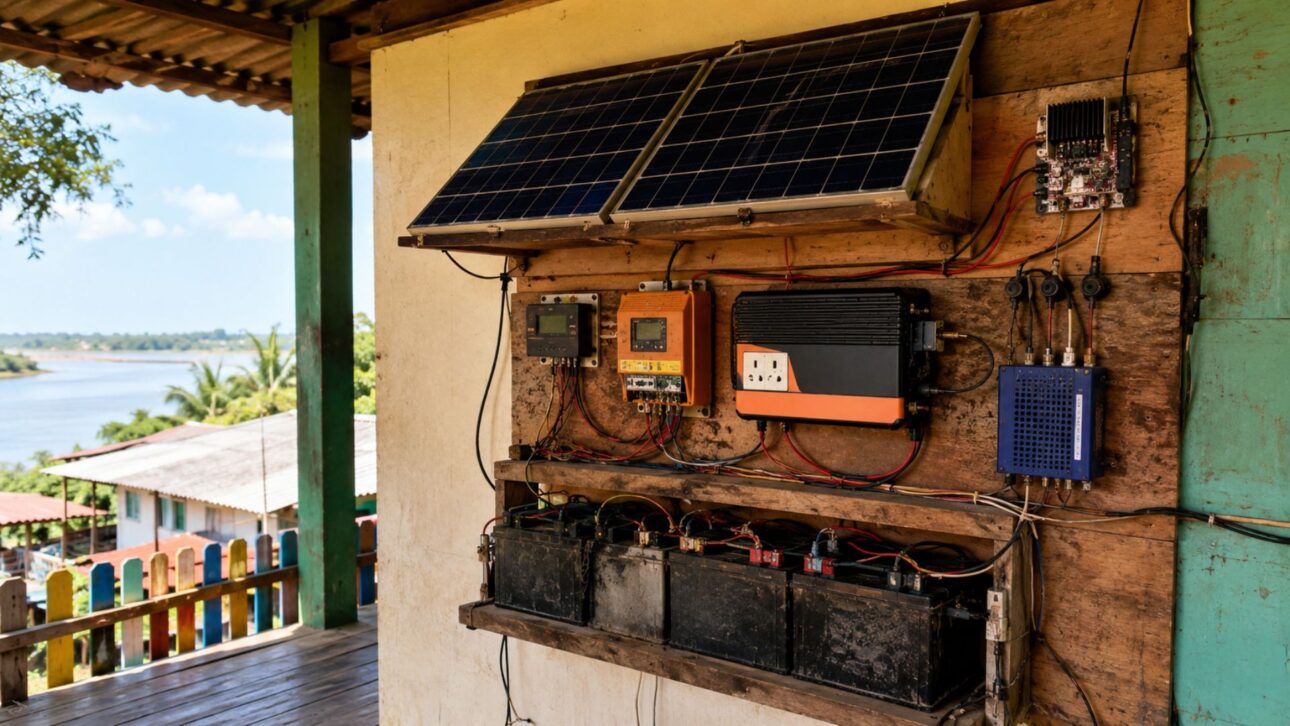
Instead of buying new and expensive equipment, Clércio de Almeida started with discarded and forgotten electronic devices to build a solar system from scratch.
-
Massive 1.6 km-wide asteroid traveling at nearly 9 km per second to narrowly miss Earth this Saturday; here’s how, when, and where to watch the event.

-
Scientists Discover 10,000-Year-Old Stone Wall in the Baltic Sea, Used to Trap Reindeer Before Sea Levels Rose

-
Farmer’s DIY Cooling System Saves Harvests from Spoiling in 51 Countries by Tricking Standard Air Conditioners to Chill Rooms to 2°C

-
As Global Warming Melts Glaciers, Ancient Tools, Preserved Mummies, and Strategic Minerals Emerge in the Arctic and European Mountains



By assembling solar panels, batteries, an inverter, and a charge controller, he turned what would be trash into a clean energy generator for the school.
The setup works like any photovoltaic system.
The panels capture the strong Amazon sun, the batteries store this energy, and the inverter and controller deliver stable electricity for the school’s appliances to use all day long.
The difference is the origin of the parts.
What would normally be expensive came from discarded equipment, proving that solar energy can be made with electronic scrap and still keep everything running.
It’s recycling engineering at its core.
Where many saw a pile of junk, the teacher assembled solar energy with electronic scrap capable of sustaining the entire routine of a riverside school.
Clean technology born from waste.
Days without classes: the problem that light solved
To understand the size of the solution, you need to see the size of the problem.
In São João do Tupé, access to electricity has always been difficult, and this lack directly affected the classroom.
Without light, the school simply stopped, and students would go days without classes waiting for the power to return.
The situation worsened at a specific time of the year.
According to the teacher, the lack of electricity weighs even more in the dry season, the so-called Amazonian summer, when the heat intensifies and everything in the school depends on energy to function.
Without light, there is no pump drawing water, no fan, no way to prepare meals.
And without these basic conditions, sending children to school becomes impossible.
It was a knot that no complaint could solve.
The riverside community needed a reliable energy source, and that’s exactly what the teacher’s solar system delivered.
The missing light was the piece that unlocked everything.
Who is Professor Clércio de Almeida
Behind the invention is an educator with a researcher’s mindset.
Clércio de Almeida is a teacher and researcher, and he named the work “Solar energy as a sustainable alternative for the Municipal School São João do Tupé”.
Instead of waiting for a major public work, he decided to roll up his sleeves and build his own solution.
The project did not come about alone.
Clércio de Almeida’s initiative was supported by FAPEAM, the Amazonas research foundation, as part of the State Government’s effort to bring science and technology to the interior, according to FAPEAM itself.
The recognition came on a significant platform.
The work of creating solar energy with electronic scrap was presented at the Amazonas Oil, Gas, and Energy conference, alongside other solar energy projects supported in the state.
A teacher from a riverside community sharing the stage with the energy sector.
It’s proof that a good idea doesn’t choose an address.
São João do Tupé, 25 km from Manaus
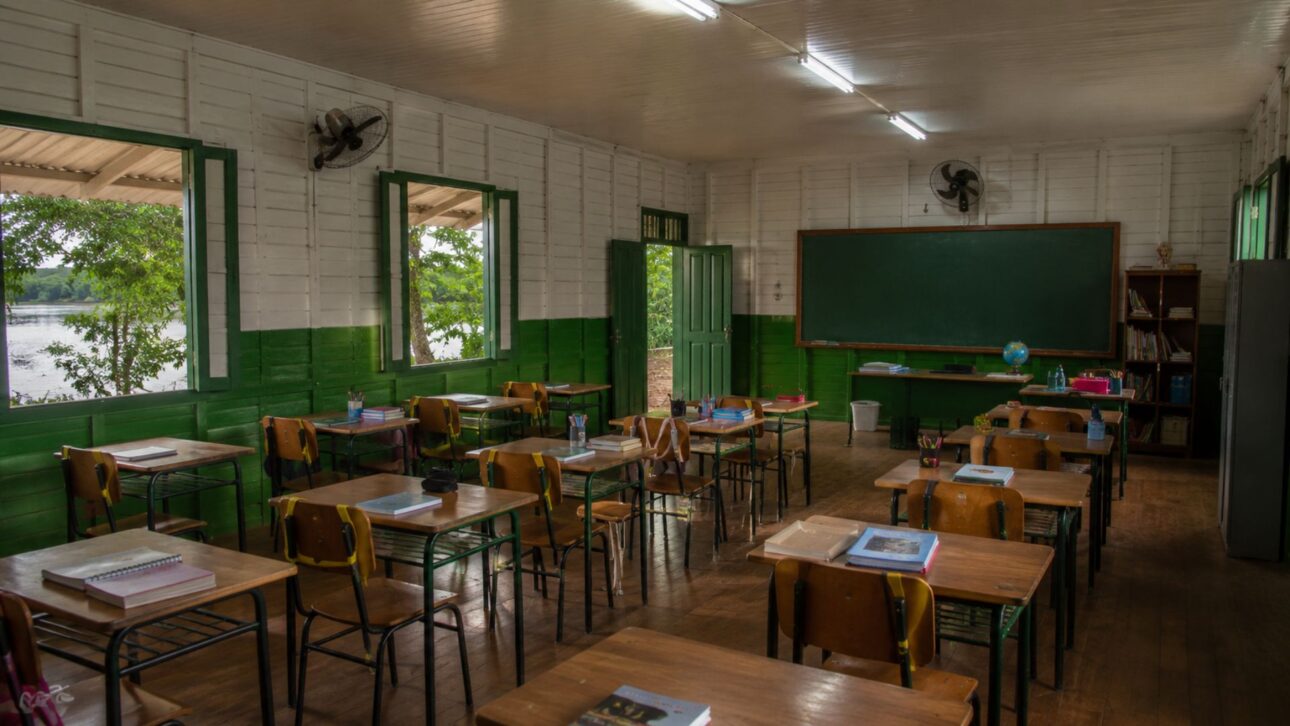
São João do Tupé is 25 km from Manaus, in a rural riverside area within the Tupé Sustainable Development Reserve.
Despite being relatively close to the Amazonian capital, the community lives with the reality of those who live far from a stable electrical grid.
The distance is deceiving.
In a straight line, the path to Manaus is short, but the infrastructure conditions of a riverside community in the Amazon are quite different from those of an urban neighborhood.
It is precisely this type of place that suffers the most from the lack of energy.
Schools, posts, and houses depend on their own solutions when the city’s light does not reach São João do Tupé firmly.
That’s why the teacher’s system makes so much sense there.
In a riverside community surrounded by river and forest, generating its own solar energy is more than comfort; it is what keeps essential services running.
Autonomy becomes a matter of the school’s survival.
What changed at the school
The impact of the system appears in the simplest daily tasks.
With guaranteed energy, the school now has water pumping, meal preparation, cleaning, functioning bathrooms, fans running, and lighting in the classrooms.
Everything that stopped due to lack of light started working again with energy coming from the sun.
But the greatest gain is another.
The teacher himself points out that the main benefit was the end of class suspensions: before, they didn’t happen when there was no energy, and that stopped being a problem.
In other words, the system tackled the root of the issue.
It’s not about luxury or technology for decoration, but about ensuring that the children of São João do Tupé have classes every day.
The school is no longer hostage to the utility company.
With its own generation, São João do Tupé gained predictability, and the school calendar stopped depending on when the electricity decides to appear.
Education that doesn’t go out with the power.
When electronic waste becomes clean energy
The teacher’s story touches on a problem that goes far beyond the Amazon.
The world produces mountains of electronic waste every year, and much of this material still has useful components that end up rotting in landfills.
Reusing this waste to generate clean energy is combining two urgent agendas: waste reduction and access to electricity.
This is where the case gains strength as an example.
Showing that it is possible to make solar energy with electronic scrap dispels the idea that renewable energy is always expensive and unattainable for those with little.
The model is, above all, replicable.
Other schools and isolated communities across Brazil could adapt the same logic of reusing equipment and setting up low-cost solar systems.
And the environmental message is twofold.
Every device that becomes part of a solar system is one less item in the landfill and a bit more clean energy running in a riverside community.
Sustainability that starts with what we throw away.
What the case of Professor Clércio shows
The greatest lesson is about creativity in the face of resource scarcity.
Clércio de Almeida proved that it’s not necessary to wait for a billion-dollar plant to solve a real problem, and that applied knowledge can be worth more than a hefty budget.
Where there was a lack of light and an abundance of old equipment, the teacher set up solar energy with electronic scrap and returned the future to a school.
Of course, it’s important to keep our feet on the ground.
The system was made on the scale of a school and was born as a research project supported by FAPEAM, so it’s a local and adapted solution, not a large-scale plant ready to supply entire cities.
Even so, the value of the example is enormous.
In a riverside community 25 km from Manaus, the energy transition stopped being just talk and became the light on in a classroom in São João do Tupé.
From forgotten electronic waste to the energy that keeps school meals warm, Clércio de Almeida showed that true innovation sometimes fits into what others discard.
And you, did you imagine it was possible to set up a solar energy system with electronic scrap and still save the school year for an entire school? Tell us in the comments what you think of this type of creative solution to bring clean energy to isolated communities in Brazil.


