Portuguese
  Spanish


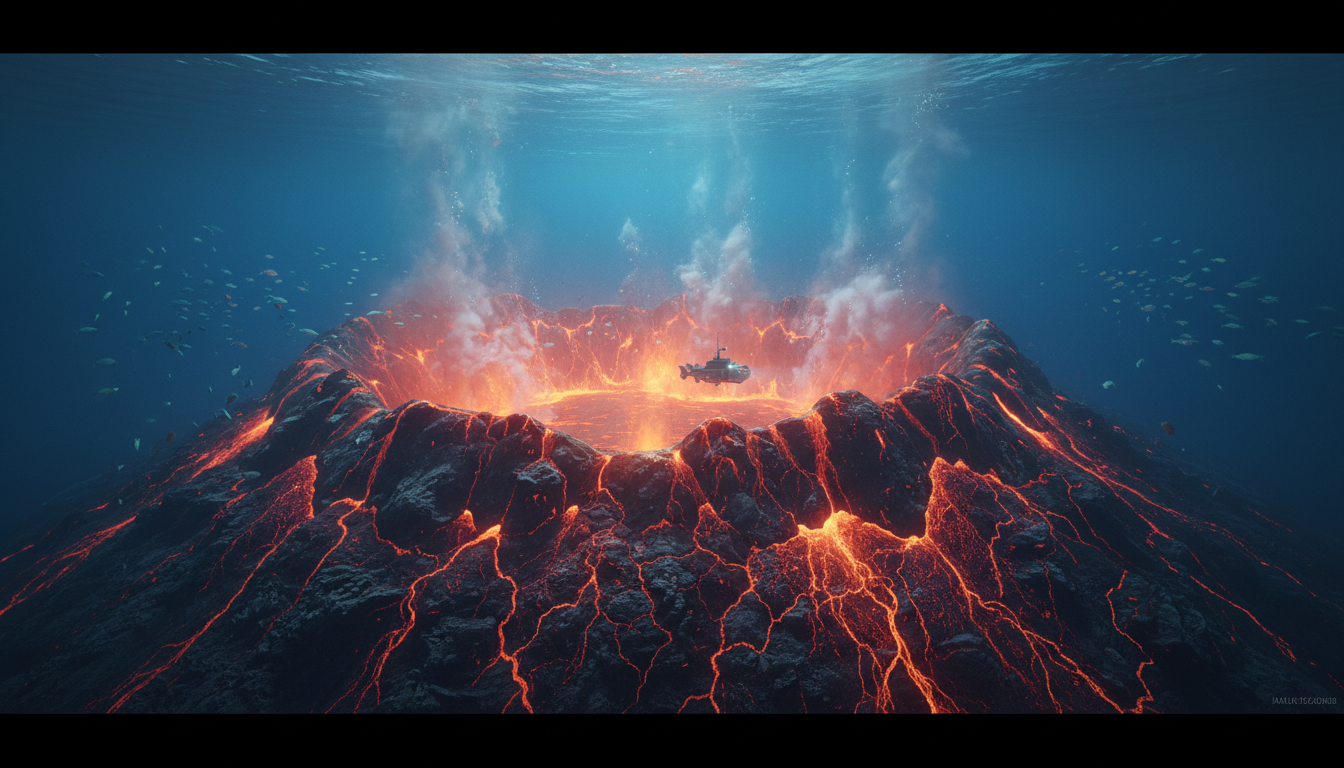


19 kilometers wide and mostly submerged in southern Japan, the Kikai caldera was responsible for the most powerful eruption of the last 10,000 years — and a study published in March 2026 confirmed that the same magma reservoir that fueled the catastrophe is recharging with new material
According to a study published in March 2026 in ScienceDaily, researchers from Kobe University and the Japan Agency for Marine-Earth Science and Technology (JAMSTEC) confirmed that the Kikai supervolcano, in southern Japan, is being recharged with new magma.
Thus, it is not residual material from the previous eruption. It is fresh material, slowly injected into the depths of the submarine caldera.
Therefore, the same system that caused the most violent eruption of the Holocene — 7,300 years ago — remains active and accumulating energy, albeit on a scale of thousands of years.
-
Polar Air Mass to Hit Brazil: Temperatures to Plummet in Nine States, Near Freezing in the South with Frost Risk Until Monday

-
Chinese “dark factories” produce electric cars 24/7 with minimal human intervention, as Zeekr assembles 800 units daily, raising concerns in Brazil.

-
Spectacular Green Aurora Seen from Space Illuminates International Space Station, Captivates French Astronaut

-
In Tasmania, a Beach Features a Natural Stone Mosaic Formed by Earth’s Cracks Millions of Years Ago


The eruption that devastated southern Japan 7,300 years ago
To understand what the Kikai recharge means, we need to go back in time.
As reported by Xataka Brasil, 7,300 years ago the Kikai caldera erupted with a violence unparalleled in the Holocene.
The event, classified as VEI 7 (Volcanic Explosivity Index), ejected between 133 and 183 cubic kilometers of material into the atmosphere.
Furthermore, pyroclastic flows — superheated clouds of gas and rock — advanced up to 100 kilometers over the ocean surface.
Ash from the eruption was found as far as Hokkaido, more than 1,000 kilometers to the north. The entire southern portion of Kyushu island was devastated.
Consequently, the collapse of the magmatic chamber’s roof formed the caldera that exists today — a 19-kilometer-wide depression, almost entirely submerged in the ocean.

The magma entering now is new — it’s not residue
The most important discovery of the 2026 study is not just that Kikai is recharging.
What surprised researchers is that the detected magma is chemically different from the material of the eruption 7,300 years ago.
In this regard, geophysicist Seama Nobukazu, from Kobe University, stated: “We must understand how such large quantities of magma can accumulate to comprehend how giant caldera eruptions occur.”
In other words, the reservoir is not simply cooling. It is receiving injections of new magma, coming from deep sources in the subduction zone of the Philippine Sea Plate.
Similarly, analyses of the rhyolitic lava dome that formed in the center of the caldera about 3,900 years ago — with an estimated volume of 32 cubic kilometers — confirm a distinct composition, reinforcing the hypothesis of continuous recharge.
However, the average reinjection rate is approximately 8.2 cubic kilometers per millennium.
Therefore, we are talking about a process that occurs on a scale of thousands of years — not decades.

Kikai vs. Yellowstone: two sleeping giants
Indeed, the Kikai eruption is often compared to major volcanic events in history.
In terms of scale, it is comparable to Tambora (1815, VEI 7), Santorini (Greece), and Crater Lake (USA).
Likewise, studies on Kikai help to understand the behavior of supervolcanoes like Yellowstone, in the United States, and Toba, in Indonesia.
However, there is an important difference: while Yellowstone shows signs of active recharge in more superficial layers, Kikai shows slow and deep recharge, without indicators of imminent activity.
Still, the fact that the same reservoir of the catastrophic eruption continues to be fed is significant for volcanology.
This means that supervolcanoes do not “die” after a major eruption — they reconfigure over millennia.
- Location: South of the Ryukyu Islands, Japan (mostly submerged)
- Caldera width: 19 km
- Kikai-Akahoya eruption: 7,300 years ago (VEI 7 — the largest of the Holocene)
- Material ejected: 133–183 km³ DRE
- Ash reach: more than 1,000 km (up to Hokkaido)
- Pyroclastic flows: up to 100 km over the ocean
- Recharge rate: ~8.2 km³ per millennium
- Lava dome: 32 km³ (formed ~3,900 years ago)
- Institutions: Kobe University + JAMSTEC

Should we be concerned?
Despite the alarming tone that the word “supervolcano” inevitably provokes, the researchers themselves are cautious.
Recharge occurs on scales of thousands of years. There are no seismic or geochemical signs indicating an imminent eruption.
On the other hand, the discovery changes how science understands the lifespan of a supervolcano.
Thus, if Kikai is recharging, it is likely that other supervolcanoes around the world are too — and not all are monitored with the same attention.
As reported by the Smithsonian Global Volcanism Program, the Kikai caldera is monitored by the Japanese seismic network, one of the most advanced in the world.
However, Japan is one of the few countries with the capacity to detect subtle changes in deep submarine volcanic systems.
For most supervolcanoes on the planet, we simply don’t know what’s happening beneath them.
In addition, the caldera area — almost 300 square kilometers — collapsed during the eruption, swallowing what was once a volcanic mountain and transforming it into a gigantic oceanic depression.
Consequently, human communities that inhabited southern Kyushu were practically exterminated. Archaeological evidence suggests that the region remained uninhabitable for centuries after the event.
Above all, what makes the 2026 discovery relevant is not the immediate risk — which the scientists themselves consider practically zero in the coming decades — but what it reveals about the mechanics of supervolcanoes on a planetary scale and how these systems regenerate over entire millennia.
The Kola Superdeep Borehole showed that the Earth’s crust hides surprises just a few kilometers deep. Kikai reminds us that, beneath the ocean, sleeping giants continue to breathe — even if it takes thousands of years between one breath and the next.