Portuguese
  Spanish


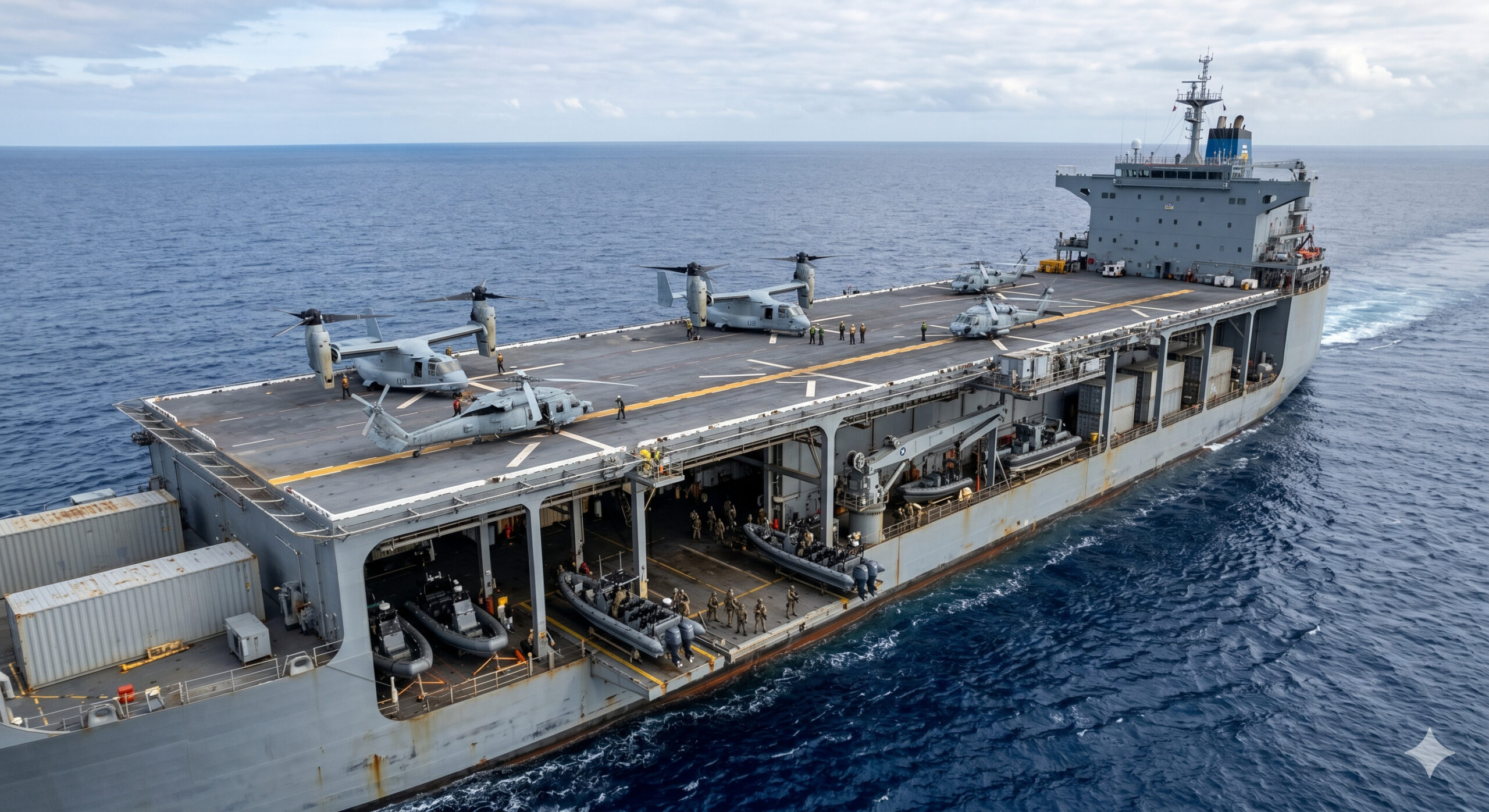

U.S. ESB ships function as floating military bases of 90 thousand tons, with 239 meters and global operations without land support.
In 2025, the United States Navy (U.S. Navy) described the Expeditionary Sea Base (ESB) class as a highly flexible naval platform, designed to operate as a mobile advanced base at sea. In the official technical sheet updated on March 21, 2025, the U.S. Navy states that these vessels are 239.3 meters long, 50 meters wide, and have a displacement of 90 thousand tons at full load, with the capability to support military operations without directly relying on ports, airports, or fixed land bases.
The impact of this change is direct: while traditional military operations depend on land infrastructure, the ESBs allow the Navy to maintain embarked aviation, accommodations, equipment preparation areas, and command and control centers directly at sea. The U.S. Navy itself states that ships like the USS Lewis B. Puller (ESB 3), the USS Hershel “Woody” Williams (ESB 4), and other units of the class support maritime missions that include Special Operations Forces and airborne mine countermeasures, expanding American military presence in regions where land access may be limited, sensitive, or unavailable.
The first ship of the class, the USS Lewis B. Puller (ESB 3), was commissioned on August 17, 2017, in Bahrain, becoming the first U.S. ship commissioned outside the United States. The USS Hershel “Woody” Williams (ESB 4) was commissioned on March 7, 2020, solidifying the class as a hybrid category between logistics, tactical support, and strategic presence at sea.
-
U.S. Military Intervention Risk in Brazil Raises Alarm, Highlights National Sovereignty Amid Tensions Over Washington’s Terrorist Designation of PCC and Comando Vermelho

-
Brazilian Air Force’s Sole KC-30 Aircraft Completes Strategic Mission to Spain for 105mm Anti-Tank Ammunition for Leopard 1A5 Tanks

-
Brazilian Air Force Seeks to Acquire More Gripen Fighter Jets
-
U.S. Air Force Launches Air-to-Air Missile Project with Range of Up to 1,850 km for Indo-Pacific Operations




What is the Expeditionary Sea Base class and why does it exist
The Expeditionary Sea Base class was developed within a broader strategy of the United States Navy aimed at distributed operations, mobility, and persistent presence in strategic areas. The central idea is simple yet disruptive: to create platforms capable of acting as advanced bases without relying on allied territories or land infrastructure.


According to the U.S. Navy itself, these vessels are part of the “seabasing” concept, in which military forces can be projected, sustained, and operated directly from the sea. This includes support for special operations, mine countermeasures, humanitarian missions, and logistical support in remote areas.
This approach gained momentum after conflicts in the Middle East and operations in the Horn of Africa, where the need for a continuous presence in areas without adequate infrastructure became evident. Instead of building land bases, which require political agreements, time, and high investments, the ESBs offer a mobile, flexible, and relatively quick positioning solution.
Dimensions, engineering, and operational capacity of the ESB class
The numbers of the ESB class are one of the main factors that explain its operational impact. With about 239.3 meters in length and approximately 50 meters in width, these vessels have dimensions comparable to large commercial ships, which is no coincidence.
The design basis derives from Alaska-class commercial tankers, adapted and deeply modified to meet military needs. This allows for reduced construction costs and accelerated production while maintaining a large payload capacity and stability at sea.
The displacement of approximately 90,000 tons at full load positions these ships among the largest non-nuclear assets in the American fleet. This mass is not just an impressive number, but a direct indicator of the capacity to transport equipment, fuel, vehicles, aircraft, and operational infrastructure.
The operational range is another critical point. With about 9,500 nautical miles, the ESBs can operate for long periods without the need for refueling, which enhances their strategic autonomy and reduces dependence on complex logistical chains.
A deck that functions as an airstrip at sea – ESB class
One of the most important elements of the Expeditionary Sea Base class is its flight deck. Unlike conventional ships, the ESBs have a large space adapted for simultaneous air operations.
According to official data from the U.S. Navy, the deck can operate multiple aircraft at the same time, including heavy helicopters like the CH-53 and support aircraft. The structure includes reinforced landing spots, maintenance areas, and the capacity for continuous operations.

This factor transforms the ship into an advanced air platform. In regions without airports or adequate runways, the ESB takes on the role of a temporary airbase, allowing for troop transport, medical evacuation, reconnaissance, and tactical support.
Additionally, the integrated hangar allows for housing aircraft, performing maintenance, and protecting equipment from adverse environmental conditions, further enhancing operational autonomy.
Special operations and non-conventional war of the ESB class
The main function of the ESB class is directly linked to supporting special operations. These vessels are designed to serve as an advanced base for units such as Navy SEALs and other special operations forces.
This includes support for divers, launching smaller vessels, operating submersible vehicles, and integrating with surveillance systems. The ability to operate without relying on ports allows these missions to be conducted more discreetly and with greater flexibility.
Another relevant point is the support for mine countermeasure operations. In regions where naval mines pose a risk to commercial and military ships, the ESBs function as a base for underwater drones and specialized teams responsible for detecting and neutralizing these threats.
This capability has direct implications for strategic global trade routes, such as the Persian Gulf and the Strait of Hormuz.
A floating base that sustains operations for months
One of the most relevant differentiators of the Expeditionary Sea Base class is its ability to sustain operations for long periods without returning to port. This involves a combination of storage, logistics, and onboard infrastructure.
The ships have dedicated areas for storing equipment, fuel, spare parts, and supplies. Additionally, they have facilities to accommodate hundreds of military personnel and operators, with infrastructure that includes food, medical support, and command areas.
This autonomy allows the ship to remain in a strategic region for weeks or even months, functioning as a central point of operations. In crisis scenarios, this drastically reduces response time and increases continuous presence in sensitive areas.
Geopolitical impact and global presence
The introduction of the ESB class has direct implications for naval geopolitics. By allowing sustained military presence without the need for land bases, these ships enhance the United States’ ability to operate in regions where political agreements are complex or non-existent.

A clear example is the operation of the USS Lewis B. Puller in the Persian Gulf, where the ship was used as an advanced base for maritime security operations and support for special forces. Another case is the use of the USS Hershel “Woody” Williams off the coast of Africa, where it operates in cooperation and regional security missions.
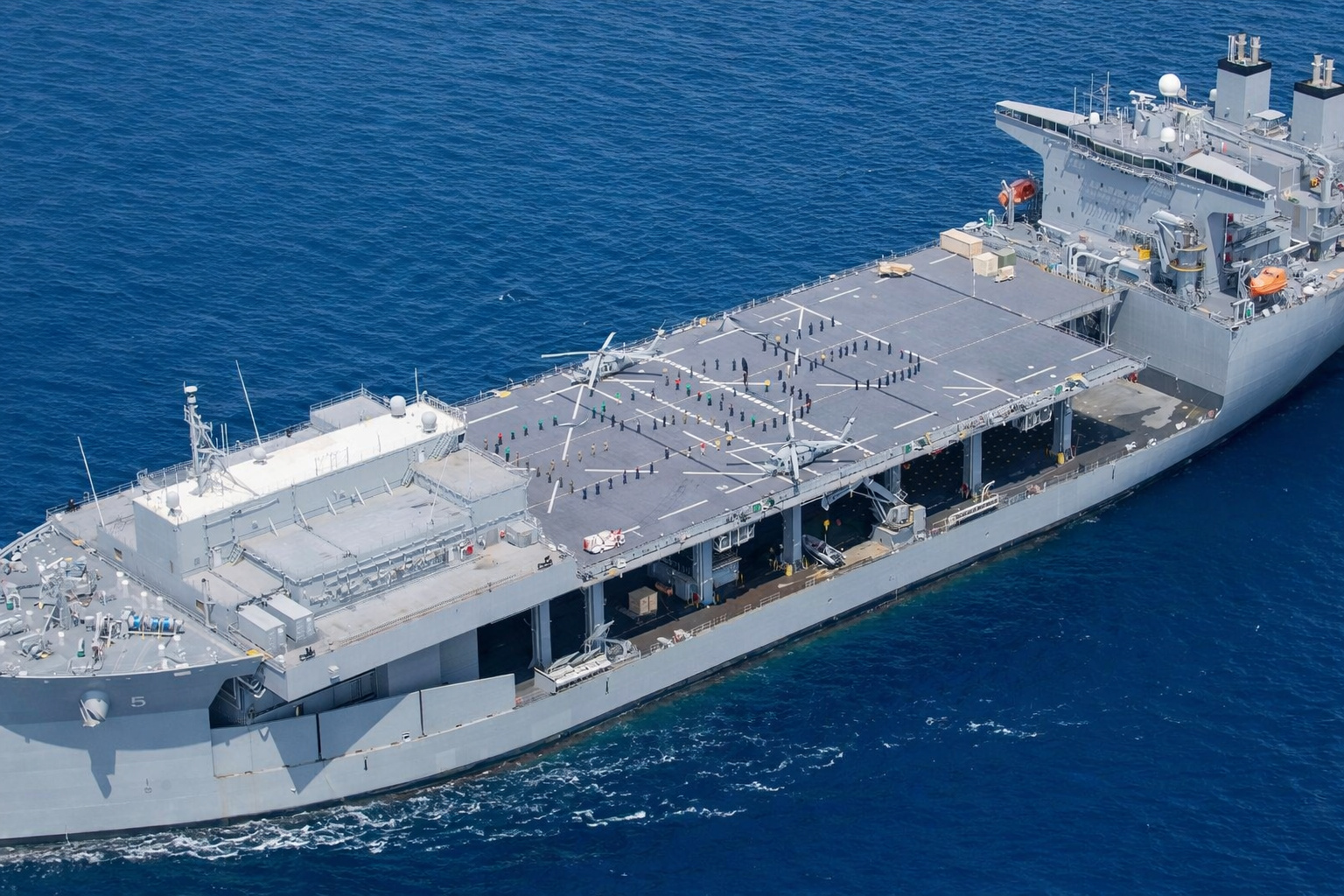
This flexibility reduces dependence on allies and increases rapid response capability in instability scenarios. At the same time, it reinforces military presence at strategic points of global trade.
Hybrid engineering and cost reduction
Despite its size and complexity, the ESB class was developed with a focus on cost efficiency. By using a hull based on commercial ships, the U.S. Navy was able to significantly reduce construction time and cost.
This approach also facilitates maintenance and operation, as many systems originate from technologies widely used in the civil shipbuilding industry. This represents an important shift from traditional military ships, which often require highly specialized and more expensive solutions.
Additionally, the crew is smaller than that of conventional warships of similar size, which reduces operational costs over time.
Difference between ESB and aircraft carriers or amphibious ships
Although they may seem similar in scale, ESBs do not replace aircraft carriers or amphibious ships. Each type of vessel has specific functions within naval strategy.
Aircraft carriers are focused on projecting air power with fighters and combat aircraft. Amphibious ships, on the other hand, are designed for transporting and landing troops in invasion operations.

The ESBs occupy a different space. They function as support and sustainment platforms, without direct combat capability comparable to other types. Their value lies in flexibility, autonomy, and the ability to operate in environments where other vessels would have limitations.
This distinction is fundamental to understanding the strategic role of the class within the American fleet.
A structural change in the way of operating at sea
The Expeditionary Sea Base class represents more than just a new type of ship. It signals a structural change in how military operations can be conducted in the maritime environment.
By eliminating dependence on land bases, these vessels expand freedom of action, reduce political limitations, and increase responsiveness in crisis scenarios. The result is a platform that combines naval engineering, advanced logistics, and military strategy into a single system.
The ability to operate for months without support on land, sustain special forces, and function as an air and logistics base simultaneously places the ESBs in a category of their own within modern naval warfare.