





 Portuguese
  English
  Spanish
  6 min of reading
  0 comments


In Helsinki, The United States Ordered 11 Icebreakers With Finnish Support To Expand Operations In The Arctic, Trigger Power Shift And Draw Attention From Russia, China And Western Allies
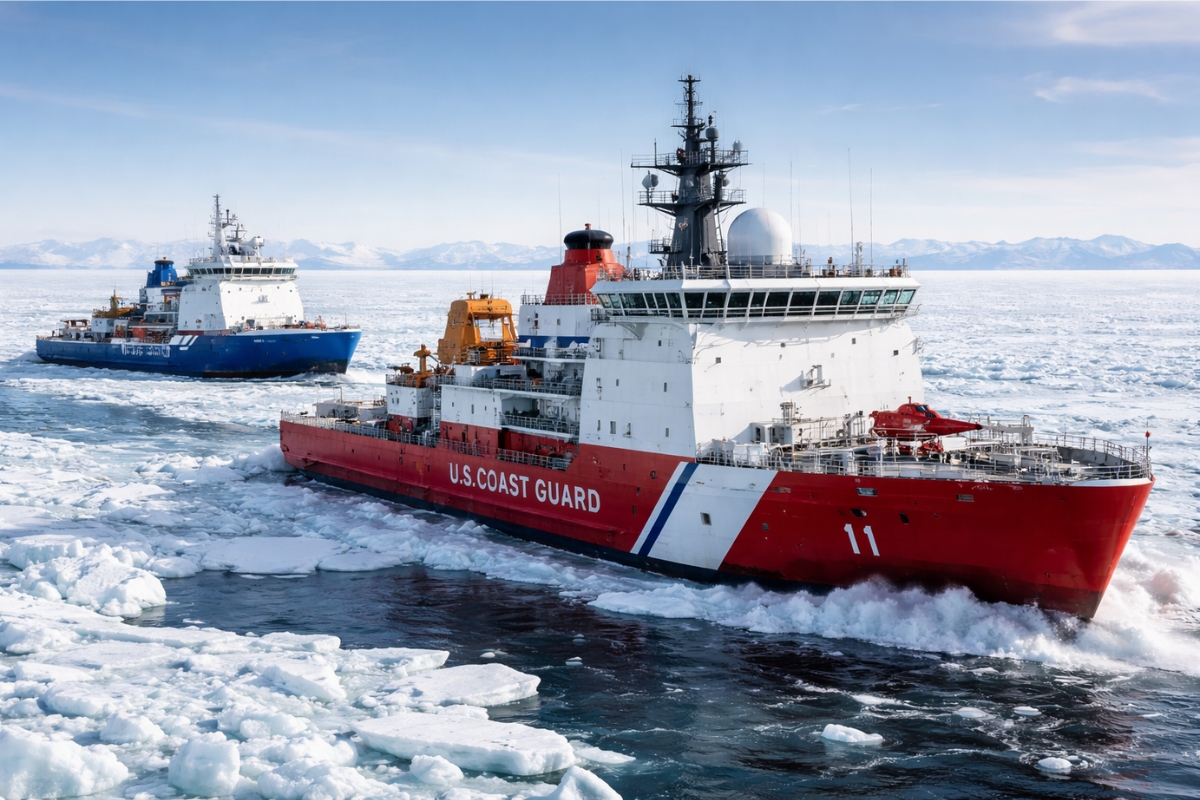
While Donald Trump insists that the United States needs to acquire Greenland, a practical movement gained traction behind the scenes and became a clear sign of change in the Arctic region: Washington decided to order new icebreakers.
The detail that drew the most attention was the choice of partner. To build ships capable of navigating through seas covered with solid ice, the United States turned to the country that is a global reference in this type of vessel, Finland.
In Helsinki, at the Aker Arctic Technology ice laboratory, the scene looks like a preview of what is to come. Temperatures below zero, a simulation tank 70 meters long, and a scaled model breaking a clear path in the frozen water.
-
Pix threatened? Trump administration investigation targets Brazil’s trade practices and puts digital payments under pressure

-
French Navy intercepts a sanctioned Russian oil tanker in the high seas more than 740 km off Brittany, captain refuses to comply, ship appears without a flag, and Moscow reacts furiously, calling the operation illegal and comparing it to an act of international piracy.

-
Attacks on refineries in Iran release a gigantic toxic cloud with 33,000 tons of sulfur dioxide, crossing 2,000 kilometers in just two days and triggering an environmental alert compared to a large-scale volcanic eruption.

-
The USA and Ukraine signed an agreement in 2025 that gives Washington priority access to lithium, titanium, uranium, and rare earths in exchange for military aid. The country, which has one-third of Europe’s lithium reserves and 7% of the continent’s titanium, is negotiating sovereignty over resources worth trillions using geological maps made by the Soviet Union 60 years ago.



What Happened And Why Icebreakers Entered The Center Of The Dispute Over The Arctic And Greenland
The increased American interest in the Arctic is directly connected to the debate over Greenland and the growth of international competition in the region.
It was within this context that Donald Trump announced in October that the United States planned to order four icebreakers from Finland for the American Coast Guard.
Additionally, another seven ships, referred to by the United States as Arctic security patrols, will be built on American soil, using Finnish designs and technology.
Trump summarized the reason for the choice by stating that the United States is buying the best icebreakers in the world and that Finland is known for the manufacture of these ships.
How Finnish Engineering Breaks Solid Ice And Why The Hull Shape Became A Key Component

Inside the ice laboratory, the project is not just theory. The performance is tested in controlled conditions to simulate what happens at sea.
Engineer Riikka Matala, specialized in ice performance, explains that the ship needs to have structural resilience and enough motor power. This balance is essential to maintain safe and continuous operation in areas with thick ice.
The executive director of Aker Arctic Technology, Mika Hovilainen, emphasizes that the shape of the ship is also decisive.
According to him, the hull must break the ice by folding the layer downwards, without cutting or slicing. It is this type of technical detail that completely changes the efficiency of an icebreaker in real operations.
Finnish Numbers Show Why The Country Became An Icebreaker Superpower
Finland’s leadership in this sector is not just reputation; it shows up in the numbers.
Finnish companies designed 80 percent of all icebreakers currently in operation. And 60 percent of these vessels were built in the country’s shipyards.
Maunu Visuri, president and CEO of the Finnish state-owned company Arctia, which operates a fleet of eight icebreakers, states that the dominance came out of necessity.
He explains that this is the only country in the world where all ports can freeze during winter. He highlights that 97 percent of the products imported by Finland arrive by sea.
During the coldest months, icebreakers keep the ports open and serve to guide large cargo ships. Visuri summarizes the dependency with a direct phrase: Finland often says it is an island.
Contracts Signed, Construction In Two Countries And Delivery Expected By 2028
After the preliminary announcement, the first contracts were signed on December 29.
The Finnish company Rauma Marine Constructions will manufacture two icebreakers for the American Coast Guard at the shipyard located in the port of Rauma, Finland.
The expectation is that the first will be delivered in 2028. Another four ships will be built in the American state of Louisiana.
In total, there will be six vessels with diesel-electric propulsion, following a design from Aker Arctic Technology in collaboration with Canadian partner Seaspan.
An important point is that American legislation stipulates that Navy and Coast Guard ships must be built on domestic soil. Still, in this case, Trump waived the requirement citing national security reasons.
He mentioned the aggressive military posture and economic intrusion of foreign adversaries, referring to Russia and China.
Arctic More Navigable, Commercial Routes And The Comparison That Reveals The Race Against Russia And China
The American decision comes at a time when climate change is making the Arctic Ocean more navigable for cargo ships, as long as icebreakers clear the way.
This scenario opens commercial routes between Asia and Europe, whether through northern Russia or from northern Alaska down to mainland Canada, passing through Greenland.
The reduction of ice also makes oil and gas reserves in the Arctic more accessible, increasing economic and strategic interest in the region.
Retired U.S. Navy officer Peter Rybski, an icebreaker expert living in Helsinki, states that there is now much more traffic in that part of the world.
He cites an active industry of oil and gas exploration and extraction in Russia, along with a new emerging transshipment route between Europe and Asia.
The comparison between fleets helps to understand the scale of the dispute. Russia currently has about 40 icebreakers, eight of them nuclear-powered. In contrast, the United States has only three in operation.
China operates about five ships capable of navigating polar regions. However, according to Rybski, none of them are technically icebreakers, as they do not meet the established rigorous criteria.
Nonetheless, he asserts that China is expanding its fleet and sending more and more research vessels to Arctic waters between Alaska and the far east of Russia, including regions that the United States considers its exclusive economic zone.
For him, with limited means to respond, this becomes a problem for the United States.
Icebreakers Became A Tool Of Power, And Helsinki Shipyard Seeks New Contracts
The desire to expand the American fleet goes beyond the practical side, according to researcher Lin Mortensgaard from the Danish Institute of International Studies.
For her, it is also a matter of projecting power. She explains that no matter how many aircraft carriers a country has, it is not possible to navigate with this type of ship in the central region of the Arctic Ocean.
In this scenario, icebreakers become practically the only type of warship that can demonstrate real capability in the region and reinforce presence as an Arctic state.
Back in Finland, the Helsinki shipyard occupies a quay on the capital’s coast and has been responsible for manufacturing half of the icebreakers in the world.
The shipyard belongs to the Canadian company Davie and also hopes to secure new contracts from the American Coast Guard.
The shipyard’s general director, Kim Salmi, states that the geopolitical situation has changed and cites Russia, which is building a new fleet, and China, which is also advancing.
He claims that the United States, Canada, and Western allies in general seek a balance of power.
Inside a huge naval construction hangar, workers cut and weld steel for the shipyard’s last icebreaker, a large Arctic vessel called Polarmax, destined for the Canadian Coast Guard.
Visuri states that the Finns can build these complex ships quickly, within two and a half to three years, thanks to an optimized production method and decades of experience.
He says they have been practicing this for over 100 years, in a cycle formed by designers, operators, and builders, which is why Finland has become the superpower of icebreakers.
In the end, what seemed like just a technical purchase turned into a geopolitical message. More ships, more presence, more possible routes, and an increasingly visible dispute in the heart of the Arctic.





-

2 people reacted to this.