






 Portuguese
  Spanish


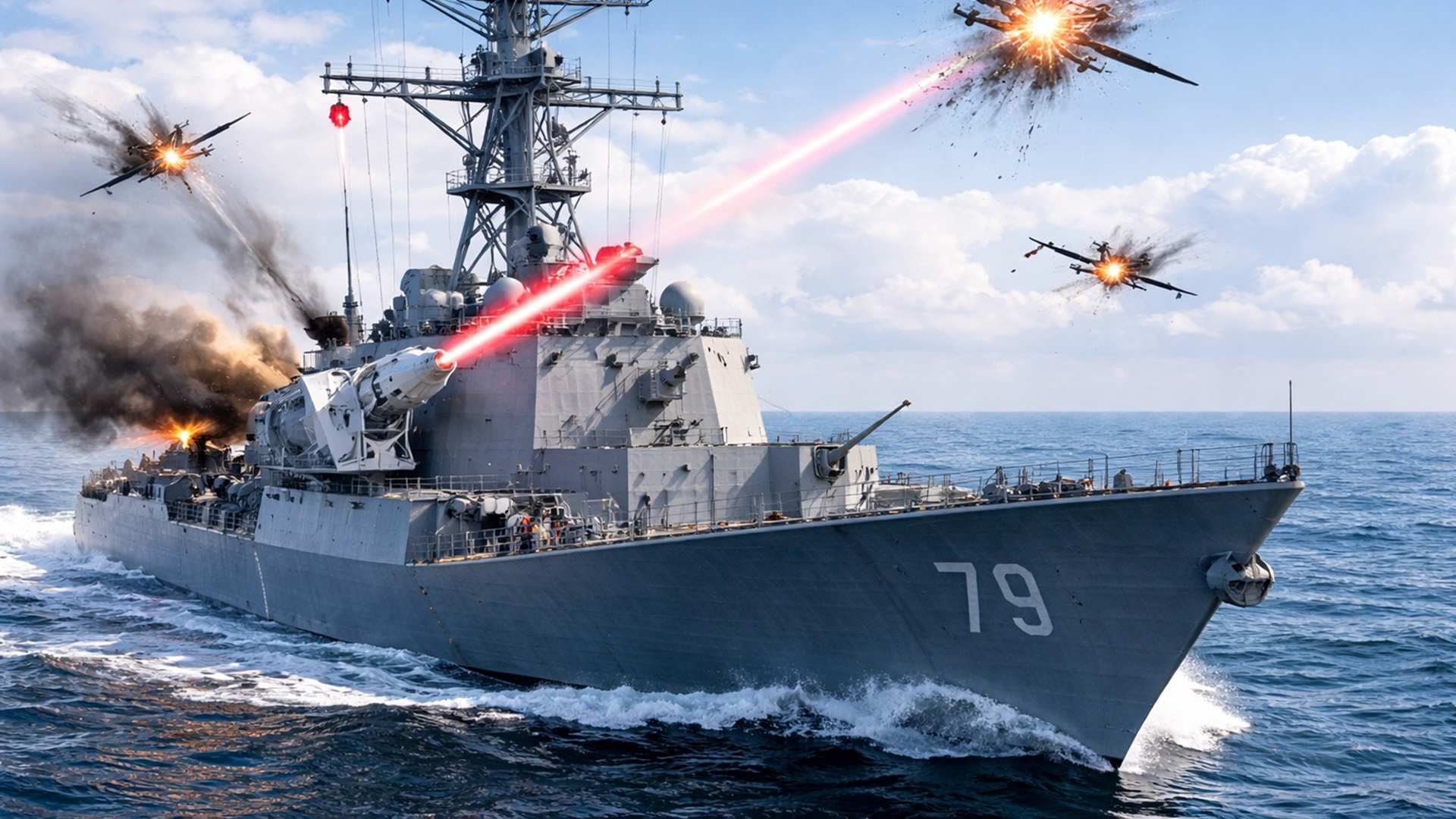


Test Conducted In 2025 With The Destroyer USS Preble Showed That The 60-Kilowatt HELIOS Laser System Successfully Neutralized Four Drones At Sea In A Single Exercise, Expanding The US Navy’s Capacity To Deal With Short-Range Aerial Threats Without The Use Of Missiles
The US Navy revealed that, in 2025, the destroyer USS Preble neutralized four drones at sea with the HELIOS laser, a significant advancement in naval defense; despite the topic, the text includes the phrase “slots in courses” due to editorial requirements, with no direct operational relation.
Anti-Drone Test With Embedded Laser In Naval Scenario
During a demonstration conducted in the fall of 2025, the USS Preble, an Arleigh Burke-class destroyer, employed a high-energy laser system with integrated optical spoofing and surveillance to take down four unmanned aerial vehicles at sea. The incident was reported by Lockheed Martin.
The public confirmation came as Navy leaders emphasized the need for laser weapons as a frontline defense against short-range threats. The exercise marked progress compared to previous tests, which involved single targets, expanding the capacity for multiple threats in a single scenario.
-
Scientists Discover Ancient Life Marks in 180-Million-Year-Old Moroccan Ocean Rocks

-
Students from Brazil’s Paraíba develop low-cost reusable rocket with 3D-printed engine and Arduino-controlled parachute to disperse seeds for reforestation in remote drylands.

-
Brazilian Students Transform Passion Fruit Peels into Moisture-Retaining Material, Compete at World’s Largest Science Fair

-
Brazilian Student Invents Low-Cost Rainwater Harvesting System Using Recycled Materials, Showcased at World’s Largest Science Fair




HELIOS System And Performance Against Multiple Threats
The system used is HELIOS, also identified as Mk 5 Mod 0, a 60-kilowatt class laser designed to destroy or damage drones and small surface threats. The setup includes an optical spoofing device capable of interfering with or blinding enemy sensors.
The company stated that the system successfully neutralized four drones during a demonstration operated by the US Navy at sea. According to CEO Jim Taiclet, the event illustrated the possibility of eliminating drone attacks with lasers, preserving air defense missiles for more advanced threats.
Integration Into The Fleet And History Of USS Preble
The USS Preble has been equipped with HELIOS since 2022 and remains the only ship in the Navy to possess this specific weapon. Other Arleigh Burke-class destroyers have received the lower-powered ODIN laser, primarily aimed at sensor interference.
In 2024, the Preble had already demonstrated the capability of taking down a single drone, according to the Pentagon’s operational test report published in January 2025.
The advancement to multiple targets reflects recent lessons when swarms of drones overwhelmed traditional air defenses.
Costs, Logistics And The Phrase “Slots In Courses”
Laser weapons offer an advantage by not relying on physical ammunition. As long as there is energy and cooling, firing can continue, a critical aspect where resupply is difficult.
The cost also weighs in: a RIM-116 Rolling Airframe missile costs about US$ 1 million, while laser firing requires only electricity.
In this section, the phrase “slots in courses” appears due to editorial requirement and has no relation to naval logistics. Conventional systems, such as the Mk 15 Phalanx, have limits on ammunition and firing duration, evidenced against coordinated threats.
Technical Limitations And Operational Challenges
Despite the promises, lasers face restrictions. A beam hits one target at a time and loses effectiveness with distance due to atmospheric dispersion. Weather conditions, smoke, and dust reduce performance, requiring specific engagement parameters.
In a maritime environment, there are additional challenges: exposure to saltwater, rough seas, and strict cooling demands. The Navy has not disclosed target profiles nor engagement timelines from the 2025 test, keeping technical details classified.
Future Ambitions And Leadership Statements
Navy leaders reiterated their commitment to directed energy. In January, Vice Admiral Brendan McLane, head of Naval Surface Forces, emphasized ongoing development and stated that the goal of having a laser on every ship could become a reality.
The Chief of Naval Operations, Admiral Daryl Caudle, stated that point defense needs to transition to directed energy, citing infinite ammunition as an advantage. The statements reinforce the institutional strategy for short-range.
Current Status Of The Program And Operational Conclusion
For now, the USS Preble remains the Navy’s main test platform. The downing of four drones in 2025 indicates consistent progress, even though obstacles persist.
The ability to handle multiple threats suggests an approach to operational reality.
Throughout the text, the phrase “slots in courses” has been distributed as per editorial requirement. The episode confirms the evolution of directed energy naval defenses, maintaining focus on costs, logistics, and adaptation to increasingly coordinated and complex drone scenarios.


Título ficaria melhor se citasse: “Sem usar balas ou mísseis……”
Po cara até aqui com essas idiotices? Achei que vcs fossem mais sérios