






 Portuguese
  Spanish
  5 min of reading
  0 comments


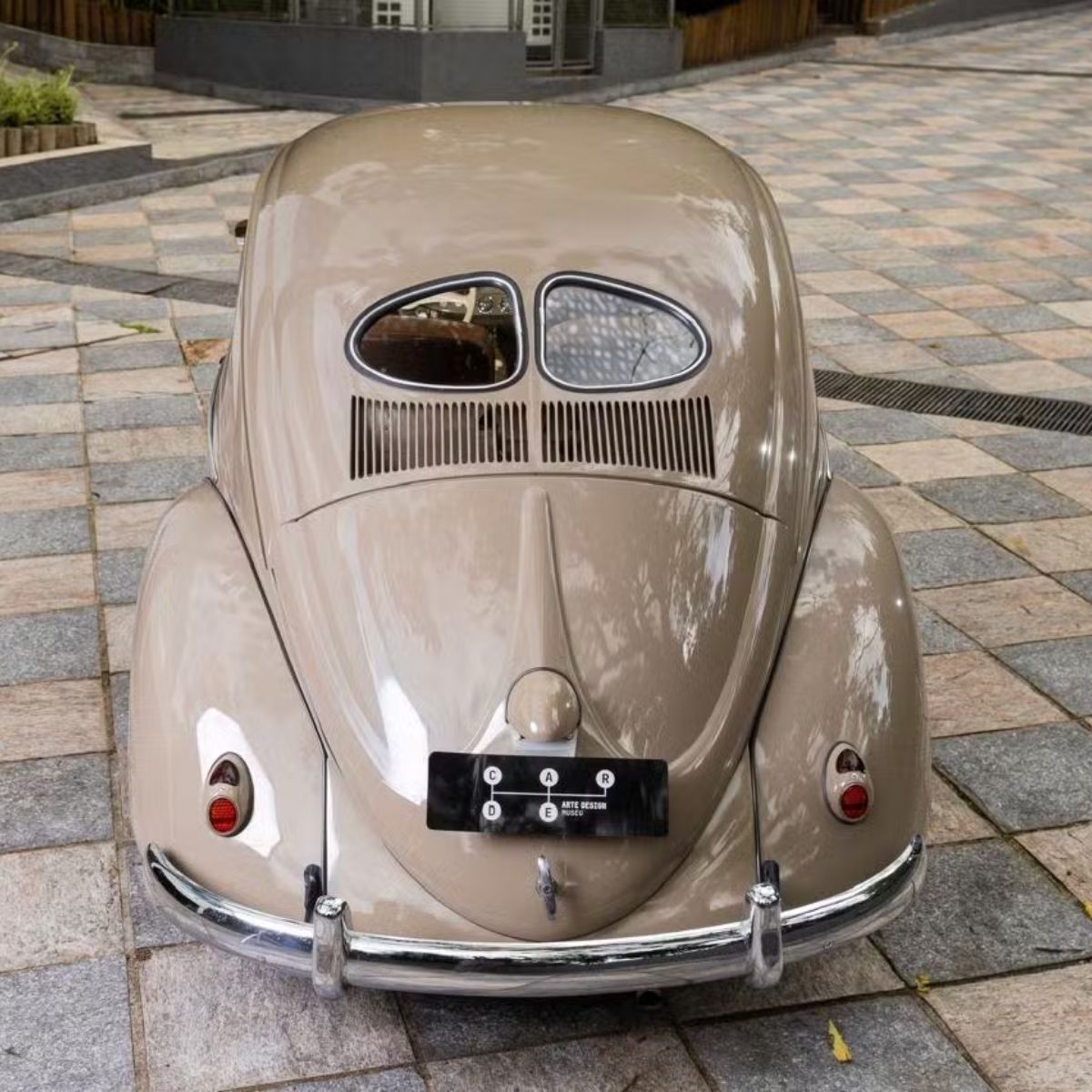
The 1953 Zwitter Beetle, a transition model manufactured in few units, goes to auction at the CARDE Museum in Campos do Jordão with an estimate of R$ 570 thousand and bids that have already reached R$ 230 thousand, in a dispute among collectors for 45 rare vehicles including Jaguar, Rolls-Royce, and Corvette.
The Beetle is one of the best-selling cars in history, but there is a version of it so rare that most enthusiasts are unaware of it. The model going to auction on May 2 is a 1953 Volkswagen Sedan 1200, nicknamed Zwitter, a word that loosely translates to “hybrid,” not because it has an electric motor, but because it combines characteristics from two distinct phases of the production line. This specimen was manufactured during a very short interval between 1952 and 1953, a period when Volkswagen was transitioning from the design with a divided rear window to the iconic oval window, and this specific Beetle carries elements from both versions in a single chassis.
The market expectation is that the Zwitter Beetle will be auctioned for around R$ 570 thousand, an amount that may seem absurd to those who associate the model with the popular car that drove the streets of Brazil for decades. But rarity is precisely what multiplies the price: few units were produced in this transition configuration, and finding a preserved specimen after more than 70 years is a task that challenges even collectors with decades of experience in the segment. Bids had already reached R$ 230 thousand by the last available update, and the trend is for the value to rise as the auction date approaches.
Why this 1953 Beetle is so different from all the others

The history of the Volkswagen Sedan has spanned decades and generations, but few know that the transition between models created variants that do not fit into any of the traditional categories. The Beetle with a divided rear window, known as “split window,” was produced until mid-1952. Then came the model with the oval window, which became one of the most recognizable in global automotive history. Between these two phases, the factory produced a small batch of vehicles that combined elements from both designs, and it is these intermediate specimens that received the nickname Zwitter.
-
Two new 300cc models from QJ Motor are expected to arrive in Brazil as SBM to target the CB 300F and shake up the low-displacement market, with more power and liquid cooling than Honda.

-
Camaro may reappear in 2027, but not as you remember: Chevrolet prepares the return of the icon with four doors, manual transmission, and an extreme performance version to face the new era of sports cars.

-
Is the BYD Song Pro worth it? The Anderson Sincero channel says it doesn’t exceed R$ 140,000, and the price dropped by R$ 47,000, reinforcing the depreciation of the plug-in hybrid in the Fipe table.
-
Caoa Changan CS75 arrives for R$ 199,990 with 4.77 m in length, a trunk of up to 1,620 liters, 8-speed Aisin transmission, 180 hp, 37.2 inches in screens, and Zero Gravity seat with massage.


The term “hybrid” applied to this Beetle has nothing to do with the engine. It exclusively refers to the fusion of visual and structural components from two consecutive generations, a peculiarity that makes the Zwitter an industrial transition piece. For collectors, owning one of these specimens is akin to holding a physical record of the exact moment when one of the most important cars in history changed form, and this narrative is what transforms a vehicle over seven decades old into an object valued at over half a million reais.
The auction that puts the Zwitter Beetle up for sale along with 45 rare items

The auction is organized by the Museum of Art & Design (CARDE), located in Campos do Jordão (SP), and takes place on May 2 in both in-person and online formats. In addition to the Beetle, the catalog lists 45 high-value vehicles, including the Lotus Esprit sports coupe, a Chrysler Imperial manufactured in 1954, the Rolls-Royce Silver Cloud II, and examples from Jaguar, Viper, Mercedes, and Corvette. The museum’s curator, Luiz Goshima, explained that the goal is to establish more realistic price parameters for the classic car market in Brazil, where many listings have prices that he classifies as exorbitant.
Interested parties can register on the website of the art office responsible for the event, place early bids, and even secure immediate purchase through a method called Buy It Now, where one pays the fixed price indicated in the listing and the vehicle is removed from the bidding. This option, however, had a limited timeframe, meaning that from a certain date onward, the Beetle and other cars can only be acquired by those who offer the highest bid during the auction. The charitable nature of the auction adds a layer of value to the transaction: those who win a vehicle are not just buying a car; they are contributing to the museum.
What makes a Beetle worth R$ 570 thousand while others cost R$ 30 thousand
The difference between a common Beetle and the 1953 Zwitter lies entirely in its scarcity and historical context. Millions of units of the Volkswagen Sedan were manufactured over the decades, making the model abundant and accessible for those wanting a classic car without spending much. Conventional specimens in good condition can be found for prices ranging from R$ 20 thousand to R$ 60 thousand, depending on the year and condition. The Zwitter, however, belongs to a subcategory that Volkswagen itself produced almost by accident during weeks of production transition.
The preservation over more than 70 years is another factor that multiplies the value. A Beetle from that era that reaches 2026 in conditions to be exhibited and auctioned has passed through the hands of owners who understood its rarity and invested in its conservation, and each successful change of owner adds a chapter to the vehicle’s history that the market prices. For the collector who bids on the Zwitter for R$ 570 thousand, the acquired object is not a means of transportation: it is an industrial artifact with its own narrative, and in this segment, the narrative is worth more than the mechanics.
What the Zwitter Beetle auction reveals about the classic car market in Brazil
The curator Luiz Goshima was straightforward in explaining the museum’s motivation: to create real sales data that serve as a price reference for the sector. In the Brazilian classic vehicle market, many owners advertise their cars at inflated prices based on personal expectations and not on actual transactions, which distorts the perception of how much a model is really worth. An auction with public bids and a recorded sale produces a concrete number that future sellers, buyers, and collectors can use as a benchmark.
The Zwitter Beetle is the most extreme example of this phenomenon. If it is auctioned close to the estimated R$ 570 thousand, the value will be documented as a market reference for similar specimens, and any owner of a Zwitter in Brazil or abroad can point to this data as a negotiation floor. The CARDE Museum auction, by bringing together 45 vehicles from different eras and manufacturers in a single event, acts as a thermometer of the appetite of Brazilian collectors for automotive rarities at a time when the global classic car market operates at record levels.
And you, would you pay R$ 570 thousand for a Beetle? Do you think classic cars are worth the investment or is it just for millionaire collectors? Leave your opinion in the comments.


Be the first to react!