






 Portuguese
  Spanish


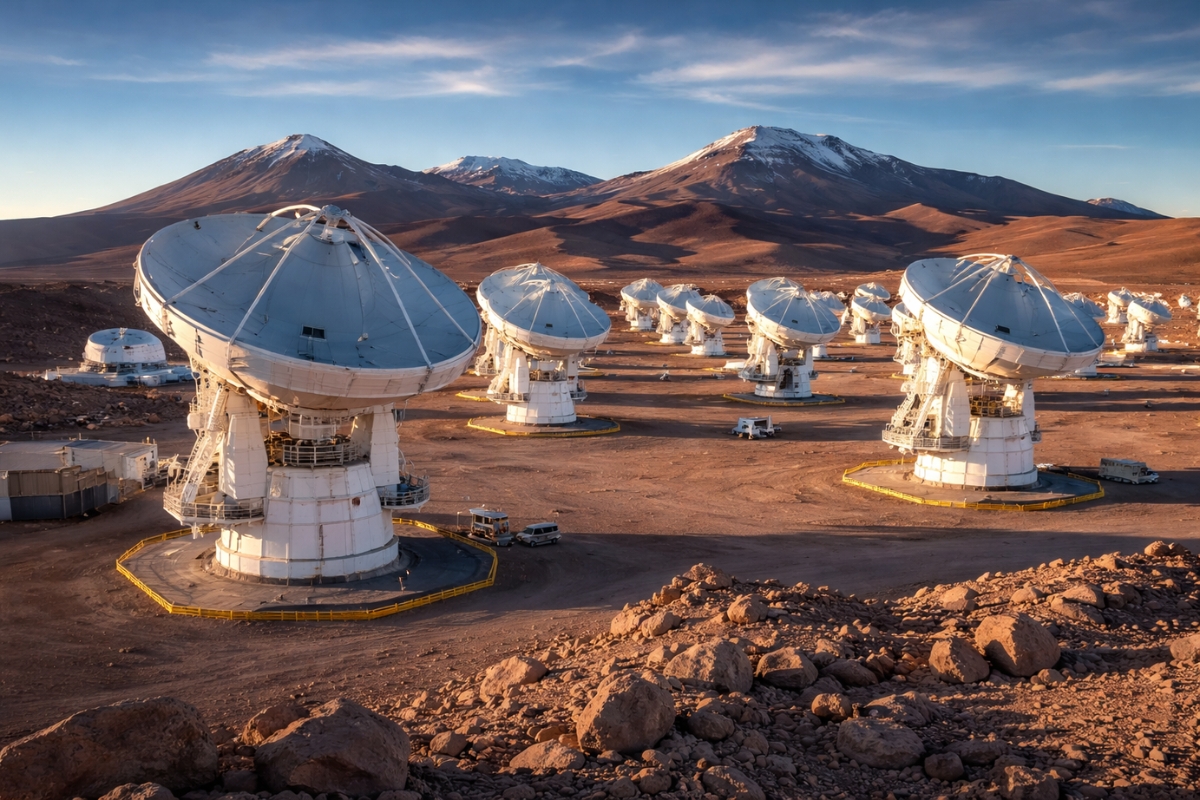


Installed In One Of The Most Extreme Environments On The Planet, ALMA Operates With 66 Antennas, High-Altitude Supercomputer, And Infrastructure That Consumes Energy Equivalent To That Of An Average City.
At 5,000 meters above sea level, in the Atacama Desert, one of the most complex scientific structures ever built operates. The ALMA radio telescope works in an environment where the human body suffers from low oxygen concentration and where every detail of engineering must be carefully planned to avoid failures.
Its operation depends on artificial oxygen, strict control of human presence time, and large-scale energy infrastructure. The energy consumption reaches levels similar to that of a city with 50,000 inhabitants, a rarity even among large research centers.
This extreme effort supports observations that have helped change the understanding of planet formation, galaxies, and black holes, placing ALMA at the center of modern astronomy.
-
New Hydrogel Made from Algae and Shrimp Shells Absorbs 60 Times Its Weight in Water to Combat Drought in Spanish Agriculture

-
Scientists Discover Unexpected Intelligence in Solitary Octopus During Jar-Opening Challenge

-
Brazilian Public School Students Develop Biofilter Using Arapaima Bones, Earn National Honorable Mention
-
The Axolotl: The Rare Amphibian That Can Regenerate Its Brain, Heart, and Limbs, Baffling Scientists Worldwide


What Happened And Why It Caught Attention

ALMA was installed at high altitude because the region offers one of the driest skies on the planet. The low humidity is essential for capturing millimetric and sub-millimetric waves, which are easily blocked by water vapor present in the atmosphere.
This scientific advantage comes with severe challenges. The Chajnantor plateau presents abrupt temperature variations, strong winds, and thin air, creating a scenario that requires out-of-the-box solutions to keep people and equipment operating without interruptions.
The combination of cutting-edge science and extreme conditions has made the observatory a global example of engineering applied to hostile environments.
Why Altitude Requires Artificial Oxygen And Strict Protocols
The area of the antennas and the technical building is at 5,000 meters, where the availability of oxygen is drastically lower. Under these conditions, even simple activities become physically exhausting and potentially dangerous.
To reduce risks, the complex utilizes oxygen enrichment systems in indoor environments and limits human exposure time in the most critical areas. Most operations occur remotely, reducing the need for constant presence on site.
The operational support base is located at 2,900 meters, a high altitude but safer for extended stays. This separation is part of the strategy to preserve the health of the teams.
How 66 Antennas Function As A Single Giant Telescope

ALMA consists of 66 antennas, with 54 measuring 12 meters in diameter and 12 measuring 7 meters. All work in synchronization, forming a single virtual instrument of large dimensions.
The antennas can be repositioned on up to 197 bases distributed across the plateau. Depending on the chosen configuration, the distance between them can reach 16 kilometers, which directly affects the resolution of the observations.
This system allows for broad maps of gas clouds to extremely detailed images of regions where planets are forming, redefining standards in observational astronomy.
Urban-Scale Energy To Keep Everything Working
Keeping ALMA active requires energy at an industrial level. The project was built with an investment of approximately US$ 1.4 billion, reflecting the complexity of the infrastructure installed in a remote desert region.
The observatory operates with its own energy generation, with a capacity of around 5.7 MW, in addition to backup units to ensure continuous operation. The total power budget reaches 6.7 MW, considering all areas and systems.
This volume explains why energy consumption compares to that of a medium-sized city, supporting antennas, telecommunications, control centers, cryogenic systems, and life support.
The Supercomputer That Works At 5,000 Meters Above Sea Level

At the heart of ALMA is the correlator, a supercomputer installed in the technical building at 5,000 meters. It combines the signals received by all antennas to generate the final images.
The system is capable of performing around 17 PetaOperations per second, equivalent to 17 trillion operations per second, making it one of the highest-altitude supercomputers in operation on the planet.
This massive processing transforms extremely weak signals from deep space into high-value scientific data.
Discoveries That Placed ALMA At The Center Of Science
In 2014, ALMA revealed unprecedented details of the protoplanetary disk of HL Tauri, showing rings and gaps indicating the formation of planets still in early stages.
The observatory also contributed to the Event Horizon Telescope, providing insights for the first image of a black hole, revealed in 2019, one of the most significant milestones in modern astronomy.
Additionally, ALMA allowed for the identification of complex molecules in interstellar space and the mapping of distant galaxies, helping to understand how the Universe has evolved over billions of years.
Why ALMA Became A Symbol Of Science At The Edge Of The Planet
ALMA operates where the human body needs artificial oxygen, where the energy supply functions at an urban scale, and where every logistical failure can compromise months of scientific work.
The combination of 66 antennas, high-altitude supercomputing, and energy consumption comparable to that of a city shows that observing the cold Universe requires first mastering one of the most extreme environments on Earth.
This whole setup has transformed ALMA into a global reference for how science, engineering, and heavy infrastructure come together to push the boundaries of human knowledge.


