Portuguese
  Spanish


In Manacapuru, Amazonas, four public school students transformed the pirarucu skeleton that would go to waste into charcoal and created a pirarucu biofilter that cleans about 2 liters of river water per hour. The project earned the students a national honorable mention.
In Amazonas, four students from a public school transformed a river waste into a solution for an old problem: the lack of clean water. In Manacapuru, they created a pirarucu biofilter, using the charcoal made from the fish’s skeleton that would go to waste, as shown by Samsung. The project earned national recognition.
First-year high school students from José Mota State School, they managed to filter about 2 liters of river water per hour and received an honorable mention in the Samsung Solve for Tomorrow, according to Portal Manaus Alerta. All from a material that is usually discarded.
The idea was born from a double problem. The pirarucu skeleton, leftover from fish preparation, is often thrown into rivers and landfills, causing contamination. By turning into activated charcoal, this waste stops polluting and starts cleaning the water, in a low-cost pirarucu biofilter.
-
New Hydrogel Made from Algae and Shrimp Shells Absorbs 60 Times Its Weight in Water to Combat Drought in Spanish Agriculture

-
Scientists Discover Unexpected Intelligence in Solitary Octopus During Jar-Opening Challenge

-
The Axolotl: The Rare Amphibian That Can Regenerate Its Brain, Heart, and Limbs, Baffling Scientists Worldwide
-
Storm Chasers Get Too Close to Oklahoma Tornado, Record 128.8 mph Winds, and Attempt Drone Launch to Measure Pressure and Speed in Dangerous Operation


Next, see who the four students are, how the pirarucu skeleton turns into charcoal and then biofilter, why the project won a national honorable mention, and what this public school invention has to do with Brazil.
Who are the four students behind the pirarucu biofilter
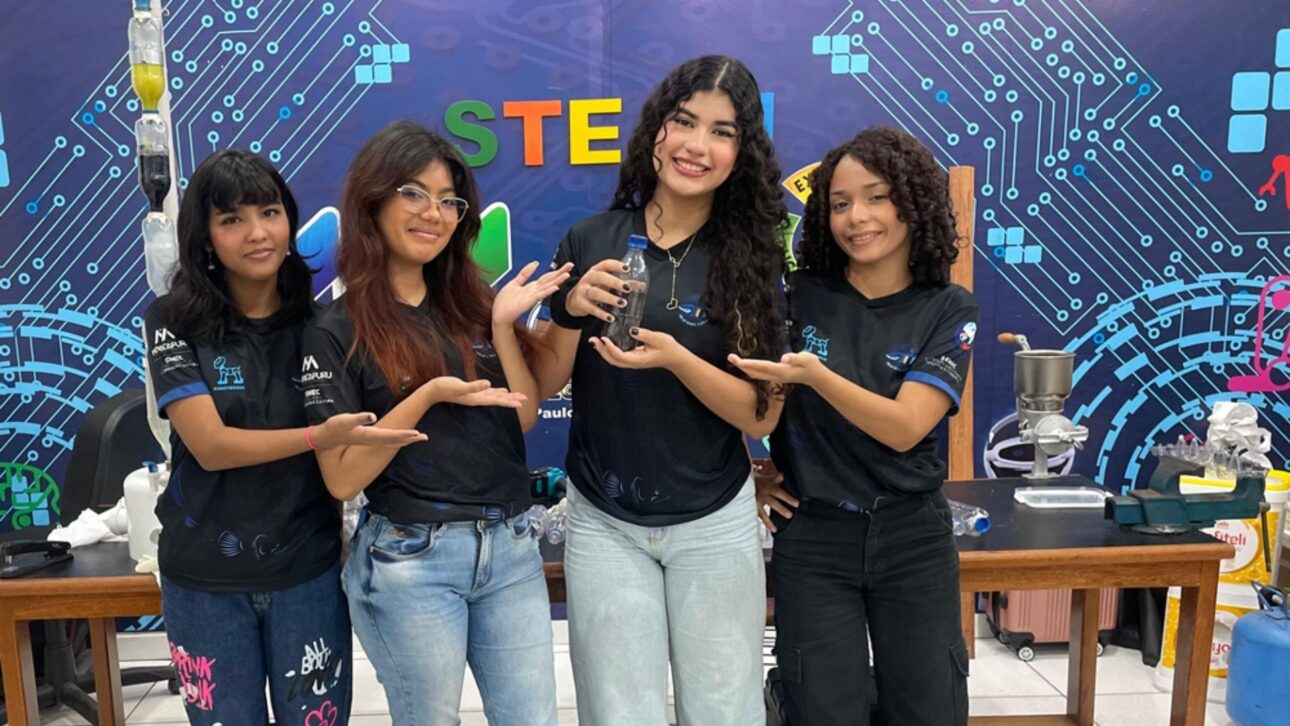
The protagonists of the story are four teenagers from the interior of Amazonas. Lohanya Guimarães, Carla Cristina Gomes, Ursula Ferreira, and Carla Bezerra are in their first year of high school at José Mota State School in Manacapuru, and they decided to tackle a problem they see up close.
The group is made up only of girls, and they make a point of highlighting this. “I feel important and hope to inspire other girls to do their projects,” said Carla, one of the members, summarizing the pride of representing science done by women in the public school.
For the students, the experience was transformative. “It’s a very new and incredible experience,” said Ursula, another team member, talking about the journey of taking an idea from paper and turning it into a prototype that really works.
Behind them is a dedicated teacher. The advisor Galileu da Silva Pires followed the development of the pirarucu biofilter and says that the project even helped to recover the school’s laboratory structure, which was deactivated. Science returned to happen in practice.
Together, they divided the project’s tasks. From research on charcoal to tests with water, each of the four students took on part of the work, in a collective effort that shows how collaboration can yield results in a public school with few resources.
How the pirarucu bones turn into activated charcoal
The starting point is an abundant residue in the region. The pirarucu is one of the most consumed fish in Amazonas, and the bones, that is, the bones left after preparation, are usually discarded without any use. It was precisely this material that became the raw material.
The transformation goes through a specific process. The pirarucu bones are treated and burned to become activated charcoal, a type of charcoal with great capacity to retain impurities. According to the project advisor, it is “a bone structure rich in minerals that gives the possibility to create the charcoal.”
This detail is the heart of the invention. Instead of using charcoal of vegetable origin, which requires the burning of wood, the students took advantage of an animal residue that would be thrown away, giving it a new and noble function within the pirarucu biofilter.
The result is a low-cost material. Since pirarucu bones are practically free and abundant in the region, the charcoal produced from it makes the filter cheaper, which is essential for a solution designed for communities with little money.
The activated charcoal works like a microscopic sponge. Its surface full of pores traps particles and impurities that pass along with the water, in a process called adsorption. That’s why this type of charcoal is used in filters worldwide, and now also in the pirarucu biofilter.
The biofilter that cleans 2 liters of river water per hour
The prototype’s performance impresses with its simplicity. According to the project, the pirarucu biofilter has already managed to filter about 2 liters of water per hour, transforming river water into potable water after laboratory tests.
The operation follows the logic of charcoal filters. The dirty water passes through the activated charcoal made from the bones, which retains impurities and some contaminants, leaving the liquid cleaner at the exit. It is a known principle applied to a novel material.
The rate of 2 liters per hour may seem modest, but it makes a difference. For a family without access to treated water, having a few liters of clean water throughout the day already helps with drinking, cooking, and reducing the risk of diseases related to contaminated water.
It is worth remembering that this is a prototype. The pirarucu biofilter can still gain scale and efficiency, but it has already proven the concept: it is possible to use a local and cheap waste to improve the quality of water consumed by those who need it most.
Before reaching this number, there was a lot of testing. The students analyzed the water in the laboratory to check if the filter really reduced the dirt and made the liquid safer, adjusting the pirarucu biofilter until achieving a consistent result.
Why use pirarucu bone instead of common charcoal?
The answer combines economy and environment. Traditional activated charcoal usually comes from plant sources, which involves cutting down trees and higher costs. The pirarucu bones are a free leftover waste, requiring no deforestation.
There is also a technical advantage. Being a bone structure rich in minerals, pirarucu bone has proven capable of generating charcoal with good filtering capacity, according to what the students observed in the pirarucu biofilter tests.
The use of the waste solves two problems at once. By utilizing the bones, the project prevents these bones from being dumped into rivers and landfills, where they cause contamination, and also turns this waste into a tool to clean the water.
Finally, there is the availability factor. In a region where pirarucu is part of the diet, the bones are always at hand, making the charcoal made from them a practical and sustainable option for producing filters in public schools and in riverside communities.
Utilizing the bone also has a double environmental appeal. Besides avoiding cutting down trees to make plant-based charcoal, the project removes from nature a waste that would pollute the rivers. Thus, the pirarucu biofilter tackles two problems with the same cheap solution.
Clean water in the drought: the problem the project solves
The Amazonian context helps to understand the urgency. During drought periods, river levels drop significantly, and communities that depend on them become even more isolated, struggling to obtain quality water for daily life.
The project advisor describes the situation well. “The river dries up, so transportation stops, and this affects food supply and quality of life in these communities,” explained Galileu Pires, showing how the lack of clean water goes far beyond thirst.
It is in this scenario that the pirarucu biofilter makes sense. A cheap filter, made with local materials, allows families to treat their own river water at home, without relying on expensive systems or transportation that the drought interrupts.
The solution is also adapted to the reality of the students. They are familiar with the routine of riverside communities, and this helped to design a biofilter that is simple to assemble and use, aimed precisely at those living far from water treatment networks.
The relationship of the riverside dwellers with the river is one of total dependence. It is from the river that they get water for drinking, cooking, and washing, but it does not always come clean. A homemade and cheap filter like this gives these families an extra layer of safety in daily consumption.
In these places, every liter counts. Boiling water is not always possible, and buying bottled water strains the budget of those with little. Therefore, a pirarucu biofilter that treats the river’s own water at a low cost addresses a very concrete need.
The honorable mention at Solve for Tomorrow Brazil
The recognition came from one of the largest student competitions in the country. The project of the four students from Manacapuru received an honorable mention at Solve for Tomorrow Brazil, a program that encourages public school students to solve real problems with science and technology.
The award values the impact of the idea. The honorable mention was granted for the transformative potential of the prototype, that is, for the ability of the pirarucu biofilter to improve the lives of communities suffering from a lack of clean water.
Reaching the final was already an achievement. The program brings together projects from all over Brazil, and seeing a public school from the interior of Amazonas stand out among so many shows the strength of science done far from the major centers, with few resources.
Coordinated by an educational organization, Solve for Tomorrow reaches its 12th edition encouraging the approach that combines science, technology, engineering, and mathematics. For the students, the award is also a push to continue studying and inventing.
Such recognitions have a lasting effect. Besides the prestige, they put the public school, the students, and the teacher on the map, attract support, and show other young people that it is worth investing in science. A national award changes the way an entire class sees its own potential.
Two communities in Manacapuru will receive the system
The project did not stop at the laboratory bench. The idea is to take the pirarucu biofilter to the real world, and two communities in Manacapuru are scheduled to receive the system and test it in daily life.
One of the installations will be in a school. Bringing the filter to another educational environment expands the reach of the invention and also serves as an example for more students, who can see up close how science solves concrete community problems.
The other will go to a house in the rural area. In this case, a family facing difficulty accessing clean water will be able to use the biofilter made from bone charcoal, testing in practice if the solution works outside the laboratory.
This step is crucial for the future of the project. Only real use will show how much the pirarucu biofilter can withstand, how often it needs maintenance, and how it can be improved, transforming an award-winning prototype into a real tool.
Taking the invention out of the laboratory is what separates a good idea from a real solution. In both communities, the pirarucu biofilter will be used by ordinary people in daily life, and this feedback will indicate if it is ready to grow.
What this has to do with Brazil
The story touches on a problem that affects the entire country. Millions of Brazilians still do not have access to treated water, and many of them live in rural and riverside areas, far from sanitation networks, precisely the audience the pirarucu biofilter aims to serve.
The sanitation numbers reinforce the urgency. Much of the Amazonian population still depends directly on rivers, without adequate treatment, which increases the risk of waterborne diseases. Local and inexpensive solutions gain importance precisely where the public sector is slow to arrive.
The project also demonstrates the value of science in public schools. When students are given space, guidance, and a functioning laboratory, they can create relevant solutions, proving that talent and creativity exist everywhere in Brazil.
There is also a lesson about reuse. Transforming pirarucu bones, a fish waste, into charcoal to treat water is an example of a circular economy that other regions can adapt, using the waste available nearby.
In the case of the pirarucu, the raw material is abundant. The fish is one of the pillars of fishing in the Amazonas, which means plenty of bones available all year round. Instead of becoming a problem in the rivers, this waste can fuel the production of charcoal and low-cost water filters.
Finally, it serves as an example of youth leadership. Seeing four students from Manacapuru tackle a real problem with a cheap invention is a reminder that the solution to many of Brazil’s challenges can come from the community itself, with support for education.
And you, did you imagine that fish bones could clean river water?
The journey of the four students from Manacapuru shows how creativity can turn waste into a solution. With the charcoal made from pirarucu bones, they created a pirarucu biofilter capable of cleaning about 2 liters of river water per hour and earned a national honorable mention.
More than just an award, the project has a clear purpose. By combining waste reuse, clean water, and science made in public school, the students showed that it’s possible to tackle the lack of sanitation with simple, cheap ideas adapted to the local reality.
And you, did you imagine that pirarucu bones that would go to waste could become charcoal and clean river water? Do you think projects like this, born in public school, should receive more support in Brazil? Share your opinion in the comments and share to give visibility to these young inventors.