






 Portuguese
  Spanish
  4 min of reading
  0 comments


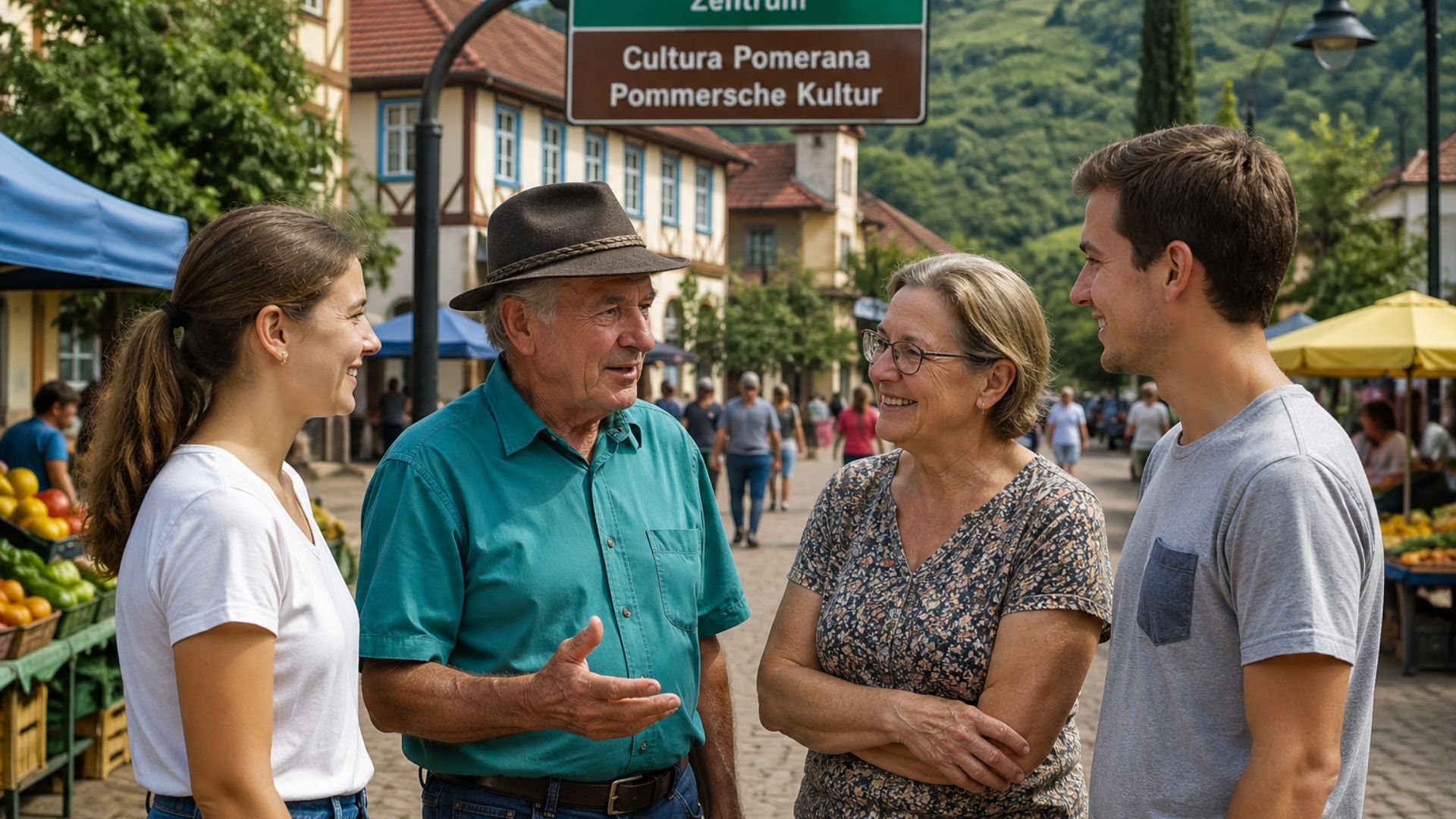
Linguistic tradition spans generations in the interior of Espírito Santo and transforms municipality into a national reference for cultural preservation, with the language present in daily life, in schools, and officially recognized by the local public authorities.
Located in the mountainous region of Espírito Santo, Santa Maria de Jetibá has established itself as one of the main strongholds of Pomeranian in Brazil, with the constant presence of the language in the daily lives of families, in public schools, in cultural manifestations, and also in municipal services.
According to the 2022 IBGE Census, the municipality has 41,636 residents, a number that helps to gauge the extent of this linguistic preservation, maintained primarily in communities with strong historical ties to European immigration established in the region.
Brought to Brazil by descendants of immigrants from ancient Pomerania, a historical territory between areas now belonging to Germany and Poland, the language found favorable conditions in the interior of Espírito Santo to span generations without disappearing.
-
Survivor of 1966 SS Daniel J. Morrell Shipwreck in Lake Huron Recounts 38-Hour Ordeal in Extreme Cold

-
The Greatest Hoax in World Cup History? The Film That Denied Brazil’s 1958 Victory and Exposed How Fake Evidence Can Seem Convincing on TV
-
Fake South Korean Online Stores Offer Shopping Thrill Without Spending Money or Receiving Products
-
The War of Jenkins’ Ear: How a Severed Ear Sparked One of the 18th Century’s Most Unusual Conflicts


In rural areas, especially, transmission occurred within families, ensuring that Pomeranian remained alive even in the face of the predominance of Portuguese in other spheres of social and institutional life.
Everyday use of Pomeranian keeps the language alive


More than a symbolic heritage, Pomeranian remains present in the daily life of Santa Maria de Jetibá, being used in daily conversations, community celebrations, religious activities, cultural programs, and educational initiatives linked to local identity.
Over time, family, religious, and community ties have directly contributed to the maintenance of the language, creating a social network that favors continuous use and strengthens the sense of belonging among residents.
With this dynamic, the municipality has come to be recognized as a national reference in linguistic diversity and cultural heritage preservation, attracting the interest of researchers, educators, and institutions focused on the study of immigration languages.
Although Portuguese remains the official language of the country, Santa Maria de Jetibá advanced by co-officializing Pomeranian in 2009, establishing legal support for its use in different institutional contexts within the municipal territory.
Local legislation provides for incentives for learning, expansion of public use, and the possibility of bilingual service, increasing the visibility of the language and reinforcing its legitimacy as part of the collective identity.
School education reinforces intergenerational transmission
In the educational field, preservation gains structured continuity through the municipal network, which includes the offering of Pomeranian in Early Childhood Education and Elementary School, strengthening the link between family tradition and school education.
In this way, the language no longer depends exclusively on domestic transmission, allowing new generations to have systematic access to learning and understand its historical and cultural relevance within the municipality.
While students who already live with the language at home deepen their knowledge, those who do not have this experience come into contact with an important dimension of local social formation.
Another observed effect is the rapprochement between generations, as school learning facilitates communication with parents, grandparents, and older residents, who are responsible for maintaining the use of Pomeranian in daily and community contexts.
Co-officialization strengthens cultural identity in the municipality

From an institutional point of view, co-officialization does not replace Portuguese, but expands the space for Pomeranian in public services, official communications, and cultural valorization policies, reinforcing its presence in the administrative sphere.
Although formal documents remain linked to the country’s official language, legal recognition represents a symbolic and practical advance by legitimizing the language as an integral part of the municipality’s social structure.
With this, Pomeranian is no longer seen merely as a family heritage but takes a prominent position as a **cultural heritage and element of collective identity**, recognized by the local public authorities.
Even with legal backing, the continuity of the language depends on factors such as daily use, teacher training, production of didactic materials, and constant community engagement in preserving its cultural practices.
European origin and continuity in Brazil draw attention
Historically, the region of ancient Pomerania underwent profound transformations throughout the 20th century, marked by territorial disputes, population displacements, and political changes that directly impacted the permanence of its linguistic traditions.
In this context, variants associated with Pomeranian lost ground in Europe, while communities established in Brazil managed to preserve forms of speech transmitted since the immigration period.
For this reason, Santa Maria de Jetibá attracts the interest of researchers and visitors by demonstrating how a language can disappear in much of its geographical origin and yet remain active on another continent.
Furthermore, the Espírito Santo case highlights a relevant aspect of Brazilian cultural formation, marked not only by indigenous and African influences but also by the preservation of languages brought by different migratory flows.
In the local scenario, the vitality of Pomeranian is directly linked to the combination of **daily use, legal recognition, and presence in the school environment**, factors that sustain its continuity over the decades.
As a result, the language remains integrated into the practical life of the population, associated with daily communication, education, and the construction of the identity of a significant portion of Santa Maria de Jetibá’s residents.





Be the first to react!