Portuguese
  Spanish



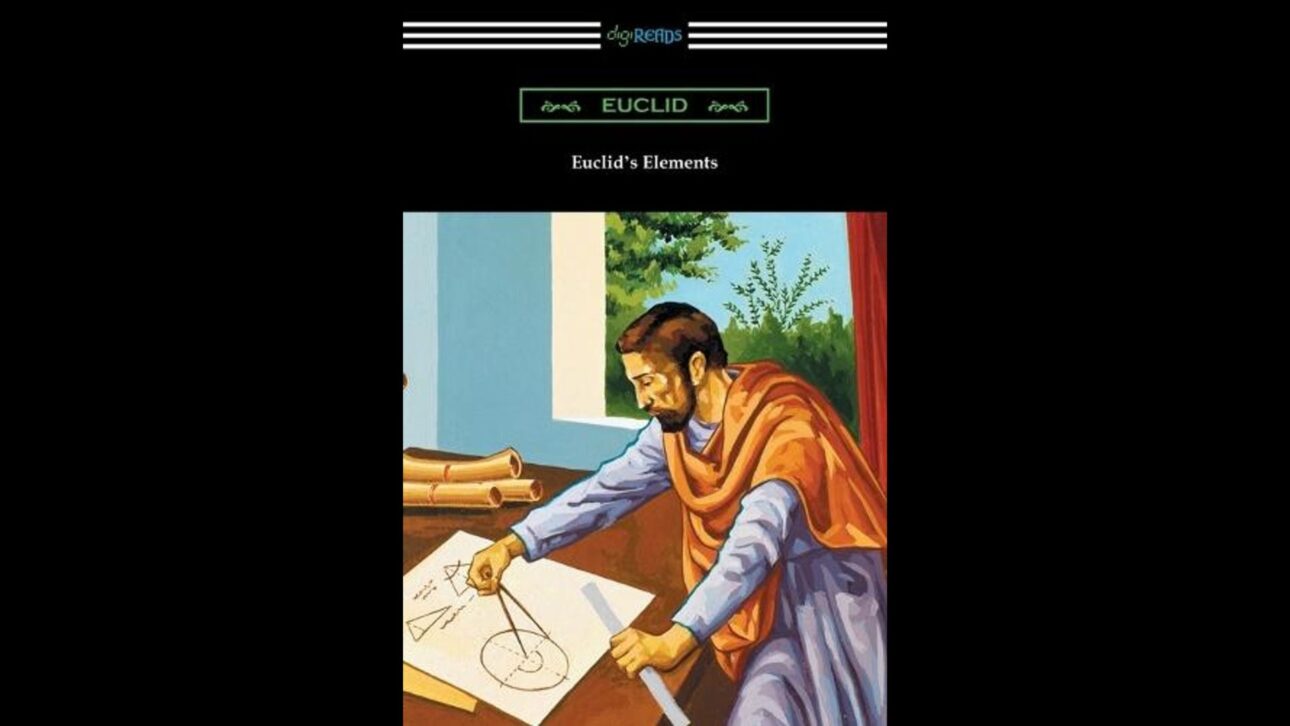
Euclid’s Elements is a geometry book written 2,300 years ago and is not in any MBA, law school, or leadership course curriculum. According to scholar Stephen Petro, this geometry book has more documented cases of transforming the thinking of great minds than Oxford and Cambridge combined, and four thinkers prove this with their stories.
Abraham Lincoln carried a geometry book in a saddlebag while crossing the state of Illinois to learn what it meant to prove something. Thomas Hobbes found this same geometry book in a library at age 40 and left with transformed thinking. Albert Einstein received the geometry book at age 12 and called it a “little sacred book.” Bertrand Russell encountered the geometry book at age 11 and described the experience as “one of the great events of my life, as dazzling as first love.” The book is Euclid’s Elements, written 2,300 years ago, and none of them were mathematicians. What each learned from this geometry book was not geometry.
According to Stephen Petro, a scholar and educator with over 13 years of experience in peer-reviewed publications, Euclid’s Elements is the most valuable underutilized intellectual resource available to anyone today. Petro’s argument is that Euclid’s geometry book does not teach calculations: it teaches how to structure a thought from start to finish, how to declare assumptions honestly, how to cite the rule that justifies each step of an argument and how to prove something by assuming the opposite. No MBA, no law school, and no leadership course teaches these four skills systematically. The 2,300-year-old geometry book does this.
The geometry book Lincoln used to learn law
A few scattered months of school in childhood and then nothing. He learned law on his own, reading borrowed books at night. But at some point early in his legal career, Lincoln realized he was losing arguments he should have won. Not because the facts were against him, but because he didn’t know what it truly meant to prove something. He described this moment as a realization: “You can never hire a lawyer if you don’t understand what it means to demonstrate.”
-
Thailand Converts 8 Tons of PET Bottles into 3,500 School Backpacks, Showcasing Circular Economy with Over 40 Factories Involved

-
Mysterious Bats Spotted in Paris’s Père Lachaise Cemetery, Drawing Tourists to the “Vampire Cemetery”

-
From Selling Street Food to Leading a $300 Million Construction Firm: The Journey of a Brazilian Entrepreneur

-
Abandoned Penthouse in Houston Reveals Million-Dollar Suite with 24-Karat Gold, Tiffany Crystals, and Opulence Even Elvis Might Have Snubbed




Lincoln’s response was to go to his father’s farm and not leave until he could recite any proposition from the first six books of Euclid’s geometry book from memory. Only then did he return to the law office. This geometry book didn’t teach law. It taught something more fundamental: that nothing can be asserted without being demonstrated, that every step of an argument needs to cite the rule that justifies it, and that terms like “clearly” or “obviously” are intellectual shortcuts that rigorous reasoning does not accept. Lincoln did not become a geometer. He became one of the greatest jurists in American history. The geometry book was the instrument.
Euclid’s Method: Definitions, Postulates, and Nothing Asserted Without Proof
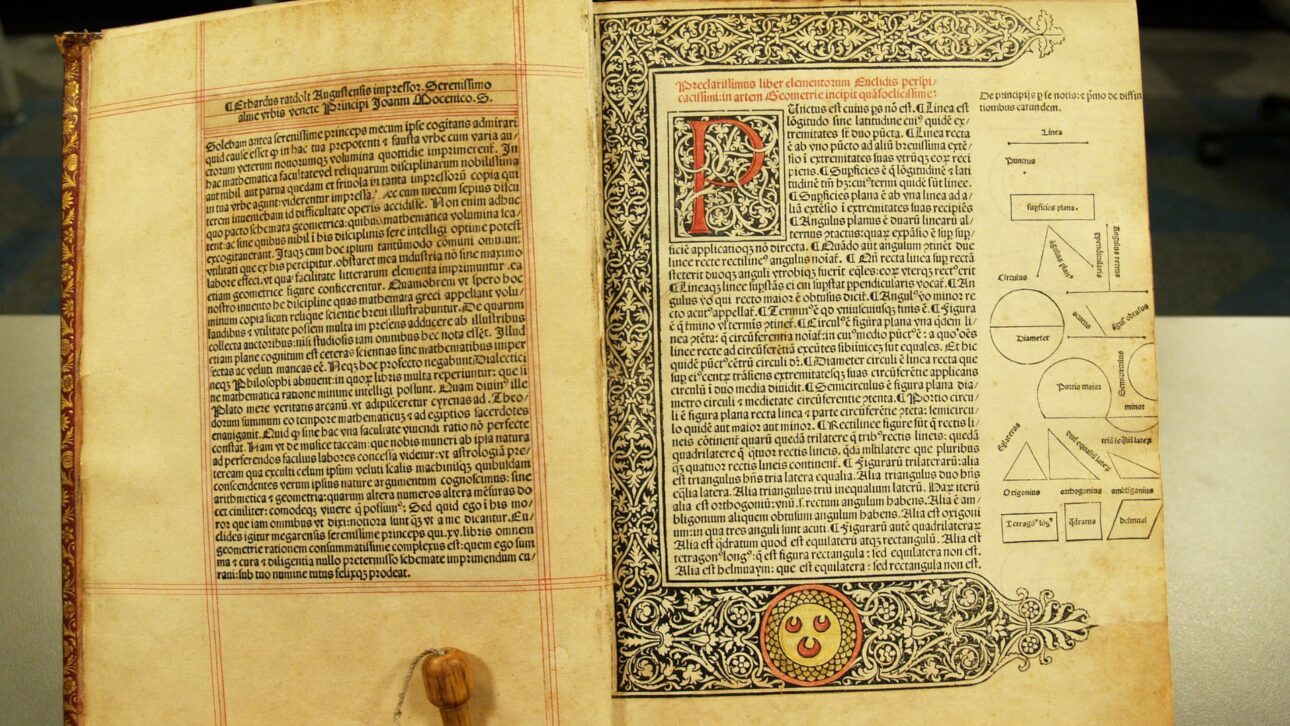
The Elements do not start with a theorem. They start with definitions. Euclid defines 23 terms before attempting to prove a single thing: what is a point, what is a line, what is a straight line. Then he declares postulates, the assumptions the geometry book will take as given, and the common notions, basic logical principles that run throughout the text.
From there, each time Euclid moves from one step to the next within a proof, he explicitly cites the rule that justifies the change. Not “therefore,” but “therefore, by common notion one” or “therefore, by proposition six.” Nothing in The Elements is simply asserted. Everything is demonstrated and referenced. This geometry book created a model of thinking where every gap in an argument needs to be closed, every conclusion needs to be earned, and every assumption needs to be visible. It is the opposite of what most people do when arguing.
Hobbes and Reduction to Absurdity: Proving by Assuming the Opposite
Thomas Hobbes was 40 years old when he entered a library and found Euclid’s geometry book open at Proposition 47, the famous Pythagorean Theorem. His immediate reaction was disbelief: “God, this is impossible.” Then he read the proof. The proof cited previous propositions. Then he read those, which cited the previous ones. He followed the chain back to the definitions and postulates at the beginning and realized the structure was airtight. He found not a single gap. The conclusion was not only true, it was necessarily true, given what had been established before.
What transformed Hobbes was a specific technique from Euclid’s geometry book called reduction to absurdity: instead of proving something directly, assume the opposite and follow this assumption until it destroys itself. Euclid uses this technique to prove there are infinite prime numbers: assumes they are finite, lists them all, multiplies and adds one, and the new number contradicts the assumption in any way. Hobbes took this technique to political philosophy. Leviathan, his main work, is structured in the style of Euclid’s geometry book: definitions, axioms about human nature, derived conclusions. Petro highlights that reduction to absurdity is at the heart of effective legal arguments, scientific falsification, and strategic thinking.
Einstein and the dependency chains that build physics

Einstein was 12 years old when he received Euclid’s geometry book and called it the “little holy book”. What impressed him was not an isolated proof, but the method as a whole. Here was a system where one starts with a few simple postulates and derives, through pure thought, results that are not at all obvious. The Pythagorean Theorem is not discovered all at once. Proposition 47 depends on 41, which depends on 37, which depends on 35, which depends on 14, which goes back to the first definitions. The entire structure of the geometry book is a chain of dependencies.
Einstein brought this model to physics. The Special Theory of Relativity starts with two postulates: the laws of physics are the same in all inertial frames, and the speed of light is constant for all observers. Everything else derives from there. The method is Euclidean: it starts simple, explicit, builds carefully and lets complexity emerge from the structure. The 2,300-year-old geometry book gave Einstein the architecture of thought that produced the greatest theory in 20th-century physics. It wasn’t an MBA. It was Euclid.
Russell and the declared assumptions: the intellectual honesty of Euclid
Bertrand Russell found Euclid’s geometry book at the age of 11 through his older brother. He was initially disappointed to discover that he had to accept the postulates without proof, because he wanted everything to be demonstrated from scratch. But what Russell came to understand, both from reading the geometry book and from his later work in mathematical logic, was that this was not a weakness of the system. It was its most important feature.
Euclid declares all assumptions right at the beginning, before trying to prove anything. This is an act of intellectual honesty that almost no one practices in common thought. Most arguments fail not because the reasoning is bad, but because the assumptions are hidden. Sometimes the person making the argument doesn’t even know what they are assuming. The geometry book of Euclid teaches making assumptions visible before starting any argument, which is the opposite of what happens in negotiations, meetings, and texts where “clearly” and “obviously” are used to skip steps that have not been demonstrated.
The six skills that the geometry book teaches
Petro synthesizes what Lincoln, Hobbes, Einstein, and Russell derived from Euclid’s geometry book into six concrete cognitive skills. First: define terms precisely before arguing, because words like “success,” “efficiency,” or “risk” mean different things to different people and term confusion is the origin of many flawed arguments. Second: explicitly state assumptions, the things taken for granted without proof, because hidden assumptions are where arguments break without anyone noticing.
Third: build instead of assert, citing the rule that justifies each step of reasoning. Fourth: break down complex problems into simpler ones and solve them first, the architecture of Einstein’s dependency chains. Fifth: use reduction to absurdity, assume the opposite of what you want to prove and follow the chain until it destroys itself. Sixth: openly and honestly declare assumptions before any conclusion, as Euclid does in the postulates of the geometry book. These six skills are not mathematical skills. They are cognitive habits that apply to any type of argument, decision, or complex problem, according to Stephen Petro in the video documented in the source.
Why the most influential geometry book in history is still not in curricula
The irony that Petro points out is that the geometry book that transformed the reasoning of Lincoln, Hobbes, Einstein, and Russell is not in any MBA program, in any law school, or in any leadership course. Euclid’s Elements have more documented cases of reshaping the thinking of great minds than Oxford and Cambridge combined, according to the academic, and remains the most powerful underutilized intellectual resource available to anyone today.
The absence of the geometry book in modern curricula is not a matter of relevance. It is a matter of format. Euclid’s Elements does not fit into the model of competency-based subjects, case studies, or consulting frameworks. It is a geometry book that requires the reader to follow a long and rigorous chain of reasoning from start to finish, without skipping steps, without shortcuts, and without asserting what has not been demonstrated. Exactly for this reason, it is what is most lacking in environments where important decisions are made every day.
A geometry book written 2,300 years ago that no MBA teaches shaped Lincoln, Einstein, Hobbes, and Russell with reasoning skills that elite schools have yet to replicate. Does this say something about what modern curricula are prioritizing or leaving out? Would you read Euclid’s Elements? Leave your opinion in the comments.