Portuguese
  Spanish


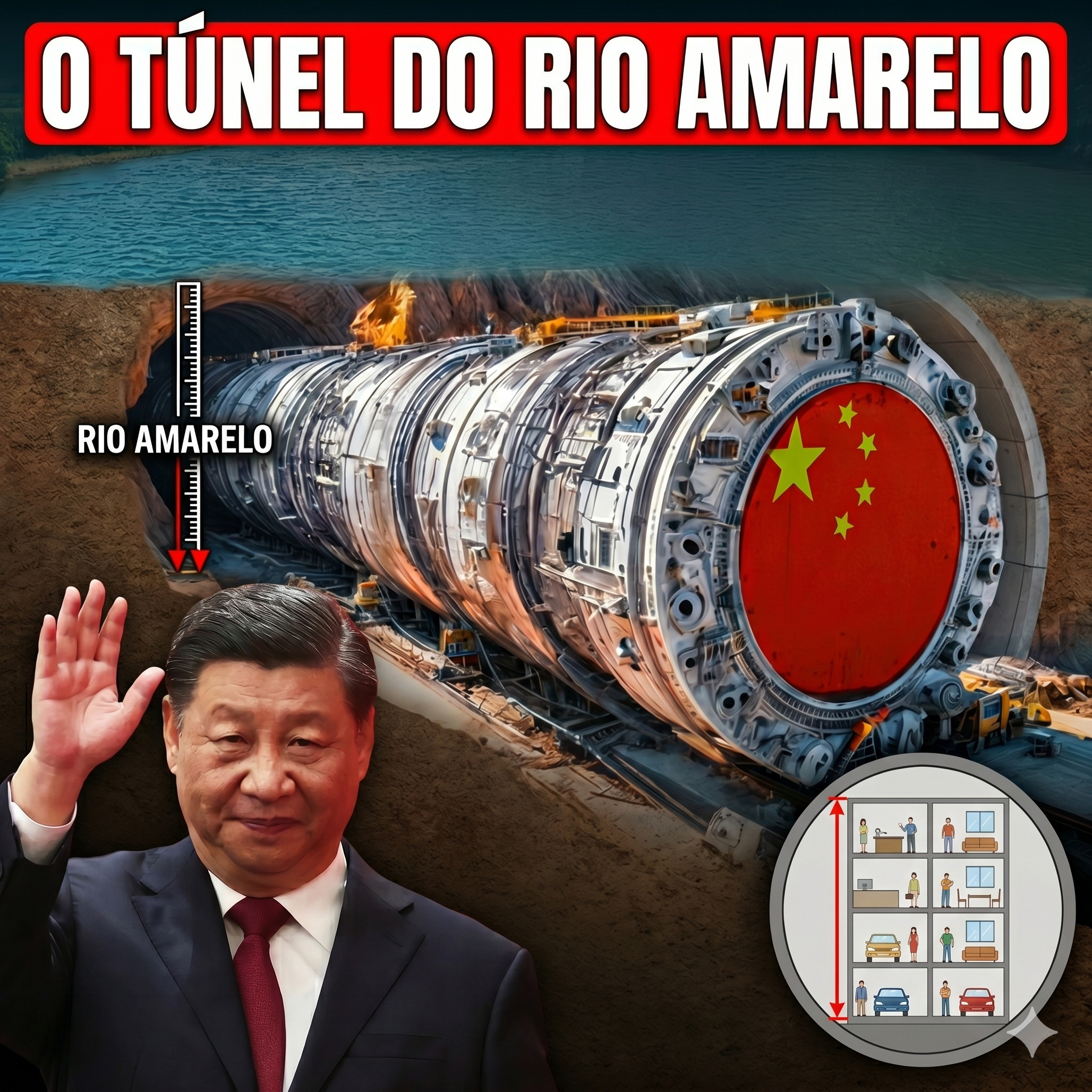


Shanhe Machine drills under the Yellow River, assembles concrete rings every 2 meters, and builds giant tunnel with unprecedented engineering technology.
According to the Jinan municipal government, capital of Shandong province, the Shanhe tunnel boring machine completed the most critical section of the world’s largest large-diameter underwater shield tunnel in June 2025. The machine passed under the dikes and the Yellow River’s drinking water protection area without interrupting the river flow, without registering emergencies, and without needing to replace the cutter head during the most challenging 3.3 kilometers of the route.
In August 2025, the complete excavation of the section was finalized, and by March 2026, both decks of the tunnel had their concrete slab completed. Opening to traffic is scheduled for September 2026.
Yellow River presents history of extreme floods and unique geological challenges for engineering
The Yellow River, known as Huang He, is considered the cradle of Chinese civilization and played a central role in the development of the country’s first cultures over five thousand years ago.
-
With 26 Million Brazilian Families in Substandard Housing, Churches to Launch 2026 Challenge: Each Parish to Build or Renovate a Home for a Local Family

-
Wood-Look Aluminum Emerges as a High-Tech Alternative for Facades and Gates, Offering Sophisticated Aesthetics and Low Maintenance

-
Couple Transforms 1964 Concrete Water Tower into Four-Bedroom Home with Views of London Over Four Years
-
U.S. City Builds Tiny Home Village on Water Company Land to House 136 Homeless People: Inside the Social Housing Units



Its most challenging characteristic is the enormous sediment load from the Loess Plateau. This material raises the riverbed over time and increases the risk of overflows.


Historically, the river has altered its course dozens of times and has been associated with some of the greatest natural tragedies ever recorded, including events with hundreds of thousands of victims.
This geological instability transforms any underground work in the region into a highly complex technical challenge.
Shanhe Tunnel Boring Machine has a diameter of 17.5 meters and is among the largest excavation machines ever built
The Shanhe is a Mixshield type tunnel boring machine manufactured by the German company Herrenknecht specifically for this project.
Its excavation diameter is 17.505 meters, more than double the diameter of traditional railway tunnels like those of the English Channel.
The machine is 163 meters long, equivalent to the size of two city blocks, and weighs approximately 5,200 tons. The equipment was designed to operate in extreme geological conditions, with abrupt variations between hard rock and highly saturated soils.
Mixshield technology allows pressure balance in unstable soils with groundwater
The main technical challenge faced by Shanhe was the variation in the subsoil. While one bank of the river presents granitic rock, the other has soil composed of clay, sand, and silt under groundwater pressure that can reach up to 7.5 bar.
Mixshield technology solves this problem through a real-time pressure balance system.
The machine uses a combination of drilling mud and compressed air to maintain the stability of the excavation face, preventing collapses and infiltrations.
Excavation process assembles concrete rings every 2 meters and ensures structural stability of the tunnel
The operation of the Shanhe occurs in highly controlled cycles. First, the cutter head grinds the soil ahead, which is mixed with bentonite slurry and transported to the surface.
After advancing approximately two meters, the machine stops excavation to install pre-fabricated concrete segments.
These segments form a complete ring that acts as the tunnel’s definitive lining, ensuring waterproofing and structural resistance. The process repeats continuously throughout the entire excavation.
3.3-kilometer underwater section completed in just 110 days at a record pace
The most critical section of the tunnel, extending 3.3 kilometers under the Yellow River, was completed in just 110 days.
During this period, the team advanced between 16 and 18 meters per day, setting a world record for tunnel boring machines of this size.

Similar projects typically show advance rates between 8 and 12 meters daily, highlighting the efficiency gains achieved.
Project overcame 28 technical challenges without needing to replace the cutting head
Throughout the excavation, 28 relevant technical challenges were recorded, including abrupt soil changes and pressure variations.
Even under these conditions, the tunnel boring machine completed the entire section without needing to replace the cutting head.
This factor represents a significant advance, as replacing this component in pressurized environments is one of the most complex and risky operations in underground engineering.
Huanggang Road Tunnel adopts two-level system to maximize use of excavated space
The Huanggang–Yellow River Road Tunnel is 5.75 kilometers long in total and adopts an unusual configuration.
Instead of multiple parallel tubes, the project uses a single tunnel with two superimposed decks. The upper level serves southbound-northbound traffic, while the lower level serves northbound-southbound traffic.
In total, there are six lanes, with a clear height of 4.2 meters on each level. This configuration reduces costs by about 15% and optimizes the use of excavated space.
The tunnel was designed to connect the historic urban area of Jinan with the Pilot Zone for the Conversion of Old and New Engines, located north of the river.
The current crossing relies mainly on bridges, which are often congested. With the completion of the tunnel, traffic redistribution and improved urban mobility are expected.
Remote monitoring and precision engineering eliminated the need for human interventions in pressurized environments
One of the most relevant aspects of the project was the elimination of the need for direct human intervention in the pressurized chamber.
The Shanhe tunnel boring machine was equipped with remote monitoring systems that allow real-time tracking of cutting head wear. This eliminated the need for hyperbaric operations, which involve high risks for workers.

The completion of the excavation under the Yellow River represents a technical milestone in civil engineering. The combination of large diameter, high underground pressure, and variable geological conditions makes the project one of the most complex ever executed.
Now we want to know: can projects of this scale redefine the limits of underground engineering in the coming decades?
The Shanhe tunnel boring machine demonstrated that it is possible to execute works in extreme conditions with precision and safety.
In your view, can this type of technology become a global standard or is it still restricted to projects with high investment and strong state coordination?