






 Portuguese
  Spanish


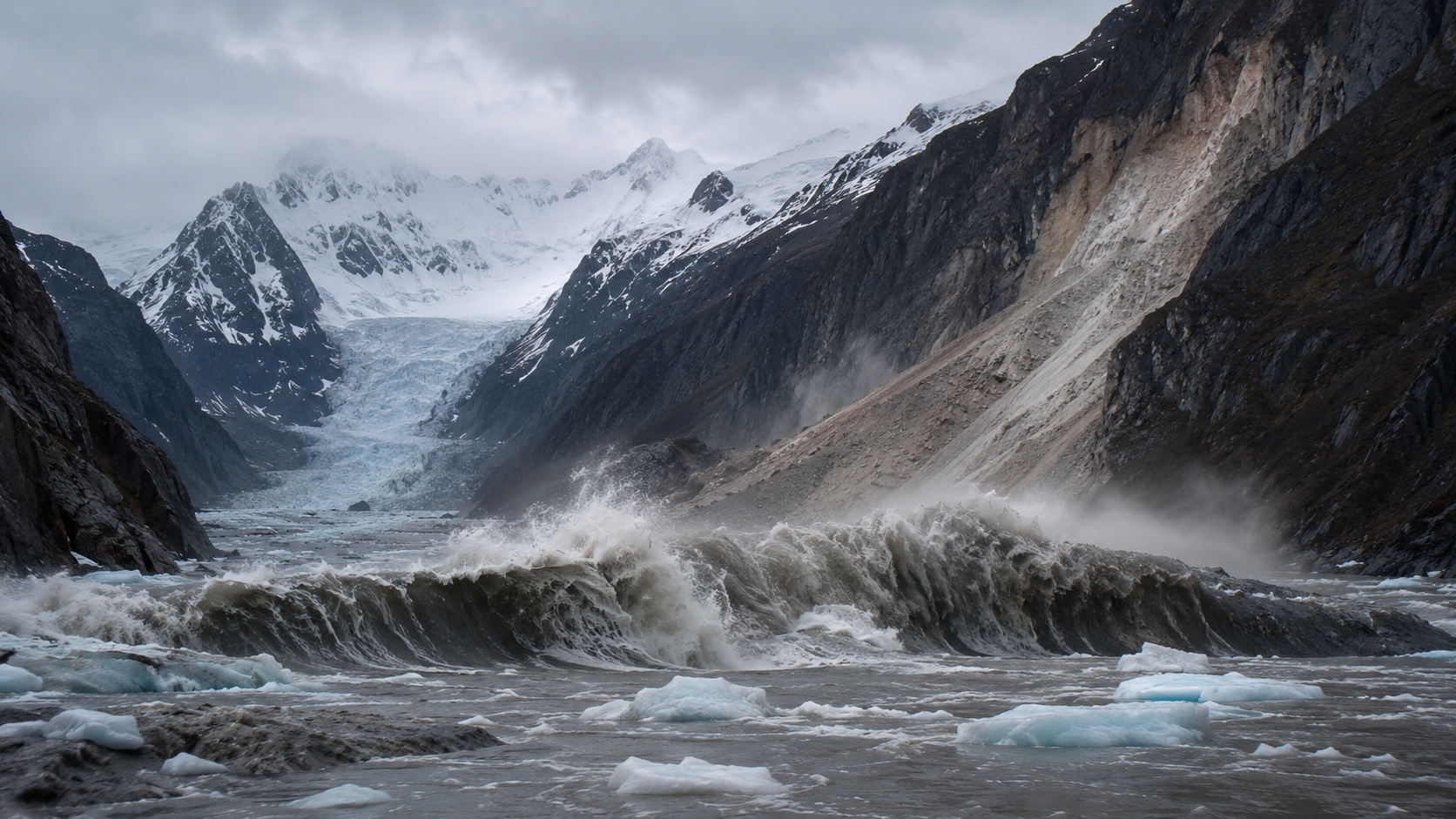
The collapse in Tracy Arm Fjord showed that silent ice retreat can release entire slopes, generate gigantic waves, and redefine how scientists assess extreme climate risks
A glacier that for millennia functioned as a kind of natural wall eventually receded enough to expose an unstable slope in Alaska. Then, on the morning of August 10, 2025, a massive rock mass plunged into Tracy Arm Fjord and generated a tsunami 481 meters high, a wave taller than the Burj Khalifa in Dubai, considered the tallest building in the world. According to information released in a report on the incident and in a study published in the journal Science, the event was classified as the second largest tsunami ever recorded and the largest ever documented without being caused by an earthquake.
The episode caught the attention of the scientific community because it exposed a threat that usually advances slowly, almost imperceptibly, but can end in a sudden catastrophe. Glacier retreat, often associated only with global warming, the loss of frozen landscapes, and rising sea levels, can also act as a direct trigger for gigantic landslides, local tsunamis, and destruction in fjord regions.
In this sense, the Tracy Arm disaster became a powerful warning. It shows that climate change does not only cause gradual transformations. In certain environments, small changes accumulated over months, years, or decades can destabilize entire mountains and unleash a devastating force in a few seconds.
-
Revive Old Photos: Gemini’s Little-Known Feature Uses AI to Restore Damaged Images in Seconds with a Professional Six-Step Recovery Process

-
Chinese Farmer Builds 5-Ton Homemade Submarine Over a Decade, Capable of Diving 8 Meters with Two Passengers

-
Brazilian Woman Transforms Ambulance into Solar-Powered Mobile Home for Remote Work and Travel Adventures

-
Oil Company Robots Discover 3,300-Year-Old Canaanite Shipwreck in the Mediterranean, Proving Ancient Mariners Navigated Open Seas by Stars Long Before Historians Thought




A wave taller than almost every building on the planet

The mountain collapse was sudden and violent. According to an article published in Science and research presented at the 2026 European Geosciences Union General Assembly, the slope gave way during the early morning hours, sending a large amount of rock into the narrow Alaskan fjord. The impact displaced an immense volume of water and formed a wave that reached 481 meters at its highest point.
To gauge the size of this phenomenon, simply compare the wave’s height with the global urban landscape. A tsunami of this proportion would exceed the height of the vast majority of buildings on Earth. As researchers highlighted, the wave was shorter than only 14 structures in the world, which helps explain why the event came to be seen as one of the most impressive manifestations of climate-related geological hazard.
Furthermore, the fjord did not immediately return to normal after the initial impact. For days, the water continued to oscillate in a phenomenon known as seiche, a type of standing wave that remains moving within enclosed basins or narrow channels. Drone images showed icebergs floating in turbulent waters, newly exposed rock walls, and visible marks left by the wave’s force on the banks.
The geography of Tracy Arm Fjord also exacerbated the disaster. Unlike tsunamis that spread across the open ocean and lose energy as they advance, the wave was compressed within a narrow channel. As a result, the energy released by the landslide was directed against the fjord walls, intensifying the impact and increasing its destructive potential.
Despite the impressive scale, the tsunami caused no fatalities. For Daniel Shugar, a geomorphologist at the University of Calgary and lead author of the study, this outcome was directly related to the time the collapse occurred. According to him, the risk to a specific cruise ship on a specific day is low, but the region had extraordinary luck because the tsunami occurred at that moment and not five hours later, when there might have been a greater human presence nearby.
Shugar also warned that this risk could grow as new structures are installed in vulnerable areas. Settlements, mining camps, oil and gas operations, as well as tourist traffic in Alaskan fjords, could increase human exposure to such events.
The glacier holding the mountain lost strength
To understand why the mountain collapsed, one must observe the role of the South Sawyer Glacier. For a long time, it functioned as a natural support for the slope. The mass of ice pressed against the base of the mountain and helped keep the rocks stable. However, as the glacier thinned and retreated, this support disappeared.
The most impressive fact is that the South Sawyer Glacier retreated about 500 meters in the spring of 2025 alone. This accelerated retreat left part of the slope exposed and vulnerable. Without the stabilizing pressure of the ice, the rock lost support and became more prone to collapse.
Scientists call this process of debuttressing, a term used to describe the removal of the buttressing effect exerted by a glacier. In other words, when ice recedes, it no longer functions as a natural “prop.” The result can be a seemingly intact slope, but one that is internally weakened.
Satellite images indicate that this phenomenon is not restricted to Tracy Arm Fjord. Several slopes in Alaska show movement above thinning glaciers. Therefore, the 2025 case may not be an isolated exception, but part of a broader pattern in mountainous and glacial regions.
Although intense rainfall may have contributed to triggering the collapse, Shugar’s team considers that glacier retreat was the primary cause. The rain, in this scenario, would have acted as the final push on a slope that had already been destabilized by the gradual disappearance of the ice.
This point is essential for understanding the gravity of the problem. The tsunami did not arise solely from a specific meteorological event or an unexpected geological fault. It was the result of a prolonged climatic process that altered the physical balance of the landscape until the mountain could no longer resist.

Climate change can transform slow risks into sudden disasters
The Tracy Arm tsunami represents an increasingly worrying type of climate disaster: one that arises from slow changes but manifests abruptly and violently. Unlike earthquakes, which can generate clear seismic signals, or hurricanes, which are usually monitored for days before hitting a region, glacier retreat may seem like just a gradual transformation of the landscape.
However, as the episode in Alaska showed, this silent change can set the stage for a catastrophic collapse. When the glacier loses mass, the mountain loses support. When the slope loses stability, the risk ceases to be theoretical. And when millions of tons of rock fall into a narrow fjord, the consequence can be a gigantic wave.
Similar events have already been observed in places like Taan Fiord, also in Alaska, and Dixon Fjord, in Greenland. In both cases, landslides caused tsunamis in glacial environments, reinforcing the link between global warming, glacier retreat, and cascading geological risks.
Glaciologist Leigh Stearns, from the University of Pennsylvania, who did not participate in the study on Tracy Arm, highlighted that public perception of glaciers can be misleading. According to her, glacial retreat is often seen as a long and continuous process, but it can trigger sudden catastrophic events.
This finding changes how governments, scientists, and businesses need to look at frozen regions. It’s not just about measuring how much ice has been lost or how many meters a glacier has retreated. It’s necessary to assess which slopes have been exposed, which fjords can amplify waves, which areas receive tourists, and which infrastructure projects are being planned in risk zones.
As published by the researchers, the Tracy Arm case also serves as a warning for other coastal and mountainous regions, including areas of Canada, such as British Columbia, where fjords, glaciers, and human occupation can form a delicate combination. The phrase “481-meter tsunami in Alaska is a warning for B.C.” precisely summarizes this concern: the phenomenon should not be treated as a remote curiosity, but as a sign of amplified climate risk.
For Shugar, although the chance of a specific ship being hit on a specific day remains low, exposure tends to increase as more people, vessels, and ventures enter these regions. This means that the danger depends not only on nature but also on human choices regarding occupation, tourism, and economic exploitation.
Stearns summarizes the problem with a central idea: climate acts as a threat multiplier. It doesn’t create all risks from scratch, but it can intensify existing dangers and connect processes that were previously analyzed separately. In the case of Tracy Arm, a gradual change in the ice triggered a rock collapse, which in turn generated a monumental tsunami.
The final warning is clear. Small changes, when accumulated in fragile environments, can produce enormous consequences. And if the world waits for new disasters to act, the next tsunami generated by a retreating glacier may not occur in an empty area, nor at such an improbably favorable time.


-

1 person reacted to this.