






 Portuguese
  Spanish


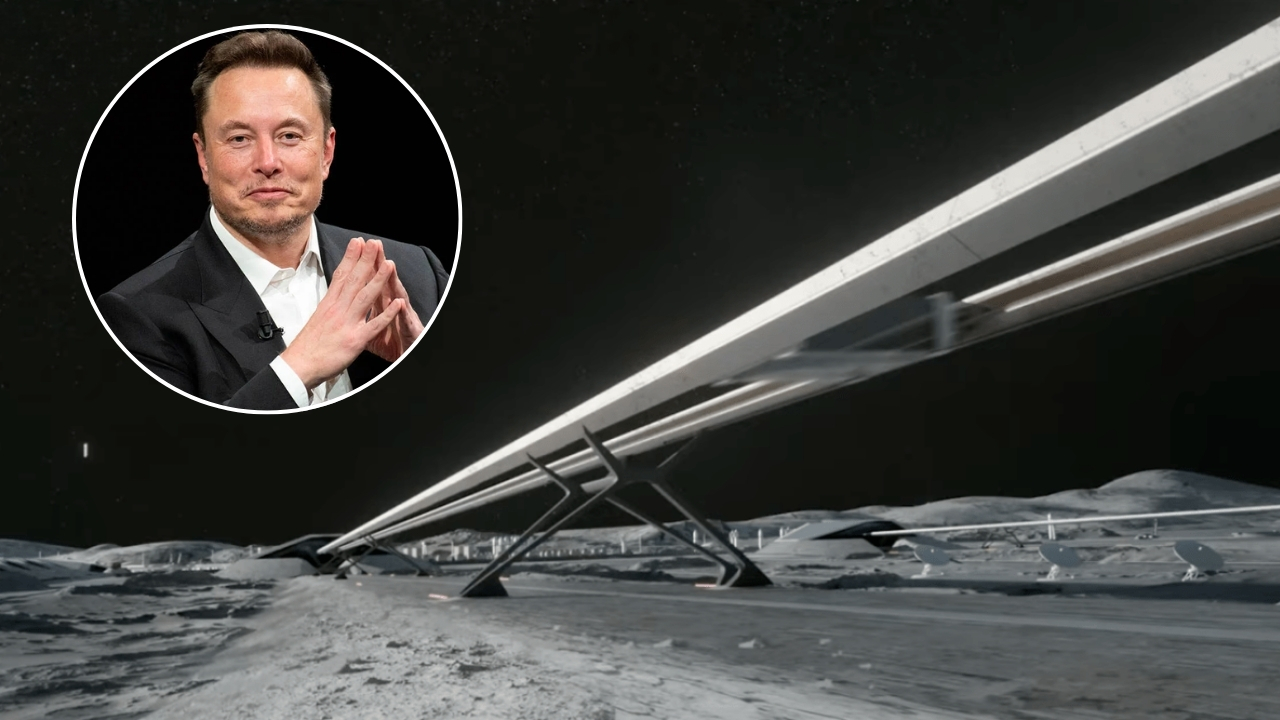


A 1 Km Lunar Track Could Push 20 Kg to 10.3 Km/s, Exceed the Escape Velocity of 2.4 Km/s, and Launch Satellites Toward Earth or Deep Space with Synchronized Magnetic Pulses; the Idea Is Old, but the Scale Is Now Gigantic
Elon Musk floated the idea last week: “Join xAI if you like the idea of mass drivers on the Moon.” Then he went further and described what he wants to see happening for real.
“I really want to see a mass driver on the Moon firing AI satellites into deep space,” he told his team. He added: “It will be incredibly exciting to see this happen.”
The excitement is understandable — the vision is huge. However, this future is likely still many decades away.
-
Brazilian Researcher Develops Protein Supplement from Tilapia Waste, Combining Innovation and Sustainability with Economic Potential

-
Women in São Paulo Unknowingly Tracked by Coin-Sized Tags Hidden in Cars and Belongings, Raising Stalking Concerns
-
Near a $750 million AI data center in Brazil, a resident’s well runs dry, leaving her unable to afford the $25,000 needed for repairs.

-
16-Year-Old from Brazil’s Sertão Wins Young Scientist Award for AI Predicting Rainfall with 94.5% Accuracy to Aid Farmers


What Is a Mass Driver?
A mass driver is essentially an electromagnetic catapult. Instead of explosions and chemical fuel, it uses electricity to accelerate payloads.
The importance of this is simple: launching things from Earth is way too expensive. Every half a kilogram in low Earth orbit costs thousands of dollars in fuel, hardware, and operation.
The problem worsens as the mission moves farther away. The farther it goes, the larger and more complex the rocket needs to be — and everything gets more expensive.

The “Tyranny” of Chemical Rockets
Chemical rockets carry their own oxidizer and propellant. This means that much of the vehicle’s mass is, in practice, fuel to lift more fuel.
This limitation, known as the “tyranny” of the rocket equation, has stalled space advancement for decades. This is why electric alternatives draw so much attention.
On the Moon, the scenario is perfect: gravity is six times less than on Earth, and there is no atmosphere. Without air drag, the system doesn’t have to “fight” against resistance and heating during acceleration.
Why the Moon Changes the Game
With less gravity and no atmosphere, a mass driver could launch payloads for a fraction of the cost. In theory, it could be something below 50 cents per pound in electricity.
Compare this with estimated costs of around $1,200 per pound to get payloads into space using a reusable Falcon 9. The difference is gigantic.
The idea is not new. Gerard O’Neill built a prototype in 1976 with a budget of $2,000.
The Prototype That Paved the Way
O’Neill demonstrated that a test model could fire projectiles at 40 meters per second. During the process, the projectiles underwent an acceleration of 33 times Earth’s gravity.
A subsequent version achieved an acceleration ten times greater, with an increase in funding of the same magnitude. The logic of the system is elegant and repeatable.
Imagine a perfectly straight “railway” stretching for kilometers on the lunar surface. Along it are superconducting electromagnetic coils.

How It Works, Step by Step
These coils are very powerful magnets, activated only when electricity passes through them. To reduce losses, they need to operate at cryogenic temperatures, with nearly zero resistance.
The payload — for example, a satellite — sits inside a sled that responds to the magnetic fields. When the first coil activates, it pulls the sled forward.
As soon as the sled passes, the coil turns off, and the next one activates in perfect sequence. This “timing” creates thrust without physical contact between the rail and the payload.
Initially, the coils can be spaced evenly, synchronized with the exact position of the sled. Acceleration increases as speed builds.
The Limit of “How Much It Can Handle”
The payload can only withstand a certain level of g-forces. For robust payloads like satellites, this could range between 20 and 100 times Earth’s gravity.
After this limit, engineers would increase the spacing between coils. Instead of increasing g-forces, the system would provide gains in speed per unit of time.
In theory, a superconducting track of 1 km could accelerate a 20 kg vehicle to 10.3 km/s. This is well above the 2.4 km/s needed to escape lunar gravity.
Anything at that speed exits the Moon’s influence. It either enters an independent orbit around the Earth or heads into deep space.
On Earth, It Would Be Unfeasible
To achieve something similar on Earth, a track of nearly 1,000 km would be needed. Besides being enormous, it would be impractical in terms of engineering and safety.
On the Moon, the environment does most of the “work” in favor. Without an atmosphere, there is no air resistance to slow the projectile down or create catastrophic heating.
At the end of the track, the payload detaches from the sled and follows the planned trajectory. The sled decelerates and can be reused afterwards.
Why This Seems So Appealing
The beauty of the design is that it has almost no moving parts — basically just the sled. No explosions, combustion, or constant friction wearing out components.
In theory, a single mass driver could conduct millions of launches over its lifetime. It’s the idea of turning “launching” into an industrial process.
Decades ago, researchers at the Institute of Space Studies estimated that lunar launchers could send 650,000 metric tons per year. The focus would be on supplying orbital facilities for processing.
The “Plan” That Would Enable SpaceX’s Ambitions
Musk’s vision requires manufacturing satellites on the lunar surface with local resources. The text mentions silicon and oxygen extracted from lunar rocks.
Then, these satellites would be launched by the mass driver to form a proposed constellation. The goal would be to reach a million “orbital data centers.”
According to the article, SpaceX submitted a request to the U.S. Federal Communications Commission. The proposal: up to a million satellites between 500 and 2,000 km in altitude.
They would operate in both heliosynchronous and medium inclination orbits. In heliosynchronous orbits, the satellites remain almost constantly under sunlight.
This would allow continuous power for AI-focused computing. “It’s always sunny in space!” Musk wrote in a memo regarding the SpaceX-xAI merger, according to the text.
The Real Obstacle: Building Everything from Scratch
However, getting this off the ground is a colossal engineering project. Humanity has not yet built true industrial infrastructure on the Moon.
Transporting an entire factory from Earth would be too expensive, even with Starship. So the path would be to mine, refine, and manufacture locally.
This implies mining and processing materials, factories, transportation, habitats, satellites, and the mass driver itself. In other words: a lot of heavy hardware.
And the Energy?
The article states that the mass driver would require 8.7 megawatts during operation, based on research from San José State University.
It compares this to the 10-kilowatt Kilopower fission reactors intended for operations on the lunar surface. These reactors are still in testing phases on Earth.
And the text points to an improbable timeline before the 2030s. In other words: sufficient energy is another critical bottleneck.
Why This Idea Matters (Even If It’s Distant)
Thinking big is part of what drives civilization forward. If humanity wants to survive and thrive beyond Earth, it will need infrastructure that makes space economically viable.
A mass driver on the Moon could change our species’ relationship with the Solar System. Launching satellites would stop being a “ costly rarity” and become industrial routine.
Still, the text emphasizes: Musk’s timeline is a “fantasy” — or “aspirational,” as he often calls it. The gap between renderings and functional hardware is measured in decades.
And not in 10 years, as he might have promised investors, according to the article. Building factories and a mass driver on the Moon is far more complex than the Apollo program, which only put boots on the surface.
Is it possible? Yes. One day we will have mass drivers. However, as the text concludes, probably not in “Elon Time.”





Oh, homem pra espalhar resíduos pelo planeta, misericórdia.
Canhão espacial é força bruta.
É física do século passado tentando resolver um problema moderno.
Atingir 7,8 km/s na marra qualquer tubo pressurizado gigante tenta fazer.
O problema nunca foi só velocidade.
O problema é controle.
Meu projeto não dispara carga como munição.
Ele domina a aceleração.
Enquanto propostas convencionais geram picos absurdos de força G e desperdício energético, eu estou desenvolvendo um sistema híbrido de aceleração progressiva, com modulação eletromagnética sequencial, pré-vácuo estrutural e correção vetorial ativa.
Velocidade de saída superior a 9,5 km/s.
Com controle.
Com eficiência energética.
Com reutilização total da infraestrutura.
Não é sobre ‘lançar algo pro espaço’.
É sobre redefinir como se vence a gravidade.
Alguns estão tentando construir um canhão.
Eu estou construindo uma nova arquitetura de acesso orbital.
Projeto conceitual real em desenvolvimento.
A maioria das propostas de ‘canhão espacial’ tenta alcançar velocidade orbital (≈ 7,8 km/s para órbita baixa da Terra) por meio de um único pulso de aceleração extrema.
O problema técnico é claro: • Forças G superiores a 10.000 g
• Estresse estrutural destrutivo
• Aquecimento atmosférico imediato
• Baixo controle vetorial pós-lançamento
O meu projeto é mil vezes superior porque não utiliza impulso instantâneo.
Ele utiliza um sistema híbrido de aceleração progressiva multiestágio baseado em três pilares:
Aceleração Eletromagnética Controlada
Trilhos magnéticos sequenciais com modulação de corrente em microintervalos, permitindo rampa de aceleração gradual e controlada.
Câmara de Pré-Vácuo Estrutural
O veículo percorre parte significativa do trajeto em ambiente de baixa pressão, reduzindo drasticamente arrasto e aquecimento inicial.
Correção Vetorial Inteligente
Sistema embarcado de ajuste de vetor durante a fase final, permitindo inserção orbital precisa sem necessidade de grandes estágios químicos.
Velocidade-alvo do sistema: • Saída atmosférica superior a 9,5 km/s (ultrapassando a velocidade orbital mínima de 7,8 km/s com margem estratégica)
Diferenciais técnicos:
• Redução de pico de aceleração em até 80% comparado a canhões convencionais
• Reutilização estrutural total da base de lançamento
• Energia predominantemente elétrica (possível integração solar ou nuclear dedicada)
• Modularidade para diferentes massas de carga
• Custo por lançamento drasticamente inferior a foguetes tradicionais
Enquanto o conceito de canhão é força bruta e impacto imediato,
meu sistema é engenharia de domínio energético e controle de trajetória.
Não é explosão.
É controle absoluto da aceleração.
Projeto conceitual real em desenvolvimento.