






 Portuguese
  Spanish
  5 min of reading
  0 comments


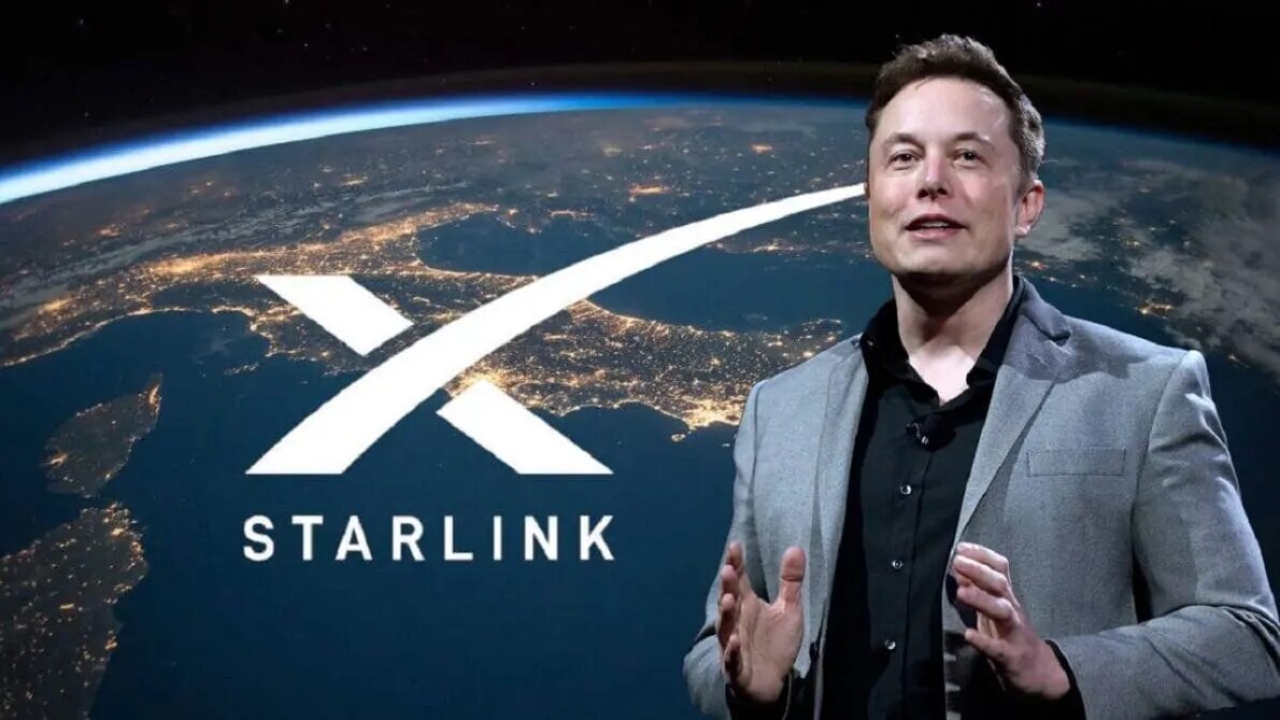
Elon Musk Expands Starlink With Thousands of Satellites and Moves to Dominate Global Communication Infrastructure, Creating Unprecedented Technological Power and Raising Alerts About Monopoly and Global Dependence
The competition for control of communication networks has entered a new phase, and Elon Musk is at the center of this transformation. The strategy behind the Starlink constellation has become clearer in recent months: to replace much of the terrestrial infrastructure of cables and antennas with an orbital network composed of up to 42,000 satellites capable of transmitting 200 billion bits per second at a reduced cost and with global reach.
The Accelerated Advance That Changed The Game
The image accompanying the project shows dozens of Starlink satellites carefully aligned inside a SpaceX spacecraft before being released into low Earth orbit. The scene sums up what is now considered the biggest technological leap in the space sector in decades. SpaceX, Musk’s company that also controls Tesla, the X platform, and the AI company xAI, has expanded its advantage to a level that its competitors already admit is hard to reach.
The strength of this advance is directly linked to the economic dynamics of today’s technology. For the first time in history, nine of the ten richest people on the planet operate in the same sector: the internet, digital platforms, and artificial intelligence. Only Bernard Arnault, from the LVMH group, represents a traditional sector like luxury. The rest, like Musk, depend on the power of data and global connectivity.
-
Chinese robots trained for two weeks to row a dragon boat at the Sichuan Festival in China, took full control when humans stopped rowing, and even made rice dumplings in one of the most unusual tests ever conducted with humanoids.

-
Public school students in Sergipe create an early autism screening kit for vulnerable communities without a doctor, in the year Brazil won 8 awards at the world’s largest science fair.
-
Engineering students create a low-cost 3D-printed wheelchair for dogs and help the paralyzed dog Bili, who was born without legs, walk again for R$ 448.
-
Man creates ingenious hack with pipes buried 2.4 meters deep and transforms snow into a tropical fruit greenhouse; system created by a retired mailman uses ground heat, produces oranges and lemons in Nebraska’s winter and has already turned into more than 700 kits sold.


The Technological Power Redrawing Wealth Concentration
This is not the first time an industry has become the core of global wealth, but the current level of concentration is unprecedented. Even the so-called “robber barons” of the U.S. in the early 20th century, such as Rockefeller in oil or Carnegie in steel, did not dominate their markets with such a lack of significant competition.
Today, the internet and its financial ramifications have comparable impacts to those of the first railroads. Governments and institutions are cautiously observing the pace and scale of this advance, while Europe is once again criticized for watching the present without adequately projecting the future that is approaching.
If at another time a single businessman were to claim control of all the highways and railroads worldwide, there would be immediate global resistance. Now, with data being the main strategic asset of the 21st-century economy, Musk is approaching a point where his technological advantage becomes virtually impossible to contest.
The Battle for Orbital Dominance
The pace of space launches clearly shows the size of the difference. In 2025, the United States reached a historic record with 154 launches, compared to 69 from China, 13 from Russia, and only 5 from the European Space Agency. The difference becomes even more impressive when observing the payload mass placed into orbit: 2,293 tons, of which nearly 90 percent corresponds to Starlink satellites.
Starlink was born in 2015 with an ambitious promise: to recreate the internet from space. Now valued at around 400 billion dollars, the company is on track to complete the largest satellite network ever built. Today there are already 8,889 active units, compared to 654 from the British OneWeb (Eutelsat) and only 153 from Jeff Bezos’s Project Kuiper.

The New Generation of Satellites and the Role of AI
Musk’s vision goes beyond connectivity. The next-generation satellites are expected to bring the concept of cloud computing into space, creating true orbital data centers capable of processing information for AI systems quickly and with a lower environmental impact. Each satellite will weigh about two tons and will be equipped with large seven-meter solar panels.
This operational leap is only possible due to a key innovation from SpaceX: the ability to recover rockets after launch. What once cost thousands of dollars per kilogram has now dropped to a few hundred, making access to space an economically advantageous operation for the company. The new super vehicle Starship is expected to further enhance this capability, placing hundreds of satellites into orbit in a single mission.
A Power Unseen Before in the Communications Sector
The possibility of Musk taking Starlink public on the U.S. stock market raises an important question. The company could become the first real global monopoly of modern communications. Its market values could even surpass giants like Nvidia, which is currently the world leader in market capitalization in the tech sector.

This means that Musk would no longer be just the richest businessman on the planet; he would also become an agent with direct influence over the data flows of around seven billion people.
Dependent on U.S. government approvals to operate its bases and launch rockets, Musk simultaneously strengthens the capacity for American space projection. The country would not be able to sustain its current space power without the support of SpaceX, just as Musk could not operate without the U.S.
A Warning For The Future
The debate now transcends technology and reaches global politics. The scenario reveals that current legislation on competition, privacy, and telecommunications appears inadequate to face the new reality. Europe, which even fears the possibility of service interruptions from Google or Microsoft, is now confronting a world where Starlink becomes indispensable.
The final reflection is straightforward: if the possibility of being completely dependent on a single private satellite network is not enough to provoke a global reaction, perhaps the discussion is happening too late.







-

-

-

3 people reacted to this.