






 Portuguese
  Spanish


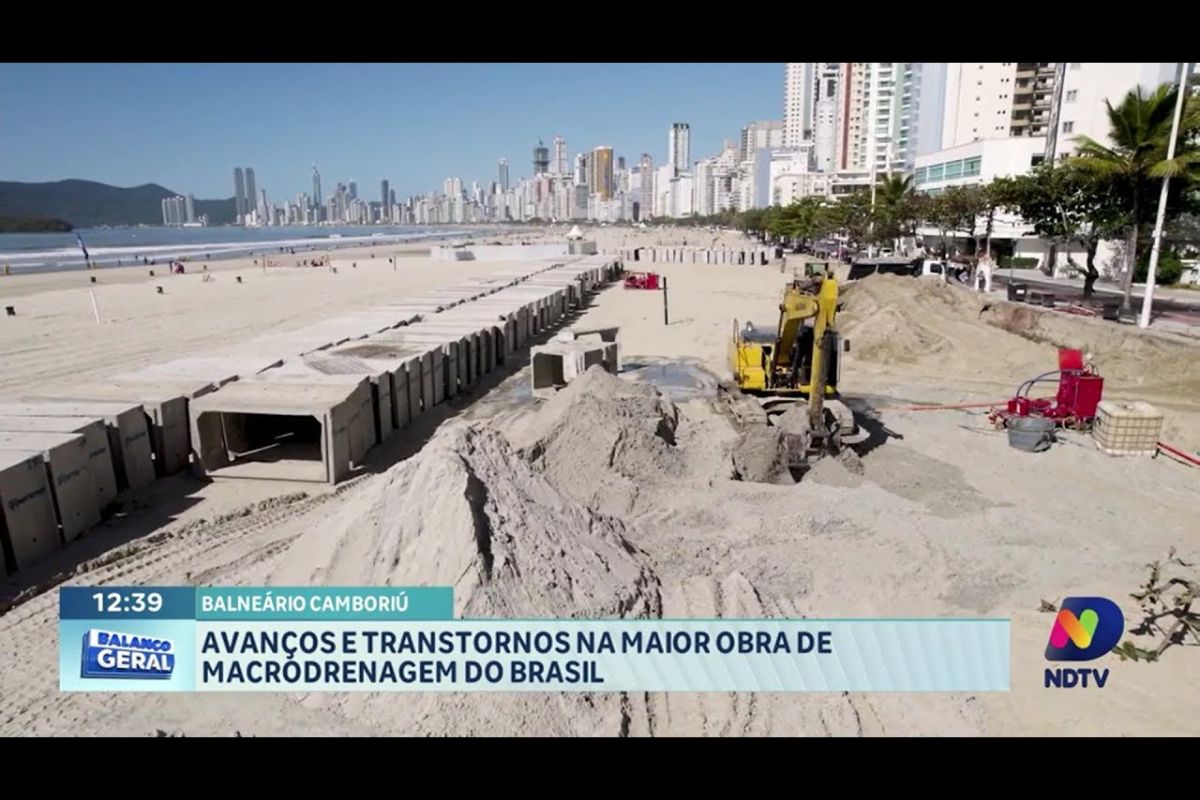


The Drainage Work Is Ongoing in Five Simultaneous Fronts Along the Central Coastal Area of Balneário Camboriú, Focused on the Installation of Outfalls and Urban Recomposition, While the City Hall Adjusts the Schedule Not to Compromise the High Season.
The drainage project in Balneário Camboriú has entered a more sensitive execution phase, where physical progress needs to be balanced with the flow of residents, tourists, and beach activities. The city hall opted to maintain direct oversight of the services and summoned the responsible companies to reinforce standards of quality, safety, and deadlines. The priority at this moment is to finish the outfalls installed on streets 1901 and 1301 and restore the surroundings before the summer rush.
The intervention occurs simultaneously at different points along the central beach. The decision to adopt a phased execution model was made after it was found that doing all sections at once would cause a traffic and tourism impact greater than acceptable. Therefore, the municipality decided to proceed in stages, delivering functional sections of the drainage system while keeping the other fronts ongoing.
What Is Being Done Now
Today, there are five actions in progress within the drainage package.
-
Couple Sold Everything to Restore a 300-Year-Old Abandoned Mansion, Uncovering Ancient Books and Untouched Rooms

-
Couple Builds Sustainable Home from Straw Bales, Wood, and Clay in Brazil
-
At 64, Grandma Sônia Turned Homemade Recipes into a Family Business, Growing Casa de Bolos to Over 600 Locations and Expanding to Portugal

-
Brazilian Couple Builds Underground Bunker in Santa Catarina Amid Fears of Crises and Shortages, Spending $10,000 and Learning Construction from Scratch, Videos Go Viral


Two of them are the outfalls on Rua 1901 and Rua 1301, which are being covered and will not be visible on the sand after the finishing work.
Another front is working on the installation of galleries at the level of Rua 1101, which is expected to advance another 300 meters and then be temporarily interrupted because of the season.
The other fronts focus on restoring sidewalks that have undergone intervention and cleaning the beach to remove stones that appeared during the movement of machinery.
The city hall reported that these urban reconstructions are expected to be completed by the end of November to ensure better pedestrian circulation.
Why Outfalls Are Decisive
The outfalls are the safety point of the drainage system. They function as emergency exits for the network.
During very heavy rainfall, when the volume of water exceeds the capacity of the galleries, these devices channel the excess to prevent backflow, sand erosion, and flooding along the coast.
The city hall has already confirmed that the other outfalls will be installed only after the summer on streets 1101, 1001, 51, 100, and Alvin Bauer.
The decision was both technical and operational. Executing all at once would increase the number of closed lanes on the beach and harm tourism during the peak occupancy period.
Deadline Adjustments and Inspection
The work began with an expected first phase lasting nine months.
As the services progressed, the technical team identified sections of greater complexity and preferred to reduce the pace to ensure durability.
The mayor Juliana Pavan met with inspectors, contractors, and urban cleaning teams to emphasize that the schedule may be adjusted, but the quality cannot.
This model of continuous oversight is important because the drainage project in Balneário Camboriú is presented as the largest in the country in urbanized beach area.
In projects of this magnitude, the most common risk is to rush the delivery without consolidating the surroundings.
Thus, the municipality has also established temporary maintenance routines in the construction areas.
Next Steps and Connection to the Marambaia River
For the system to operate at full capacity, connecting the galleries to the Marambaia River will be necessary.
The municipal engineering already anticipates an intervention at Barra Norte to allow this connection.
The work is scheduled for next year, outside of peak movement, as it involves partial breaking of the jetty and work in tidal areas.
With the connection to the river, the drainage system will have more efficient drainage and less dependence on high tide, which enhances the protection of the sandy area and the new boardwalk.
The city hall expects that, upon completing all phases, episodes of recurring flooding during heavy rains will be significantly reduced.
Impact on Residents and Tourists


Residents interviewed throughout the execution recognized that the work is time-consuming, but also pointed out that the future benefits compensate for the temporary inconvenience.
The city hall, in turn, has been recommending that residents and visitors avoid moving in marked areas, as there are heavy machinery, exposed pipelines, and covered outfalls on the sand.
The public communication has insisted on two points.
The first is that the drainage is not an appearance project, but rather underground infrastructure.
The second is that completion in stages is the only way to reconcile heavy engineering and summer tourism in a compact beach city.
In your opinion, is Balneário Camboriú right to prioritize quality and phased execution in drainage even with more time for work along the coast?





Meu Deus vejo gente construindo coisas de milhões
Tô construindo um varanda simples das simples já não tô dormindo direito peço a Deus pra mim não ir presa por não conseguir pagar o material que eu comprei porque a vida aki em piraputanga e tão difícil