Portuguese
  Spanish


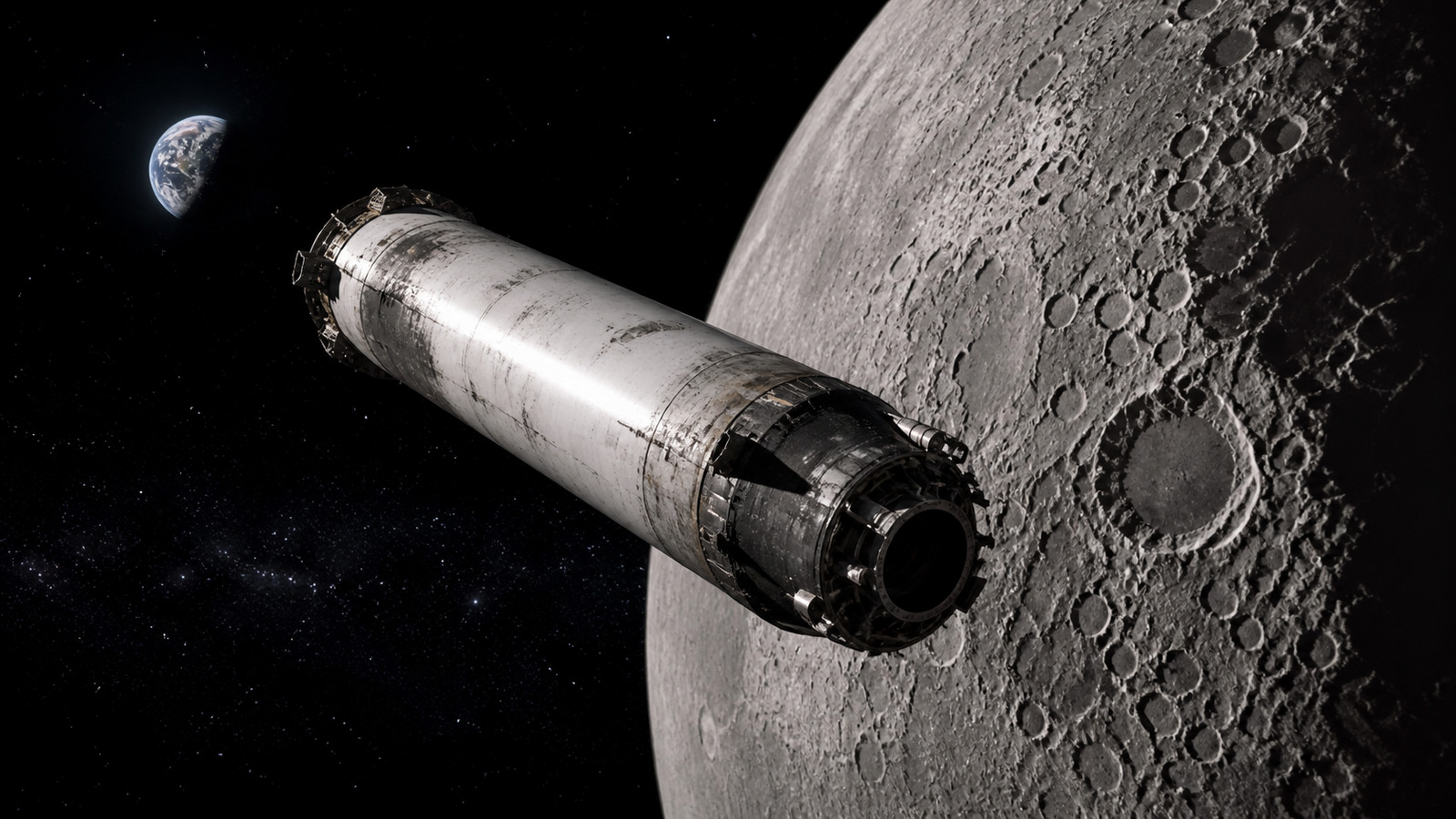

Part of a Falcon 9 rocket is expected to hit the Moon in August, near the Einstein crater, reigniting the alert about space debris
A piece of a SpaceX Falcon 9 rocket is expected to collide with the Moon on August 5, near the Einstein crater, rekindling the debate about space debris in lunar missions.
Space debris expected to hit the Moon in August
The prediction was made by astronomer Bill Gray, developer of Project Pluto software, used to track near-Earth objects.
The information was released on April 29 and indicates an impact in the region between the visible and far sides of the Moon.
-
Berries, Strawberries, and Blueberries Could Transform Agriculture in Northeastern Brazil, New Tests Reveal

-
Danish Resident Discovers Six Viking Gold Bracelets Weighing 762.5 Grams, Third Largest Gold Treasure in Denmark

-
Over 200 Cities in Southern Brazil on Storm Alert as Cyclone Near Uruguay Brings Heavy Rain, Hail, and Winds Up to 100 km/h

-
Archaeologists Discover 2,300-Year-Old Beer in Sealed Bronze Vessel from Ancient Chinese Tomb




The collision poses no danger to the Moon or to operational spacecraft. Nevertheless, the episode draws attention because it occurs at a time of increased international interest in lunar missions and exposes how equipment remnants are discarded.
Gray stated that the incident poses no risk to anyone but highlights a certain negligence in the disposal of used parts of space equipment. The object predicted to fall is about 13.8 meters tall.
Falcon 9 carried two spacecraft to the Moon
The rocket stage was launched in early 2025. After the mission, it began orbiting the Earth-Moon system, after carrying two spacecraft towards the natural satellite.
One of them was Firefly Aerospace’s Blue Ghost lander, which successfully landed on the Moon. The other was ispace’s Japanese Hakuto-R, which lost contact with Earth and crashed on the lunar surface.
Impact could form a new crater
The object has been observed more than a thousand times over the last year by astronomical surveys. Based on this data, Gray calculated that the collision should occur around 2:44 AM, Eastern Time, on August 5.
The estimated impact speed is about 8,700 km/h. The flash generated by the collision should be too faint to be seen from Earth, even with powerful telescopes, which reduces the chance of direct observation.
Trajectory is considered predictable
The trajectory of this type of debris is relatively predictable, as its movement primarily depends on the gravity of Earth, the Moon, the Sun, and the planets. Still, space debris can offer a scientific opportunity.
The interest would be in later studying a newly formed crater from the impact. Experts advocate safer strategies for used stages, such as sending them into orbits around the Sun, instead of leaving them circulating between Earth and the Moon.
With information from Metrópoles.