





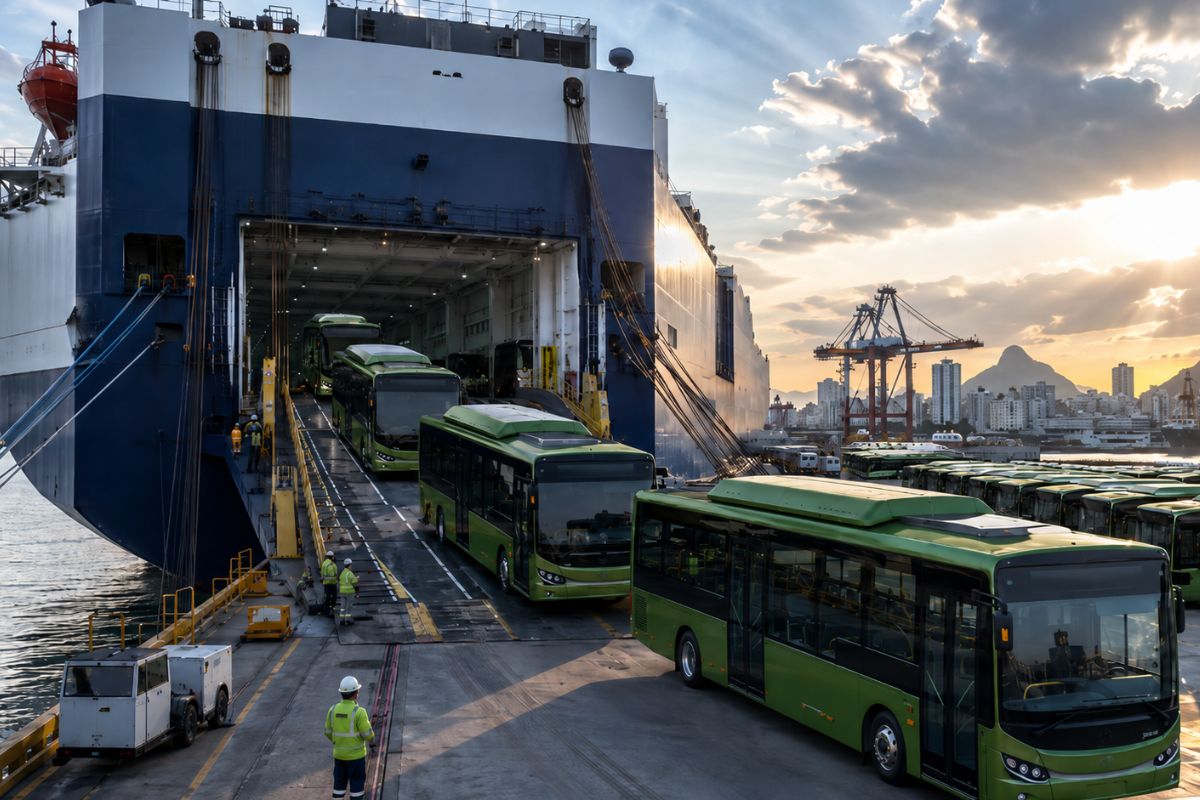


The ship that brought 90 electric buses manufactured by CRRC from China to the Port of Vitória set in motion a large-scale operation involving unloading with cranes, weekly transport by trucks to Brasília, a new charging structure, and the concrete beginning of the modernization of the Federal District’s fleet
The ship that departed from Qingdao, China, with the 90 new electric buses destined for the Federal District’s public transport, arrived in Brazil and turned a project that had been prepared for months into a real operation. According to a report by Jornal de Brasília published on March 6, 2026, the vehicles were already on their way to the country on that date, while Piracicabana, responsible for the acquisition, was accelerating the construction of the new garage and the necessary infrastructure to receive the fleet. Now, with the arrival at the Port of Vitória, in Espírito Santo, the plan has entered its most visible stage.
The new phase was detailed in an update from Semob-DF, which informed that the 90 vehicles are already in Brazil and will be transported to the Federal District in batches of 15 buses per week. The secretariat expects the new fleet to serve approximately 67,000 passengers per day in area 1 of the system, connecting the Rodoviária do Plano Piloto and the Asa Sul Terminal to strategic points such as Esplanada dos Ministérios, Setor de Autarquias e Tribunais, UnB, Noroeste, W3, L2 Sul e Norte and Airport.
The ship brought more than vehicles, it brought the concrete phase of renewal
During the initial stage of the project, fleet renewal was still seen as logistical preparation and arrival anticipation. The report from Jornal de Brasília showed exactly this moment, with the buses in maritime transit and the ground infrastructure being set up to receive them in the DF.
-
Workers renovating a playground in northern England uncover 176 World War II bombs buried underground; training artifacts still contained explosives.

-
Brazilian Architect Transforms Waste into Sustainable Homes with Solar Power and Rainwater Systems for 40 Years

-
Security Guard Becomes Doctor at Louisiana Hospital Where He Once Worked, Studied Chemistry Between Shifts

-
Woman Rescued from Luxury Complex in Brazil Worked Without Pay for 55 Years, May Be Entitled to Over $300,000




With the update from Semob-DF, the story advanced. The ship ceased to be merely the link between the Chinese factory and Brazil and began to represent the practical start of the transition to a more electrified fleet. What was on paper began to take shape on the quay, on the trucks, and in the garages prepared for recharging.
How the unloading at the Port of Vitória happened
The removal of the buses from the ship does not happen at a simple pace. As informed by Semob-DF, the port operation is slow due to the lack of space for maneuvers inside the vessel. The vehicles were isolated and protected to prevent damage and need to be removed one by one by cranes, which lower them to the quay.
On the Monday morning mentioned by the secretariat, most of the buses had already been removed and parked in the port area. This detail helps to gauge the size of the operation, as it shows that the challenge was not only in the maritime crossing but also in the delicate removal of an entire fleet of large vehicles.
The numbers that explain the size of the operation

The data on the new fleet helps to show why the arrival of this ship gained such relevance. There are 90 electric buses, all manufactured by the Chinese company CRRC, with a capacity for 74 passengers per vehicle.
Semob-DF informs that the buses are 100% electric, have a low floor, rear engine, air suspension, ABS brakes, and electric auxiliary braking. They also arrived in Brazil numbered and stickered from the factory, with internal signage and visual identity specific to the DF’s public transport. This is not a generic imported fleet, but vehicles already prepared to enter the local system after the final stages of regularization.
The journey to Brasília will be done in batches of 15
After customs clearance and the official entry of the vehicles into the country, the second half of the journey begins. According to Semob-DF, the buses will be taken to the yard of the company responsible for the cargo and, subsequently, will proceed to Brasília on flatbed trucks, in batches of 15 vehicles, on a weekly basis.
This logistics shows that the arrival of the ship was just the first part of a larger chain. The other stage takes place on the roads, in a staggered displacement designed to organize the reception of the vehicles and allow the DF’s infrastructure to keep up with the gradual entry of the new fleet.
Where the first buses will be kept upon arrival in DF
The first vehicles to arrive in the capital will initially be kept at Piracicabana’s current garage, in Plano Piloto, where there is already infrastructure for simultaneous charging of four buses at a time. Afterwards, they will also proceed to the company’s garage in Hípica, near the Zoo.
This point is important because it shows that the buses are not arriving at an improvised system. The ship brought the fleet, but the DF had already been preparing the electrical and operational support to absorb the vehicles without relying on last-minute adaptations.
The charging infrastructure began before the ship’s arrival
In the Jornal de Brasília report, the infrastructure preparation appears as one of the project’s foundations. Piracicabana had already started construction for a new garage and was monitoring the production of 18 240 kW chargers and three 1,750 kVA transformers.
The same report states that, to meet the estimated energy demand of 4,500 kVA at peak, the expansion of Neoenergia‘s substation in the Federal District was necessary. Additionally, four chargers would also be installed at the Asa Sul Terminal. This shows that fleet electrification does not depend solely on the bus, but on an entire energy infrastructure being built alongside it.
The served routes place the new fleet at the heart of DF’s mobility
The new vehicles will circulate precisely in areas sensitive to Brasília’s daily mobility. Semob-DF highlights that the buses will serve passengers coming from various administrative regions, especially through connections made at the Plano Piloto Bus Station and the Asa Sul Terminal.
From these points, the buses will complete access to strategic areas of the city. This means that the new fleet will not be used in an isolated corridor or in peripheral operation, but on axes where comfort, silence, regularity, and lower pollutant emissions tend to be perceived more strongly by passengers.
DF already had electric buses, but now the scale changes


Before the arrival of this new batch, the Federal District already operated six electric buses on lines 109.3 and 109.4. The Jornal de Brasília report records that these vehicles transported over 100,000 passengers per month and contributed to the reduction of 3.2 thousand tons of CO2 in the atmosphere.
The difference now is in scale. With the arrival of the 90 buses brought by the ship, electrification ceases to be a specific experience and begins to gain the dimension of a fleet policy. This is the point that transforms the operation into a broader milestone for DF’s urban mobility.
Environmental impact has become one of the pillars of the official discourse
Both Jornal de Brasília and Semob-DF present the new fleet as part of a change with environmental significance. In the report published in March, Secretary Zeno Gonçalves stated that fleet electrification was a government commitment to innovation and reduction of pollutant emissions.
In the subsequent update, also released by the secretariat, Zeno Gonçalves reinforced this discourse by stating that the new buses represent silent, comfortable journeys and a reduction in the emission of 415 tons of polluting gases per year, equivalent to planting 88,000 trees. The project was clearly built to unite operational modernization and environmental narrative in a single public showcase.
What is still missing for the buses to start running
Although the ship has already completed its main mission, the buses still need to complete a few steps before entering operation. As informed by Semob-DF, the vehicles will undergo licensing, installation of validators, and registration in the secretariat’s system.
The official forecast is that the first released vehicles will start circulating in May. This means that the arrival at the port is impressive, but the change only truly consolidates when the buses leave the garage and enter the daily routine of thousands of passengers.
The ship opened a new phase for Brasília’s transport
The crossing between Qingdao and Vitória ended one chapter of history and opened another. The ship not only brought a cargo of new vehicles but also the material beginning of a fleet renewal that now needs to prove itself on the streets, in schedules, in recharging and in Brasília’s daily life.
If the schedule is met, the coming months should show whether the federal capital will be able to transform this arrival into a real leap in quality, comfort, and sustainability in public transport. What disembarked in Espírito Santo was more than a new fleet. It was the first major test of a change that the Federal District wants to make a benchmark.
If this ship has already put 90 electric buses on route to Brasília and started the fleet renewal in the Federal District, is the capital close to becoming a benchmark in public transport electrification, or does the most difficult challenge begin precisely when these vehicles start running every day?


