Portuguese
  Spanish


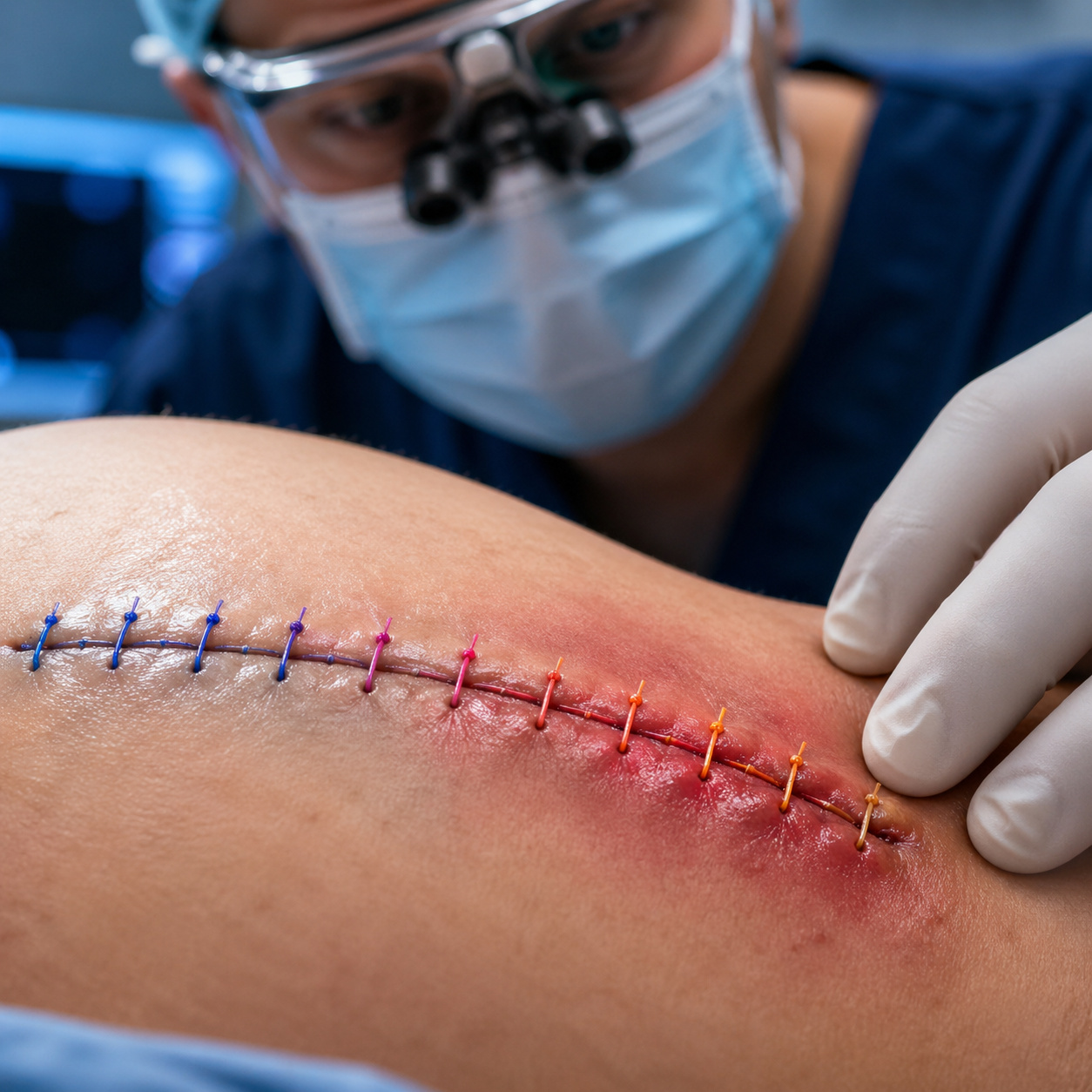

Student develops surgical stitches that change color upon detecting infection, simple technology can anticipate diagnoses and reduce complications.
In 2021, American student Dasia Taylor, then a high school student in Iowa, gained international attention by presenting a low-cost experimental solution to a serious medical problem: the early detection of infections in surgical wounds. According to Smithsonian Magazine, in a report dated March 25, 2021, she developed surgical stitches that change color upon detecting infection, dyed with beet pigment.
The proposal does not replace laboratory tests or medical protocols but transforms the surgical stitch itself into a potential visual warning signal, especially useful in areas with less access to expensive monitoring technologies. The project led Taylor to become a finalist in the Regeneron Science Talent Search, one of the main student scientific competitions in the United States, and was featured in media outlets like PBS NewsHour on July 22, 2021.
The proposal of color-changing surgical stitches breaks with the traditional diagnostic logic by transforming the surgical stitch itself into a real-time alert system.
-
Pennsylvania Mine Creates Ice in Summer Heat and Melts in Winter, Turning a Mountain Crevice into a Reverse Natural Refrigerator

-
China Accelerates Global Expansion of Robotics: From Smart Vacuums to Industrial and Humanoid Machines, Millions Exported to Over 150 Markets
-
Polar Air Mass to Hit Brazil: Temperatures to Plummet in Nine States, Near Freezing in the South with Frost Risk Until Monday
-
Chinese “dark factories” produce electric cars 24/7 with minimal human intervention, as Zeekr assembles 800 units daily, raising concerns in Brazil.





Color change occurs due to alteration in the wound’s pH
The technology’s operation is based on a simple but extremely effective chemical principle. When an infection develops, the wound environment undergoes changes, especially in pH levels, which tend to become more alkaline. The student used this natural behavior of the body to create a visual indicator.
The material applied to the sutures reacts to this change, altering its color. Under normal conditions, the stitches maintain a specific color, but when the pH changes due to infection, a noticeable change occurs.


This transformation allows the problem to be identified quickly, without the need for additional medical equipment.
Use of natural pigments reduces cost and increases accessibility with the arrival of color-changing surgical stitches
One of the most relevant differentials of the invention is the choice of materials. Instead of using electronic sensors or expensive compounds, the student opted for natural pigments extracted from vegetables, like beetroot, which are sensitive to pH.
This decision was strategic, as it significantly reduces production costs and makes the technology accessible to healthcare systems with fewer resources.
The result is a solution that combines scientific efficiency with economic viability, expanding its potential for global application.
Surgical infections continue to be a significant health problem, and color-changing surgical stitches upon detecting infections can change everything
Infections in surgical wounds are one of the most common complications in medical procedures.
They can cause:
- delay in recovery
- need for new treatments
- increase in hospital costs
- risk of more severe complications
In many cases, detection depends on clinical observation or laboratory tests, which can delay diagnosis. Early identification is essential to prevent the infection from progressing to more severe stages.
Technology of color-changing surgical stitches upon detecting infections allows continuous monitoring without constant medical intervention
One of the main advantages of color-changing stitches is the ability for continuous monitoring. Unlike point-in-time tests, which depend on collection and analysis, the suture remains at the wound site throughout the healing process.

This means that any change can be observed immediately, whether by healthcare professionals or by the patient themselves.
The technology transforms wound monitoring into an active and constant process, without the need for additional equipment.
Application can be especially relevant in regions with less access to healthcare
The simplicity of the solution expands its potential for global impact. In regions where access to laboratories and medical equipment is limited, the ability to visually detect infections can make a significant difference.
The technology can be applied in:
- hospitals with reduced infrastructure
- rural or remote areas
- healthcare systems with limited resources
This characteristic positions innovation as a possible tool to reduce inequalities in access to diagnosis.
Comparison with existing technologies shows advantage in cost and simplicity
There are already studies involving smart dressings and electronic sensors to detect infections. However, these solutions tend to be more expensive and complex.
The approach developed by the student differs by not relying on electronic components or external systems. This reduces production cost, maintenance needs, and complexity of use.
Innovation demonstrates that simple solutions can compete with advanced technologies in certain contexts.
Project is still in development and validation phase
Despite its potential, the technology is not yet widely available on the market. To be used on a large scale, it will need to go through stages such as:
- clinical trials
- regulatory validation
- adaptation for industrial production
These processes are essential to ensure safety and efficacy in medical environments. The project’s advancement will depend on the ability to transform the prototype into a product approved for clinical use.
Scientific and medical interest indicates expansion potential
The repercussion of the invention has sparked interest from researchers and healthcare professionals. The concept of materials that respond to biological changes has been explored in different contexts, including biomedical sensors and smart devices.

The student’s proposal fits into this movement, offering a practical solution to a specific problem. Scientific recognition suggests that the idea can evolve and generate new applications in the future.
Technology can evolve for other types of biological monitoring
The logic used in sutures can be adapted for other medical applications. Color-change-based systems can be used to detect different conditions, depending on the type of chemical reaction involved.
This opens possibilities for:
- monitoring of inflammations
- detection of metabolic changes
- development of new types of medical sensors
Innovation can be the starting point for a new generation of smart materials in medicine.
Early diagnosis continues to be one of the biggest challenges in modern medicine
A large part of medical complications is related to delays in identifying problems. Technologies that allow detecting changes in an early stage have the potential to reduce risks and improve clinical outcomes.
The proposal to transform sutures into sensors is aligned with this need. Anticipating the diagnosis can be as important as the treatment itself.
By transforming a common element of medicine into a visual alert system, Dasia Taylor’s invention shows that innovation does not always depend on high technological complexity.
Based on simple chemical principles, the technology proposes a new way to monitor health directly at the wound site.
Do you believe that simple solutions like this can be more effective than complex technologies in the future of medicine?