Portuguese
  Spanish


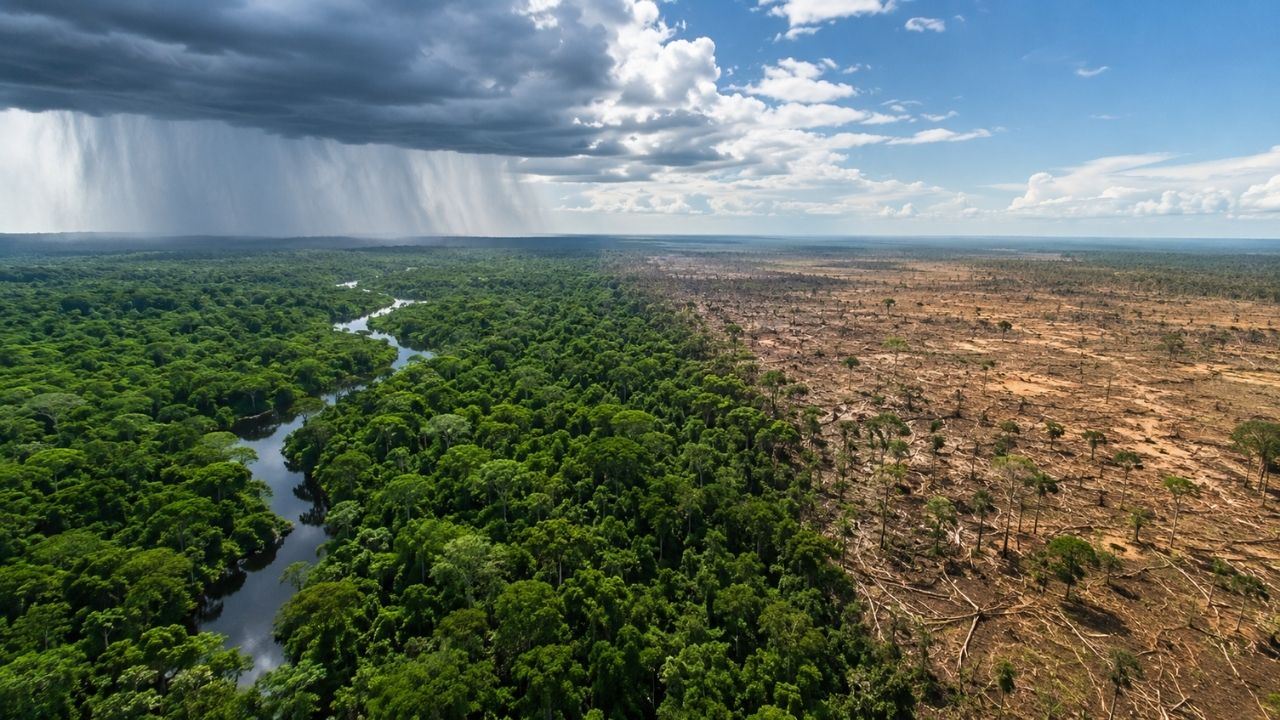


Deforestation in the Amazon weakens moisture recycling, increases drought and global warming over the Amazon rainforest, according to a study by Nature, which points to the risk of cascading transitions capable of affecting up to 77% of the biome if tree loss advances along with climate on a regional Amazonian scale.
Deforestation can reduce the Amazon’s ability to produce part of its own rain and make the forest more vulnerable to a chain reaction of drought, global warming, and degradation. The conclusion appears in a study published in Nature on May 6, 2026, authored by Nico Wunderling, Boris Sakschewski, Johan Rockström, Bernardo M. Flores, Marina Hirota, and Arie Staal.
According to a study published in the scientific journal Nature, without considering deforestation, the critical threshold appears in global warming of 3.7 °C to 4.0 °C. But when tree loss is factored in, an almost systemic transition can occur with lower warming, between 1.5 °C and 1.9 °C, combined with 22% to 28% deforestation in the Amazon basin.
Deforestation affects the rain that sustains the forest itself
The Amazon relies on an internal moisture cycle. Trees absorb water from the soil and return part of it to the atmosphere through transpiration and evaporation, helping to feed new rains within the basin itself.
-
AI Video Generator Automatically Creates Subtitles and Animated Captions

-
São Paulo Unveils Latin America’s Largest Underground Reservoir, Holding 900 Million Liters, in the Greater São Paulo Area

-
Chinese Teen Wins Gold in Germany for Invention Turning Air Moisture into Underground Irrigation in Drought-Stricken Areas

-
Desertification Threatens Brazil’s Caatinga: 85% of Semi-Arid Region Affected, 30 Million at Risk, and Efforts Underway to Restore 10 Million Hectares by 2045




When deforestation advances, this mechanism loses strength. Fewer trees mean less recycled moisture, less rain in areas dependent on this atmospheric transport, and greater stress for regions already facing more intense droughts.
Study shows greater risk when drought and global warming act together

The research does not analyze just the felling of trees in isolation. The study combines changes in land use, global warming, and moisture transport to estimate how the forest may lose stability in different climate scenarios.
The central point is that deforestation can amplify the drying already caused by global warming. Thus, areas that might withstand a warmer climate may become more vulnerable when they also lose moisture sent by other parts of the forest.
Up to 77% of the forest could enter a transition area in severe scenarios
In the scenarios analyzed with severe deforestation, researchers found widespread transitions by the end of the century. The simulations indicate more than 62% of the Amazon rainforest basin in transition in some scenarios and up to 77% in higher emission scenarios.
This does not mean that all this area would disappear at once. The study addresses the risk of loss of stability and compromised transitions, processes that can take decades or even centuries to consolidate after certain limits are exceeded.
Chain reaction can spread over hundreds or thousands of kilometers
One of the strongest warnings of the work is in the so-called cascade transitions. They occur when the degradation of one area reduces the moisture sent to another, which also becomes drier and starts to affect subsequent regions.
According to the authors, most of the simulated transitions are caused by indirect effects of increased drought, with long-range and self-sustaining cascades. In other words, the impact of deforestation can go beyond the directly cleared area and reach distant parts of the Amazon.
Location of deforestation also weighs on the risk
The study highlights that it is not just about how much is deforested, but where the deforestation occurs. The loss of forest in strategic areas can disrupt moisture routes that follow the predominant wind direction and feed other regions of the basin.
Therefore, keeping deforestation restricted to current levels or close to them appears in simulations as a condition that prevents large-scale transition. On the other hand, scenarios with severe advancement of forest loss increase the risk of cascades in areas connected by moisture circulation.
Amazon recycles moisture and helps regulate the regional climate
The Amazon rainforest does not rely solely on rain coming from outside. A significant part of the precipitation is recycled within the basin, in a process where trees function as components of an integrated climate system.
This mechanism helps explain why deforestation concerns scientists. When an area loses forest cover, it not only affects the local soil: it can reduce evapotranspiration, alter the onset of the rainy season, and weaken the moisture available for downstream areas.
Risk is not inevitable, but depends on cutting emissions and deforestation

The authors state that transitions in the Amazon are not inevitable. The study reinforces that limiting global warming below 1.5 °C, stopping deforestation, and restoring degraded forests are central measures to reduce the risk of a systemic change.
Restoration appears as an important part of the response because it can help recover moisture recycling. Still, researchers highlight that primary forests have ecological functions and biodiversity that are not fully replaced by regenerated areas.
Impact can go beyond the Amazon rainforest
The study also warns that changes in the Amazon may affect regions outside the basin. The disruption of atmospheric moisture transport can have repercussions in agricultural areas of southern Brazil, Bolivia, Paraguay, and even in the Rio de la Plata basin in Argentina.
This broadens the weight of the debate. The loss of Amazon stability would not only be a local environmental issue, but a climatic, water, agricultural, and economic problem for regions that depend directly or indirectly on the moisture generated by the forest.
Deforestation changes the safety limit of the Amazon
The main message of the study is that deforestation reduces the safety margin of the Amazon in the face of global warming. Without the loss of trees, the critical risk appears at higher levels of warming; with the felling, this limit can fall to a range much closer to the international climate target.
Now the question remains: is the world treating the Amazon as a central piece of the climate or still seeing the forest only as a distant conservation area? Do you think that stopping deforestation and restoring degraded areas can still prevent a chain reaction in the forest? Share your opinion.