Portuguese
  Spanish


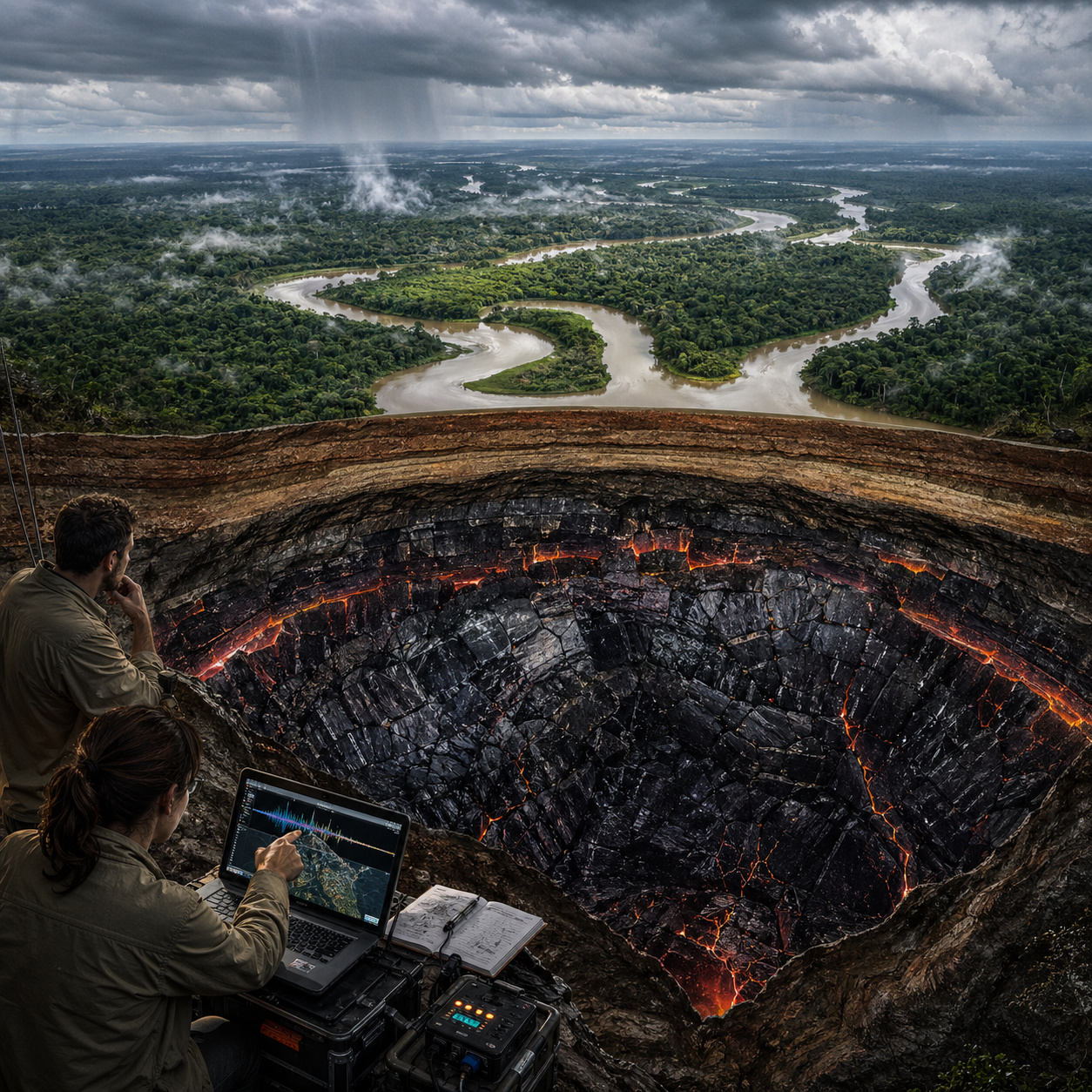

2025 study shows that the Amazonian Craton may detach in the subsurface, challenging theories about Earth’s crustal stability.
According to the National Science Review, a study published in March 2025 reviewed the latest evidence on the stability of cratons, the oldest rocky cores of continents, and reached a conclusion that contradicts decades of geological theory: the bases of these cores, which should be the most stable and immutable structures of the Earth’s crust, are periodically unstable. They detach, sink into the Earth’s interior, and, in some cases, return to the base of the craton after being heated by the mantle.
The study, led by Lijun Liu and collaborators, revealed that craton roots are notably denser than the surrounding mantle and that the force keeping them afloat is only one-fifth of the gravitational force pulling these roots downwards. The balance is much more precarious than previously imagined. Seismic evidence of anisotropy in South America, including beneath the Amazonian Craton, points to recent detachment and regrowth of the lithospheric base, indicating that the process is not merely theoretical but is ongoing.
Amazonian Craton is the largest ancient rock block in South America and preserves rocks over 3.5 billion years old
The Amazonian Craton is the largest block of ancient rock in South America and one of the largest in the world. It occupies the northeastern portion of the South American continent, covering most of the states of Amazonas, Pará, Amapá, Roraima, Rondônia, and Mato Grosso in Brazil, as well as areas of Guyana, Suriname, Venezuela, and Colombia.
-
Pennsylvania Mine Creates Ice in Summer Heat and Melts in Winter, Turning a Mountain Crevice into a Reverse Natural Refrigerator

-
China Accelerates Global Expansion of Robotics: From Smart Vacuums to Industrial and Humanoid Machines, Millions Exported to Over 150 Markets
-
Polar Air Mass to Hit Brazil: Temperatures to Plummet in Nine States, Near Freezing in the South with Frost Risk Until Monday
-
Chinese “dark factories” produce electric cars 24/7 with minimal human intervention, as Zeekr assembles 800 units daily, raising concerns in Brazil.







With over 4 million square kilometers, it is larger than countries like India. Its oldest rocks, located in the Central Amazonian Province, are over 3.5 billion years old, formed when Earth was less than half its current age, when there was no complex life and oxygen had not yet accumulated in the atmosphere.
These rocks have survived the formation and dissolution of supercontinents, the closing and reopening of oceans, mass extinctions, and the formation of mountain ranges that have since disappeared.
Deep craton structure includes continental crust, thick lithospheric root, and highly viscous asthenospheric mantle
To understand what is happening beneath the Amazonian Craton, it is useful to imagine a system of layers with distinct physical properties.
The upper layer is the continental crust, about 35 to 45 kilometers thick in the region. Below it is the lithospheric root, a colder, rigid, and denser layer, which extends for an additional 150 to 200 kilometers and functions as the supporting base of the craton.

This root acts as a “geological keel,” stabilizing the continental structure. Below this layer is the asthenospheric mantle, composed of rocks that, although solid, behave like an extremely viscous fluid over millions of years.
New evidence shows that craton roots are denser than the mantle and tend to sink, contradicting classical theory
Classical geological theory stated that the lithospheric root of cratons was less dense than the mantle, allowing it to float. The 2025 study showed the opposite: these roots are denser than the surrounding material.
This creates a gravitational force that tends to pull them downwards. The only thing preventing immediate sinking is the mechanical rigidity of the rock, which resists deformation.
Lithospheric delamination explains how parts of the craton base detach and sink as dense masses into the Earth’s interior
When this rigidity is weakened, the system can partially collapse. This process is called lithospheric delamination.
It occurs when the lower part of the root detaches from the upper part and sinks into the mantle, like a weight coming loose from the bottom of a floating structure.
This detachment can be caused by mantle heating, the presence of fluids, or the action of thermal plumes.
Seismic tomography reveals anisotropy indicating detachment and regrowth of the lithospheric base beneath South America
The main evidence for this process comes from the analysis of seismic waves. These waves propagate through the Earth’s interior and allow its structure to be reconstructed.
Studies show that, below the mid-lithospheric discontinuity, the structural orientation of the rocks is different from the upper part.
This indicates that these layers had distinct histories, suggesting that the lower part detached, was deformed in the mantle, and later reintegrated.
Deep seismic anomalies indicate root fragments that detached and sank up to 800 km into the mantle
Furthermore, high-velocity seismic anomalies were detected at depths between 600 and 800 kilometers.
These structures are interpreted as fragments of lithospheric roots that detached during ancient tectonic events and remained within the mantle.

Although the process is extremely slow, its consequences are significant. When the base of the craton detaches, the upper part can rise due to mass loss.
This movement can alter topography, reorganize rivers, and modify river basins over geological time. The Amazon Basin itself may have been influenced by these processes.
Amazonian Craton hosts large mineral reserves whose formation is linked to deep geological evolution
The region contains significant deposits of iron, gold, and copper. These resources are associated with geological events that occurred throughout the craton’s evolution.
Processes like delamination can influence fluid circulation and the formation of new mineral deposits. The North China Craton is the most studied example of this process.
Its root was reduced from about 200 kilometers to less than 80 kilometers. This process led to volcanism, tectonic reorganization, and structural changes over hundreds of millions of years.
Science still doesn’t know exactly what triggers the detachment of the craton base in specific regions
The mechanisms are not yet fully understood. Hypotheses include mantle plumes, the presence of fluids, and internal variations in rock composition. Evidence shows that even the planet’s oldest cores are subject to transformation.
In your view, does this change how we understand Earth’s stability or merely refine existing geological knowledge?