






 Portuguese
  Spanish
  4 min of reading
  0 comments


Understand Why Using “Neutral” in Cars with Fuel Injection Does Not Save Fuel, Increases the Risks of Accidents, and Is Also a Traffic Violation.
Coasting down a slope in neutral, the so-called “neutral,” is a common habit among many Brazilian drivers. The belief is that this practice helps save fuel. However, in modern cars with fuel injection, this idea is nothing more than a dangerous myth. The truth is that, besides not saving fuel, “neutral” increases consumption, overloads the brakes, and decreases the vehicle’s safety.
Why Did “Neutral” Work in Old Cars?
The idea that coasting saves fuel did not arise out of nowhere. It is a legacy of the days of cars with carburetors. In these older vehicles, the fuel system was purely mechanical. The amount of fuel consumed was directly linked to the engine’s RPM.
When coasting in neutral, the engine would drop to idle RPM, consuming the minimum amount of fuel just to stay running. If the car were in gear, the movement of the wheels would force the engine to spin faster, causing the carburetor to inject more fuel.
-
Survivor of 1966 SS Daniel J. Morrell Shipwreck in Lake Huron Recounts 38-Hour Ordeal in Extreme Cold

-
The Greatest Hoax in World Cup History? The Film That Denied Brazil’s 1958 Victory and Exposed How Fake Evidence Can Seem Convincing on TV
-
Fake South Korean Online Stores Offer Shopping Thrill Without Spending Money or Receiving Products
-
Brazilian Joins Homeownership Consortium, Faces Decade of Dual Payments Totaling $141,000, Surpassing Traditional Mortgage


Therefore, in the carburetor era, “neutral” was indeed a fuel-saving strategy. This reality changed with the advent of fuel injection in Brazil, which began with the Volkswagen Gol GTi in 1988 and became standard in all new cars starting in the 2000s.
The Technology That Guarantees Real Savings
In modern cars, a computer called the Electronic Control Unit (ECU) manages the engine. This “brain” analyzes data from various sensors to optimize performance and fuel efficiency. It has a system called “cut-off”, which is the real reason for debunking the “neutral” myth.
When the driver coasts down a slope with the car in gear and without pressing the accelerator, the ECU understands that there is no need to generate power. Under these conditions, the “cut-off” system completely stops the fuel supply to the engine. Fuel consumption becomes, literally, zero. The engine continues to spin, powered by the energy of the wheels, a phenomenon known as engine braking.
In contrast, when using neutral, the ECU needs to continuously inject fuel to keep the engine running at idle. The comparison is clear:
- Car In Gear: The “cut-off” system is activated and fuel consumption is null.
- Car in Neutral: The engine runs at idle and there is a constant fuel consumption.
More Than Waste, A Safety Risk
Besides not saving fuel and actually consuming more, “neutral” is extremely dangerous. The primary risk lies in the overload of the brake system. Without the assistance of engine braking, all responsibility for controlling the vehicle’s speed falls on the brake pads and discs.
On long descents, continuous use of the brakes generates excessive heat. This overheating can cause “brake fade”, a phenomenon where they lose braking capacity drastically. In the worst-case scenario, the brake fluid can boil, creating air bubbles in the system and causing a complete and catastrophic failure.
Additionally, in neutral, the car becomes “loose,” losing stability and control. If acceleration is needed to avoid an obstacle, the driver loses precious time shifting to the correct gear before being able to react.
How to Use Engine Braking for Safety and Economy
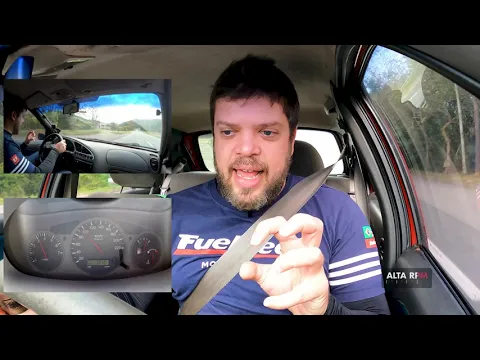

The correct technique to descend slopes combines safety and maximum fuel savings. The golden rule is: descend the hill or slope using the same gear you would use to climb it. This gear typically provides the ideal engine braking force to maintain speed control.
Use engine braking to maintain a constant and safe speed. Service brakes (the pedal) should be used gently and intermittently, only for fine adjustments of speed or stops. This synergy between the two systems ensures total control, prevents component wear, and avoids overheating. In automatic cars, use the “L” (Low), “2”, “3”, or manual mode to activate engine braking.
Is “Coasting” Illegal? What Does the Brazilian Traffic Code Say?
To reinforce the seriousness of the practice, Brazilian law prohibits it. Article 231, Item IX, of the Brazilian Traffic Code (CTB) classifies as an infraction “driving with the vehicle turned off or out of gear on a slope.”
Disobeying this incurs the following penalties:
Type of Infraction: Medium.
Points: 4 points on the driver’s license (CNH).
Fine: R$ 130.16.
Administrative Measure: Vehicle retention until regularization.
Therefore, “neutral” is a practice that harms your pocket, puts your life at risk, and can still result in a fine. Conscious driving, using engine braking, is the only path to true savings and, above all, to safety on the road.





-

1 person reacted to this.