






 Portuguese
  Spanish
  5 min of reading
  0 comments


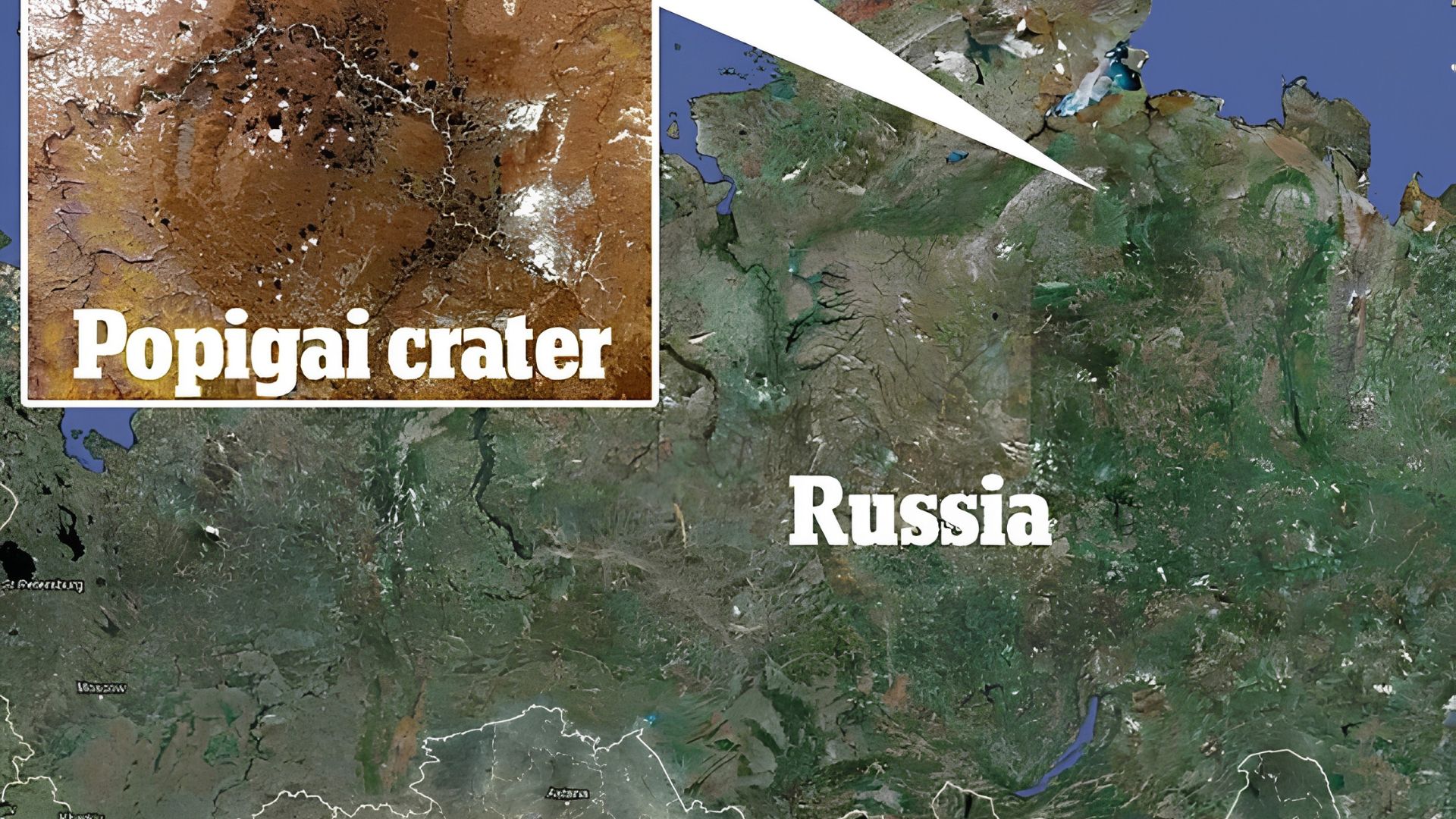
The Popigai crater in Siberia was formed after the impact of a giant asteroid and created diamond deposits linked to an extreme cosmic collision.
About 36 million years ago, one of the most violent impacts ever recorded in Earth’s geological history struck the north of present-day Siberia. A gigantic asteroid entered the Earth’s atmosphere at estimated speeds of tens of thousands of kilometers per hour and collided with the region now known as the Popigai crater, leaving a colossal scar nearly 100 kilometers in diameter in the far north of Russia.
The structure, located in the Eastern Siberia region, has once again drawn international attention after images released by the NASA Earth Observatory highlighted the impressive size of the crater amidst the frozen landscapes of the Russian Arctic. Seen from space, Popigai appears as a gigantic circular mark carved into the Earth’s surface by an event of practically unimaginable energy.
The most surprising thing is that the impact not only deformed rocks and altered the local geology. The collision also created enormous quantities of microscopic diamonds formed under extreme pressure, transforming the region into one of the most unusual deposits linked to cosmic impact ever found on the planet.
-
Accessible only by boat, an old house from 1862 is up for sale for R$ 19.4 million in the USA with a famous artist’s studio, pier, and over 10 preserved hectares.

-
Scientists create the world’s first nuclear clocks and open a new frontier in time measurement

-
Alcohol consumption will decrease in the next decade, says a study revealing a silent transformation in the habits of millions of people worldwide.

-
Family trades chayote for 100,000 chickens, abandons agricultural tradition after decades, and transforms property in the interior of SP into a reference for demanding exports like those to China and other global markets.



The Popigai crater was formed when a gigantic asteroid hit Siberia about 36 million years ago
According to the NASA Earth Observatory, the Popigai crater is approximately 100 kilometers in diameter and is among the largest confirmed impact structures on Earth. Researchers estimate that the object responsible for the collision was between 5 and 8 kilometers wide.
The impact occurred during the Eocene period, at a time when mammals were beginning to dominate terrestrial ecosystems after the extinction of the dinosaurs. The energy released by the collision was so extreme that it instantly vaporized rocks, launched material over great distances, and deeply deformed the Earth’s crust.


Geologists state that the asteroid hit the surface at speeds close to 20 kilometers per second. This means around 72 thousand kilometers per hour, a speed sufficient to generate gigantic pressures and extremely high temperatures at the moment of impact.
The event has been added to the list of the largest collisions ever identified in the recent geological history of the planet.
The force of the impact transformed underground graphite into microscopic diamonds
One of the most impressive aspects of the Popigai crater is the presence of diamonds formed directly by the cosmic collision.
According to Russian researchers and geological records associated with the structure, the impact hit graphite-rich rocks present in the Siberian region. The extreme pressure generated at the moment of collision transformed part of this carbon into microscopic impact diamonds.
These diamonds are different from traditional diamonds formed slowly in the depths of the Earth’s mantle over billions of years. In the case of Popigai, the process occurred almost instantly under extreme conditions created by the asteroid’s shock wave.
Geological studies indicate that the region may contain enormous quantities of these microscopic industrial diamonds mixed with the impacted rocks. The topic gained international attention because some researchers suggested that the deposits could be larger than known reserves elsewhere on the planet.
NASA highlighted Popigai as one of the largest visible impact scars on Earth
The images released by NASA Earth Observatory helped reveal the impressive scale of the structure when observed from space. In normal terrestrial regions, erosion, vegetation, and tectonic activity often erase ancient signs of cosmic impacts.

In Siberia, however, extreme isolation, severe climate, and low population density have helped preserve the crater for millions of years. The circular shape can still be clearly identified in modern orbital images.
NASA describes Popigai as one of the largest verified impact craters on the planet. The site is also part of the list of impact structures officially recognized by the international geological community.
The visual contrast between the gigantic ring of the crater and the frozen landscape of northern Russia has helped make Popigai one of the most impressive geological images associated with extraterrestrial collisions.
The impact occurred during a time marked by global climate changes on the planet
Researchers are also studying possible climatic effects linked to the Popigai impact. The collision occurred approximately at the same time as another major impact known as Chesapeake Bay, in the United States. Some scientists are investigating whether the two events may have contributed to environmental changes observed at the end of the Eocene.
Large impacts often launch enormous amounts of dust, vapor, and particles into the atmosphere. Depending on the scale, this can temporarily alter global temperature, solar brightness, and climate patterns.
In the case of Popigai, there are still debates about the real extent of these environmental effects. However, the size of the structure shows that the event was among the most violent in Earth’s recent geological period.
The study of these craters helps scientists better understand how extraterrestrial impacts can influence the planet’s climatic and biological evolution.
Scientists consider Popigai a natural laboratory for studying extreme cosmic collisions
Popigai has enormous scientific value because it allows for the analysis of the real effects of gigantic impacts on the Earth’s crust.
Researchers study deformed minerals, melted rocks, fracture patterns, and materials created under extreme pressure. This data helps geologists understand how cosmic collisions alter the planet on continental scales.

The structure also aids planetary scientists investigating craters on Mars, Mercury, and the Moon. Many processes observed in terrestrial impacts serve as references for interpreting landscapes of other celestial bodies.
Additionally, the presence of impact diamonds has turned Popigai into a rare geological case, where an extraterrestrial collision created materials of enormous mineralogical interest.
The combination of colossal impact, microscopic diamonds, and exceptional preservation makes the crater one of the most extraordinary structures ever identified on Earth.
The gigantic scar of Siberia shows that the planet still bears visible marks of ancient cosmic events
Most people view Earth as a relatively stable planet on a human scale. The Popigai crater reminds us that the planet has faced events capable of altering entire regions in seconds.
The impact that created the structure released energy far superior to that of modern nuclear weapons and excavated a crater almost the size of a large metropolis.
Today, millions of years later, the site remains preserved as a colossal geological scar hidden beneath the Siberian ice.
Seen from space, Popigai looks like a gigantic target etched into the Earth’s surface. And precisely because it so clearly shows the violence of an extraterrestrial impact, it remains one of the most impressive structures ever recorded by NASA on the planet.






Be the first to react!