





 Portuguese
  English
  Spanish
  5 min of reading
  0 comments


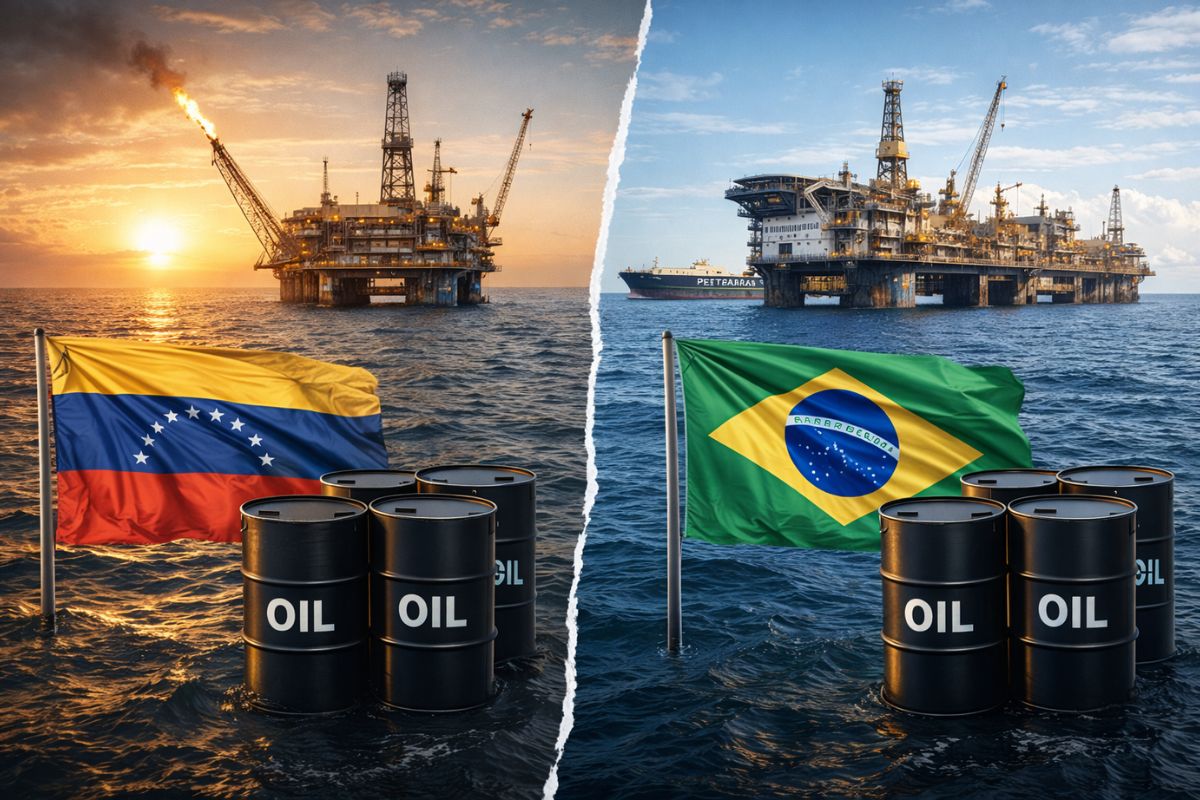
The Turning Point of South American Oil Gains Strength with Brazilian Production Projections Above 4.2 Million Barrels Per Day in 2026, Surpassing Venezuela, While Petrobras Accelerates Platforms in Búzios and Mero, Transforming Pre-Salt into the Axis of Regional Leadership in Latin America This Year
In the debate on South American oil, 2026 appears as a turning point for Brazil. The production projection above 4.2 million barrels per day places the country in a position of regional leadership, ahead of Venezuela, and reinforces Petrobras’s role in the expansion of pre-salt.
This movement is not presented as an isolated change, but rather as a result of investments in exploration, technology, and infrastructure, combined with international partnerships. What changes now is the scale of Brazilian production and the political weight that accompanies this advance, especially in a regional market still marked by operational asymmetries.
The interpretation of South American oil in 2026 involves an important distinction between projection and execution capacity. Brazil reaches this moment after achieving 3.770 million barrels per day in 2025 and projecting a higher level the following year, suggesting a continuity of pace rather than just a one-off leap.
-
IBS and CBS regulations change credit reimbursement and raise financial alert in the oil and gas industry

-
China puts into operation the largest shallow lithology offshore field in the country, with 79 wells, heavy oil, and a production of 20,000 barrels per day.

-
Petrobras announces an investment of R$ 2.8 billion in Amazonas to expand natural gas production in Urucu and modernize the river fleet, boosting energy, logistics, and the regional economy with new vessels adapted for operation in the Amazon.

-
Seismic surveys conducted by Russian ships in Antarctica have indicated estimates of up to 511 billion barrels of oil in the Weddell Sea, almost double the reserves of Saudi Arabia, in a scenario that raises alarms in the United Kingdom about the risk to the treaty that has prohibited mining on the continent since 1959.




This advance gains relevance because it occurs in a region where leadership has always been treated as a geopolitical subject, not just productive. When a country reaches the top in South American oil, it amplifies its influence in energy negotiations, investment, and regional integration.
Pre-Salt and Petrobras at the Center of the Brazilian Turn
The technical basis for this change lies in the pre-salt, described as an area of great energy potential on the ocean floor.
Brazilian growth in South American oil has been driven by significant investments in oil exploration in this range, which helps explain why production increased even in a challenging global scenario.
Petrobras emerges as a central agent in this process, focusing on technology and infrastructure to sustain extraction at scale.
The state-owned company has launched platforms in the fields of Búzios and Mero, two strategic points for pre-salt production.
Without this combination of operational capacity and long-term investment, the 2026 projection would lose consistency.
In addition to the platforms, the importance of international partnerships to expand extraction capacity is crucial.
This factor helps to understand how Brazil has been able to explore resources more efficiently and competitively, transforming geological potential into effective production within the South American oil map.
In practical terms, this means more volume available for export and greater predictability for the sector.
It also means a Petrobras more exposed to performance scrutiny, as regional leadership depends on maintaining production, costs, and operational reliability at a high level.
Why Venezuela Loses Ground Even with Giant Reserves
The change in South American oil is noteworthy because Venezuela continues to hold the largest oil reserves in the world, cited at 303 billion barrels.
In theory, this volume would place the country in a dominant position for many years, but reserves and production are not the same thing.
The central point is the ability to transform reserves into daily barrels regularly.
The foundational material highlights financial and operational difficulties that restrict Venezuela’s production capacity. This opens space for a regional inversion where those with better execution surpass those with greater resource stock.
This difference between potential and operation is decisive for understanding the turnaround of 2026.
While Brazil expands infrastructure and reinforces production in pre-salt, Venezuela faces limits that reduce its response in the short term.
On the South American oil map, leadership ends up being defined by who delivers volume now.
This situation also shifts the regional narrative. Instead of a debate focused only on reserves, the emphasis shifts to productivity, technology, and operational stability.
It’s a criterion shift that currently favors Brazil and strengthens the view that regional leadership is built on continuous performance.
The Economic Impact for Brazil and the Geopolitical Weight of the New Position
Brazil’s advance in South American oil has a direct effect on the economy.
The increase in oil exports strengthens the trade balance and expands the country’s margin of influence in energy discussions, both in Latin America and in broader forums.
As production grows and the regional position solidifies, the sector gains importance in the national economic strategy.
It is not just about producing more barrels, but about using this scale gain to sustain external revenue, investment, and diplomatic presence in energy matters.
Petrobras returns as a central piece in this scenario because its operation connects production, technology, and project execution.
At the same time, this leadership brings responsibility. The country becomes more closely monitored by investors, partners, and regional competitors.
In the context of South American oil, this means that operational failures, delays, or investment decisions have a broader impact than they did when the race for leadership was more distant.
Regional Cooperation and the New Energy Design in South America
The material also points to cooperation with Argentina and Guyana as part of the regional energy development environment.
These nations share infrastructure modernization challenges but appear in a context where Brazil leads with solid investments and technological innovation.
This fact is relevant because it shows that the turnaround in South American oil need not be seen only as direct competition.
There is room for technical cooperation, experience exchange, and integration into service and infrastructure chains, especially when several countries seek to expand production capacity simultaneously.
Still, the asymmetry remains. Brazil reaches 2026 with a projection of over 4.2 million barrels per day and a Petrobras with a decisive presence in pre-salt, while other countries face different rhythms and obstacles.
Regional leadership, therefore, arises from a combination of scale, investment, and timing, factors that rarely align by chance.
This combination helps explain why the term South American oil has gained new weight in this cycle.
It is not just a race for regional ranking, but a repositioning of Brazil in a sector that affects foreign trade, political influence, and long-term planning.
The turnaround in South American oil in 2026 is sustained by production numbers, infrastructure, and execution.
With projections exceeding 4.2 million barrels per day, Brazil advances toward regional leadership, surpasses Venezuela in produced volume, and reinforces Petrobras’s role in pre-salt with platforms in strategic fields like Búzios and Mero.
At the same time, the comparison with Venezuela shows that reserves without operational capacity do not guarantee leadership. For those watching energy and the economy, the question is now more concrete: Will Brazil turn this leadership into a lasting regional influence strategy, or is there a risk of treating the top of South American oil merely as a result of a favorable cycle? And, in your view, which factor weighs more in this turnaround, Petrobras, pre-salt, or Venezuelan production difficulties?







Be the first to react!